Feeling nervous is something everyone experiences. Whether it’s waiting for a job interview, a first date, or an important presentation, that flutter in your stomach can be hard to describe.
That’s where similes come in. Similes help writers capture emotions in vivid, relatable ways. By comparing nervousness to familiar sensations or objects, your writing instantly becomes more engaging and relatable.
This guide is designed for anyone who wants to express nervousness with precision and creativity. You’ll discover over 37 similes, including fresh and uncommon ones that will make your writing stand out.
By the end, you’ll have a rich arsenal of comparisons to convey nervous tension, anxiety, or jitters in essays, stories, or even poetry. Writing about nerves has never been this fun—or this clear.
What Is a Simile? (Quick Clear Definition)
A simile is a figure of speech that compares two things using words like “like” or “as”. It helps readers understand emotions or objects by relating them to something familiar.
Example: She was as nervous as a cat in a room full of rocking chairs.
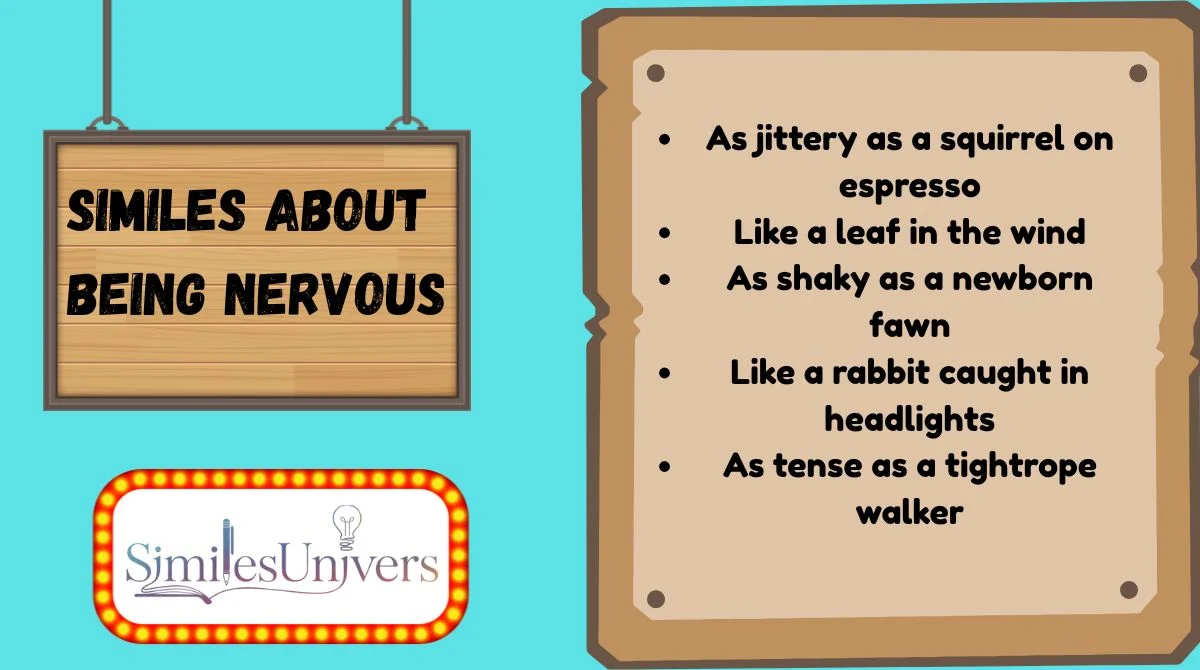
Quick List – Most Popular Similes for Being Nervous
- As jittery as a squirrel on espresso
- Like a leaf in the wind
- As shaky as a newborn fawn
- Like a rabbit caught in headlights
- As tense as a tightrope walker
- Like a dog hearing thunder
- As anxious as waiting for exam results
- Like a volcano about to erupt
- As restless as a hummingbird
- Like a kite in a storm
Complete List of Similes for Being Nervous (Grouped by Meaning)
Funny & Lighthearted
As jittery as a caffeinated chipmunk
- Meaning: Extremely restless and jumpy
- Explanation: This simile creates a humorous image of small, energetic, twitchy movements.
- Examples:
- He was as jittery as a caffeinated chipmunk before his stand-up routine.
- She felt as jittery as a caffeinated chipmunk while waiting for the roller coaster.
- Tone: Funny
Like a cat watching a cucumber
- Meaning: On edge and startled easily
- Explanation: Cats often react dramatically to harmless objects, perfectly illustrating sudden nervousness.
- Examples:
- He jumped like a cat watching a cucumber when the phone rang.
- She sat like a cat watching a cucumber during the surprise announcement.
- Tone: Funny
As twitchy as a frog on hot coals
- Meaning: Fidgety and uncomfortable
- Explanation: Imagery of a frog jumping constantly mirrors nervous, restless energy.
- Examples:
- He was as twitchy as a frog on hot coals during the math test.
- She fidgeted like a frog on hot coals before her speech.
- Tone: Funny
Emotional & Deep
Like a storm trapped in a teacup
- Meaning: Intense anxiety contained in a small body
- Explanation: Evokes the tension of feeling powerful emotions in a confined space.
- Examples:
- She felt like a storm trapped in a teacup before the confrontation.
- His heart was like a storm trapped in a teacup as he approached the podium.
- Tone: Serious
As nervous as a candle in the wind
- Meaning: Vulnerable and unstable
- Explanation: Suggests fragility and fear of being blown off balance.
- Examples:
- He was as nervous as a candle in the wind before the exam.
- She walked in as nervous as a candle in the wind on her first day.
- Tone: Poetic
Like ice cracking underfoot
- Meaning: Fear of breaking or failing
- Explanation: Creates tension by comparing nervousness to the fragility of ice.
- Examples:
- His voice wavered like ice cracking underfoot.
- She felt like ice cracking underfoot before confessing her feelings.
- Tone: Serious
Dramatic & Intense
As tense as a bowstring about to snap
- Meaning: Ready to burst with nervous energy
- Explanation: Evokes extreme anticipation and pressure.
- Examples:
- He was as tense as a bowstring about to snap waiting for the results.
- She stood as tense as a bowstring about to snap in the audition hall.
- Tone: Serious
Like a volcano minutes from eruption
- Meaning: Anxiety ready to explode
- Explanation: Illustrates nervous energy building up to a climax.
- Examples:
- He was like a volcano minutes from eruption before the debate.
- Her hands shook like a volcano minutes from eruption as she took the stage.
- Tone: Dramatic
As fidgety as a caged tiger
- Meaning: Restless and eager to escape
- Explanation: Captures extreme impatience and tension in a vivid image.
- Examples:
- He paced as fidgety as a caged tiger waiting for the news.
- She tapped her foot as fidgety as a caged tiger before the interview.
- Tone: Dramatic
Slow & Monotonous (Subtle Nervousness)
Like a clock ticking in an empty room
- Meaning: Quiet, steady anxiety
- Explanation: Slow, persistent tension that’s noticeable even in silence.
- Examples:
- His mind ticked like a clock in an empty room during the long meeting.
- She waited like a clock ticking in an empty room before the results.
- Tone: Serious
As hesitant as a snail crossing a road
- Meaning: Nervous, cautious
- Explanation: Suggests careful, tentative movements due to anxiety.
- Examples:
- He approached the microphone as hesitant as a snail crossing a road.
- She stepped into the room as hesitant as a snail crossing a road.
- Tone: Casual
Like shadows stretching at dusk
- Meaning: Subtle tension growing over time
- Explanation: Captures the slow buildup of unease.
- Examples:
- His thoughts stretched like shadows at dusk, filled with worry.
- The waiting felt like shadows stretching at dusk before the news arrived.
- Tone: Poetic
Creative & Unique
As restless as a thought chasing itself
- Meaning: Endless nervous energy
- Explanation: Imagery of circular mental agitation.
- Examples:
- He was as restless as a thought chasing itself before the speech.
- Her hands shook as restless as a thought chasing itself.
- Tone: Creative
Like a wind-up toy with broken gears
- Meaning: Out-of-control jitters
- Explanation: Suggests mechanical, uncontrollable energy.
- Examples:
- He paced like a wind-up toy with broken gears.
- She fidgeted like a wind-up toy with broken gears in the waiting room.
- Tone: Creative
As edgy as a pencil ready to snap
- Meaning: Nervous tension reaching a breaking point
- Explanation: Combines fragility with pressure in a relatable object.
- Examples:
- He felt as edgy as a pencil ready to snap under stress.
- She was as edgy as a pencil ready to snap during the interview.
- Tone: Creative
Poetic & Literary
Like morning mist over a restless lake
- Meaning: Gentle, mysterious anxiety
- Explanation: Evokes soft tension and unease in a lyrical way.
- Examples:
- He drifted like morning mist over a restless lake.
- Her thoughts moved like morning mist over a restless lake.
- Tone: Poetic
As fluttery as a butterfly in a storm
- Meaning: Fragile and anxious
- Explanation: Imagery of delicate nervous energy in chaos.
- Examples:
- Her stomach felt as fluttery as a butterfly in a storm.
- He entered the room as fluttery as a butterfly in a storm.
- Tone: Poetic
Like petals trembling in the rain
- Meaning: Fragile and exposed nervousness
- Explanation: Combines beauty with vulnerability.
- Examples:
- Her hands shook like petals trembling in the rain.
- He spoke like petals trembling in the rain.
- Tone: Poetic
Fresh and Unique Similes You Won’t Hear Every Day
- Like a compass lost in a metal storm – Feeling disoriented and anxious.
- As nervous as a chess piece on the edge of the board – Anticipating a decisive moment.
- Like popcorn in the microwave before it pops – Energy building toward an inevitable release.
- As jumpy as ink on a blank page – Writer’s anxiety or creative tension.
- Like a candle flame in a hurricane – Extremely fragile nervousness.
Each simile creates a strong visual, helping readers feel nervousness rather than just read about it.
How to Use These Similes in Writing
- Essays: Use similes to illustrate feelings vividly, making academic or reflective writing more relatable.
- Stories: Add tension, humor, or emotion to characters by describing their nerves through comparison.
How to Create Your Own Similes (Mini Writing Guide)
- Identify the emotion or sensation.
- Think of familiar objects, animals, or experiences.
- Compare them using like or as.
- Experiment with exaggeration for effect.
- Edit for clarity and tone.
Practical Tips:
- Use sensory details
- Avoid clichés
- Match tone to context
- Keep comparisons short
- Test in sentences
Transformation Examples:
- Nervous → like a sparrow in a windstorm
- Anxious → as tight as a drum ready to snap
- Fidgety → like marbles rolling in a box
Common Mistakes When Using Similes
- Overuse: Too many comparisons dilute their impact.
- Clichés: Avoid overused phrases like “butterflies in the stomach.”
- Tone mismatch: Ensure the simile matches the context—don’t use funny ones in tragic scenes.
Practice Exercise
Fill in the blanks with appropriate similes for being nervous:
- She paced __________ before her performance.
- His hands were shaking __________.
- The students waited __________ for the results.
- He fidgeted __________ as the elevator doors opened.
- Her thoughts spun __________ before the meeting.
- He stood __________ as the crowd stared.
- The cat watched the balloon __________.
- She felt __________ on the exam day.
- His heartbeat was __________ during the confession.
- The actor waited __________ behind the curtain.
- She approached the podium __________.
- He tapped his foot __________ while waiting for news.
Answers:
- like a caffeinated chipmunk
- as edgy as a pencil ready to snap
- like a leaf in the wind
- like a wind-up toy with broken gears
- as restless as a thought chasing itself
- as tense as a bowstring about to snap
- like a cat watching a cucumber
- like a snail crossing a road
- like ice cracking underfoot
- like a volcano minutes from eruption
- like a butterfly in a storm
- as jittery as a squirrel on espresso
FAQs
What is a good simile for being nervous?
Use comparisons like “as jittery as a squirrel on espresso” or “like a rabbit caught in headlights.”
Can similes make writing more vivid?
Yes, they help readers visualize feelings and experiences in relatable ways.
How many similes should I use in one paragraph?
One or two strong similes per paragraph usually works best to avoid clutter.
Are similes different from metaphors?
Yes. Similes use like or as; metaphors directly state the comparison.
Can similes be humorous?
Absolutely. Funny similes lighten the mood and create memorable imagery.
How can I write my own similes?
Identify the feeling, think of relatable objects or experiences, compare using like or as, and keep it concise.
Final Thoughts
Similes are powerful tools for expressing nervousness, helping readers feel the tension, anxiety, or excitement you describe. By using both classic and fresh comparisons, your writing can be vivid, relatable, and unforgettable. Practice, experiment, and soon you’ll have your own arsenal of similes ready for any story, essay, or creative project.

Daniel Harper
I am simplifies complex literary concepts into clear, practical lessons for students and learners worldwide.
Through SimilesUnivers, he aims to make mastering similes engaging, structured, and academically enriching.