The moon has captivated humans for millennia — a silent guardian in the night sky, a source of inspiration for poets, dreamers, and stargazers alike. But how do you describe its glow, its mystery, or its pull in a way that sparks imagination?
That’s where similes come in. Similes bring abstract ideas to life by comparing one thing to another, helping your readers “see” and “feel” your words.
Whether you’re writing a story, a poem, or even a social media caption, the right simile can transform ordinary sentences into vivid imagery.
This guide gives you over 37 fresh, creative similes about the moon, organized by tone and style, so you can pick the perfect one for your writing. By the end, you’ll not only have an arsenal of moon similes but also know how to craft your own, making your work shine as bright as a full moon on a clear night.
What Is a Simile? (Quick Clear Definition)
A simile is a figure of speech that compares two different things using words like “like” or “as”. It’s a simple yet powerful way to create vivid imagery.
Example:
“The moon hung in the sky like a silver lantern.”
Quick List – Most Popular Similes for the Moon
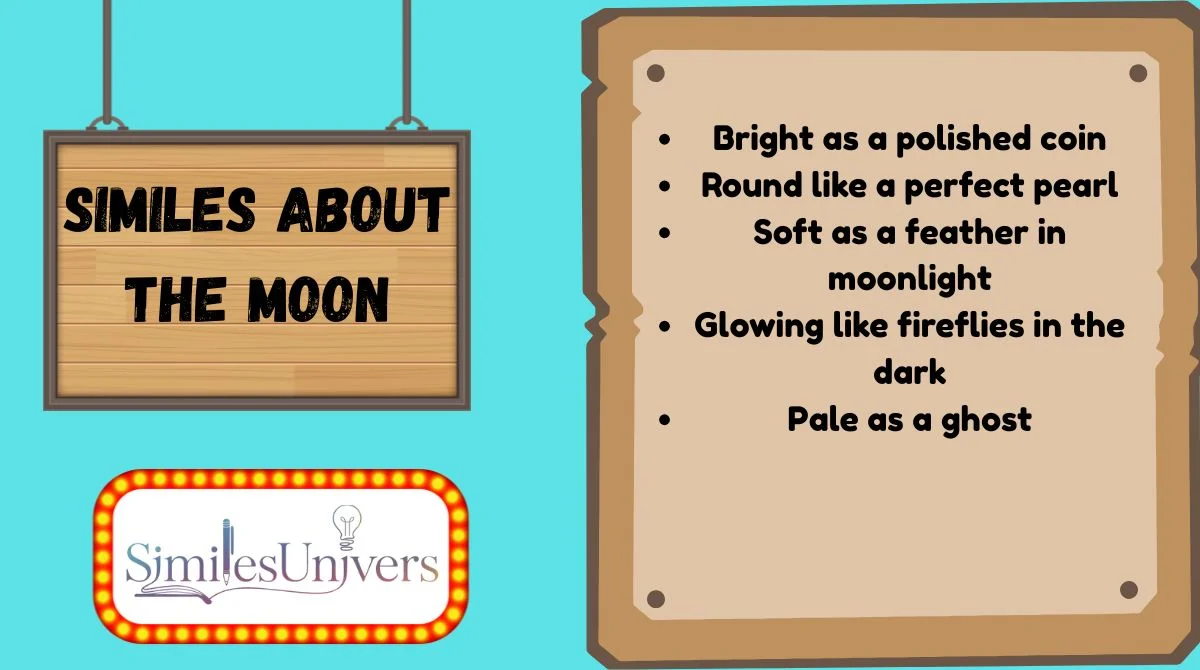
- Bright as a polished coin
- Round like a perfect pearl
- Soft as a feather in moonlight
- Glowing like fireflies in the dark
- Pale as a ghost
- Hanging like a lantern in the sky
- Shimmering like frost on glass
- Silent as a sleeping cat
- Floating like a balloon
- Watching like a silent guardian
Complete List of Similes for the Moon (Grouped by Meaning)
Funny & Lighthearted
Glowing like a nightlight left on
Meaning: Gentle, comforting brightness
Explanation: Compares the moon’s soft glow to a familiar, cozy source of light
Examples:
- The moon glowed like a nightlight left on, keeping the campers calm.
- Children giggled as the moon shone like a nightlight through their bedroom window.
Tone: Funny
Round like a cheese wheel
Meaning: Playful comparison to food
Explanation: A lighthearted visual that makes the moon feel approachable
Examples:
- Farmers joked that the moon looked round like a cheese wheel above the barns.
- The cat stared at the sky, mesmerized by the moon, round like a cheese wheel.
Tone: Funny
Floating like a bubble
Meaning: Delicate and whimsical
Explanation: Captures the moon’s seemingly effortless presence in the sky
Examples:
- The moon floated like a bubble over the city skyline.
- The sky was serene, with the moon floating like a bubble above the hills.
Tone: Casual
Emotional & Deep
Pale as a memory
Meaning: Reflects a gentle, nostalgic feeling
Explanation: Links the moon’s soft glow to the wistfulness of memory
Examples:
- She gazed at the pale moon, as pale as a memory of childhood summers.
- The moon, pale as a memory, reminded him of lost dreams.
Tone: Serious
Silent as a heartbeat in the night
Meaning: Evokes introspection and calm
Explanation: The moon’s presence mirrors the quiet, subtle rhythms of life
Examples:
- The moon hung silent as a heartbeat in the night.
- Wandering alone, he felt the moon, silent as a heartbeat, guiding him.
Tone: Poetic
Hanging like a forgotten promise
Meaning: Creates a bittersweet mood
Explanation: The moon’s lingering presence mirrors something left unresolved
Examples:
- The old poet watched the moon, hanging like a forgotten promise.
- Memories floated back under the moon, hanging like a forgotten promise.
Tone: Serious
Dramatic & Intense
Shining like molten silver
Meaning: Intense brightness and radiance
Explanation: Makes the moon’s light feel almost tangible and metallic
Examples:
- The moon shone like molten silver over the battlefield.
- Wolves howled beneath the moon, shining like molten silver.
Tone: Poetic
Watching like an ancient eye
Meaning: Gives the moon an ominous presence
Explanation: Suggests the moon observes all, creating suspense
Examples:
- The forest trembled under the moon, watching like an ancient eye.
- He felt judged as the moon watched like an ancient eye from above.
Tone: Dramatic
Cold as winter steel
Meaning: Sharp, chilling atmosphere
Explanation: Conveys a sense of distance or severity
Examples:
- The moonlight was cold as winter steel on the frozen lake.
- Her fears felt magnified under the moon, cold as winter steel.
Tone: Serious
Slow & Monotonous
Drifting like smoke
Meaning: Calm and languid movement
Explanation: Compares the slow movement of the moon to drifting smoke
Examples:
- The moon drifted like smoke above the quiet village.
- Night stretched endlessly, the moon drifting like smoke.
Tone: Casual
Hanging like a lazy thought
Meaning: Lazy, unhurried presence
Explanation: Mirrors the slow passage of time
Examples:
- The moon hung like a lazy thought above the pond.
- Students watched the moon, hanging like a lazy thought in the sky.
Tone: Casual
Glimmering like a fading candle
Meaning: Gentle, fading illumination
Explanation: Shows a soft, slow, almost melancholic effect
Examples:
- The moon glimmered like a fading candle over the meadow.
- Her eyes reflected the moon, glimmering like a fading candle.
Tone: Poetic
Creative & Unique
As enigmatic as a locked diary
Meaning: Mystery and intrigue
Explanation: Suggests the moon holds secrets unknown to humans
Examples:
- The moon hung as enigmatic as a locked diary.
- Secrets seemed to whisper under the moon, as enigmatic as a locked diary.
Tone: Poetic
Like a pearl in a velvet pouch
Meaning: Rare, precious beauty
Explanation: Highlights the moon’s soft yet luxurious glow
Examples:
- The sky cradled the moon like a pearl in a velvet pouch.
- Lovers admired the night sky, where the moon shone like a pearl in a velvet pouch.
Tone: Poetic
Hovering like a thought you can’t catch
Meaning: Fleeting, almost untouchable
Explanation: Captures the ephemeral and elusive quality of the moon
Examples:
- The moon hovered like a thought you can’t catch.
- The quiet night left the moon hovering like a thought you can’t catch.
Tone: Poetic
Poetic & Literary
Soft as winter silk
Meaning: Elegant, smooth illumination
Explanation: Conveys a refined, delicate image
Examples:
- The moonlight fell soft as winter silk over the garden.
- Her dress reflected the moon, soft as winter silk.
Tone: Poetic
Like a silver whisper
Meaning: Gentle, subtle influence
Explanation: The moonlight is barely noticeable yet pervasive
Examples:
- The night breathed like a silver whisper of moonlight.
- Moonlight trickled through the trees, like a silver whisper.
Tone: Poetic
Floating like a quiet dream
Meaning: Dreamlike, serene
Explanation: The moon evokes peaceful, imaginative feelings
Examples:
- The moon floated like a quiet dream across the midnight sky.
- She drifted to sleep, with the moon floating like a quiet dream.
Tone: Poetic
Fresh and Unique Similes You Won’t Hear Every Day
- As watchful as a librarian’s gaze – Moonlight observing the world silently.
- Like sugar melting in tea – Gentle and natural blending of light into the night.
- As fleeting as a cat’s shadow – Quick, elusive, barely graspable.
- Like a silver coin tossed into eternity – Precious and suspended in time.
- As comforting as an old quilt on a cold night – Warm, reassuring presence.
These similes rely on unexpected imagery, making readers pause and visualize in new ways.
How to Use These Similes in Writing
- Essays: Add similes to descriptive paragraphs to make abstract concepts tangible.
- Stories: Use similes to deepen mood, evoke emotion, or define character perspective.
Example: “The moon, pale as a memory, watched over the village, stirring nostalgia in every heart.”
How to Create Your Own Similes (Mini Writing Guide)
- Identify the mood or quality you want to describe.
- Find a familiar object, action, or emotion to compare it with.
- Connect them using “like” or “as”.
- Test the simile for clarity and imagery.
- Revise to make it fresh and avoid clichés.
Tips:
- Use sensory details
- Avoid overused comparisons
- Mix humor with seriousness
- Draw from nature
- Keep it concise
Transformation Examples:
- The moon is bright → The moon glows like molten silver.
- The moon is pale → The moon is pale as a forgotten note.
- The moon is quiet → The moon drifts like a silent thought across the sky.
Common Mistakes When Using Similes
- Overuse: Too many similes can overwhelm readers.
- Clichés: Avoid tired comparisons like “bright as the sun” repeatedly.
- Tone mismatch: Ensure the simile fits the mood of your writing.
Practice Exercise
Fill in the blanks with suitable moon similes:
- The moon hung ________ above the forest.
- Her eyes reflected the moon, ________.
- The night was calm, with the moon ________ over the village.
- He felt lonely under the moon, ________.
- The moonlight spilled ________ across the river.
- The sky glimmered, the moon ________.
- Children played as the moon ________ above them.
- The old lighthouse shone, the moon ________ nearby.
- Shadows danced while the moon ________.
- The night smelled of rain, the moon ________.
- Lovers whispered beneath the moon, ________.
- The mountains were silent, the moon ________.
Answers:
- like a silver lantern
- soft as a feather in moonlight
- floating like a bubble
- pale as a memory
- like a silver whisper
- shimmering like frost on glass
- round like a cheese wheel
- bright as a polished coin
- drifting like smoke
- cold as winter steel
- like a pearl in a velvet pouch
- hanging like a forgotten promise
FAQs
What is the best simile to describe the moon?
It depends on the mood. For peaceful nights, “soft as winter silk” works well.
How do similes make writing better?
Similes create vivid mental images, making abstract concepts easier to understand.
Can I use funny similes in poetry?
Yes! Humor adds charm and can make your work memorable.
How many similes are too many in writing?
Use 2–3 per paragraph; too many can feel forced.
Are similes different from metaphors?
Yes. Similes use “like” or “as”; metaphors do not.
Can similes be unique and original?
Absolutely. Drawing from personal experience or unexpected comparisons keeps them fresh.
Final Thoughts
The moon offers endless inspiration, and the right simile can capture its magic in words. From playful and lighthearted to deep and poetic, these 37+ similes give you the tools to make your writing shine. Use them to enrich your essays, stories, or poems, and let your words reflect the quiet brilliance of the night sky.

Daniel Harper
I am simplifies complex literary concepts into clear, practical lessons for students and learners worldwide.
Through SimilesUnivers, he aims to make mastering similes engaging, structured, and academically enriching.