Anger is a powerful emotion, and expressing it vividly in writing can make your stories, essays, or dialogue more engaging.
One of the best tools to capture anger is the simile—a comparison that paints a picture in your reader’s mind. Using similes not only adds color to your writing but also makes abstract feelings like anger tangible and relatable.
In this guide, you’ll discover over 37 similes for anger, from familiar favorites to fresh, unique expressions you won’t find elsewhere. By the end, you’ll have a versatile arsenal of similes to make your writing pop and emotionally resonate with your audience.
What Is a Simile? (Quick Clear Definition)
A simile is a figure of speech that compares two different things using “like” or “as.” It helps readers visualize emotions or actions.
Example: She was as furious as a storm at sea.
Quick List – Most Popular Similes for Angry
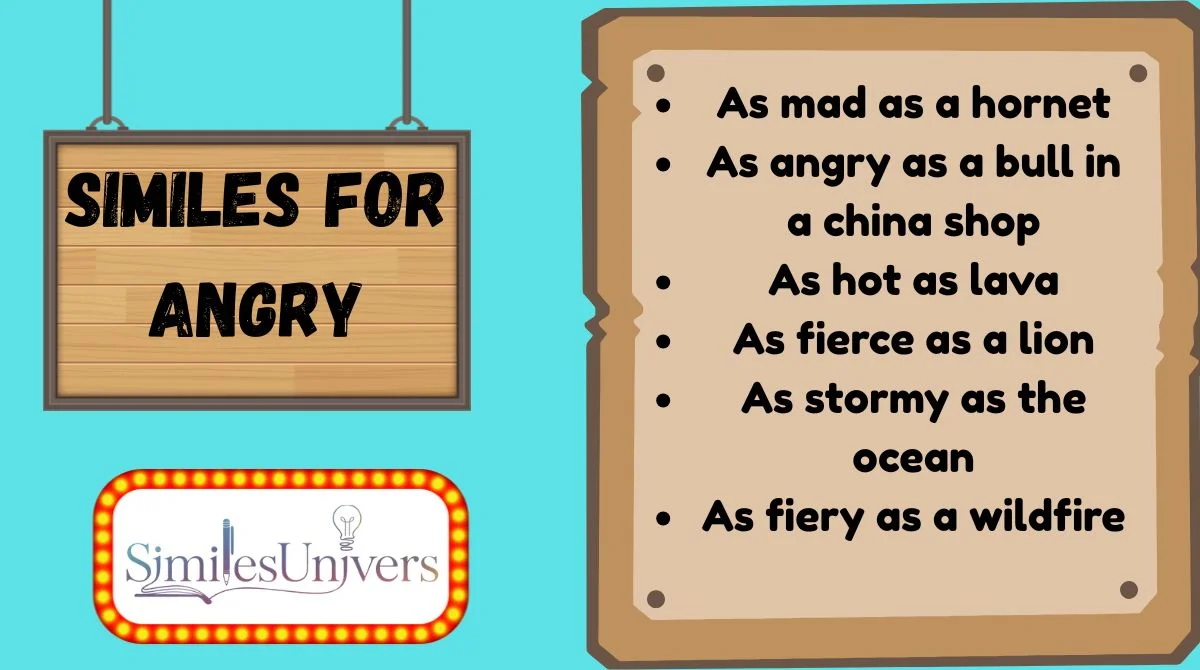
- As mad as a hornet
- As angry as a bull in a china shop
- As hot as lava
- As fierce as a lion
- As stormy as the ocean
- As fiery as a wildfire
- As bitter as gall
- As sharp as a knife
- As raging as a thunderstorm
- As tense as a drawn bow
Complete List of Similes for Angry (Grouped by Meaning)
Funny & Lighthearted
As mad as a hatter
- Meaning: Completely crazy or irritable
- Explanation: Suggests a quirky, exaggerated anger
- Examples:
- He was as mad as a hatter when he found out his sandwich was missing.
- The kids were as mad as a hatter over the canceled trip.
- Tone: Funny
Like a cat with a laser pointer
- Meaning: Easily irritated and twitchy
- Explanation: Evokes a playful, sudden anger
- Examples:
- She was like a cat with a laser pointer when her phone died.
- He dashed around like a cat with a laser pointer after hearing the news.
- Tone: Funny
As cranky as a toddler denied candy
- Meaning: Childishly angry
- Explanation: Highlights impatience and frustration
- Examples:
- The editor was as cranky as a toddler denied candy all morning.
- I felt as cranky as a toddler denied candy after the long commute.
- Tone: Funny
Emotional & Deep
As burning as molten iron
- Meaning: Deep, intense anger
- Explanation: Suggests a scorching, consuming emotion
- Examples:
- Her anger was as burning as molten iron when she read the betrayal.
- He spoke with words as burning as molten iron, cutting deep.
- Tone: Serious
Like a volcano ready to erupt
- Meaning: Suppressed rage about to explode
- Explanation: Compares anger to the natural, destructive force of a volcano
- Examples:
- He was like a volcano ready to erupt after hearing the insults.
- She sat quietly, but inside she was like a volcano ready to erupt.
- Tone: Serious
As stormy as the North Sea
- Meaning: Emotional turbulence and volatility
- Explanation: Suggests unpredictability and intensity
- Examples:
- His mood was as stormy as the North Sea, tossing everyone around.
- Her words were as stormy as the North Sea, full of fury and waves of pain.
- Tone: Serious
Dramatic & Intense
As fierce as a lion
- Meaning: Powerful, aggressive anger
- Explanation: Conveys strength and intimidation
- Examples:
- He defended his point as fierce as a lion protecting its cubs.
- She glared at the intruder as fierce as a lion ready to strike.
- Tone: Dramatic
Like a wildfire through dry grass
- Meaning: Rapid, uncontrollable anger
- Explanation: Evokes speed and destructiveness
- Examples:
- His temper spread like a wildfire through dry grass.
- Gossip fueled her rage like a wildfire through dry grass.
- Tone: Dramatic
As sharp as a dagger
- Meaning: Cutting, hurtful anger
- Explanation: Anger that can emotionally wound
- Examples:
- His criticism was as sharp as a dagger.
- She snapped back with words as sharp as a dagger.
- Tone: Dramatic
Slow & Monotonous
As simmering as a slow-cooked stew
- Meaning: Anger building gradually
- Explanation: Evokes patience turning into irritation
- Examples:
- His annoyance was as simmering as a slow-cooked stew.
- She held back, as simmering as a slow-cooked stew, until she spoke.
- Tone: Casual
Like water dripping on stone
- Meaning: Slow, persistent irritation
- Explanation: Shows long-term frustration
- Examples:
- His anger grew like water dripping on stone.
- The unfair rules grated on her like water dripping on stone.
- Tone: Serious
Creative & Unique
As prickly as a cactus in a desert
- Meaning: Defensive, easily irritated
- Explanation: Suggests someone protecting themselves with spikes of anger
- Examples:
- She was as prickly as a cactus in a desert when questioned.
- He responded as prickly as a cactus in a desert, avoiding small talk.
- Tone: Creative
Like thunder trapped in a jar
- Meaning: Anger contained but threatening to burst
- Explanation: Evokes tension and potential explosion
- Examples:
- He was like thunder trapped in a jar during the meeting.
- Her words echoed like thunder trapped in a jar, controlled but fierce.
- Tone: Poetic
As jagged as broken glass
- Meaning: Cutting and uncomfortable anger
- Explanation: Suggests pain inflicted on others
- Examples:
- His voice was as jagged as broken glass.
- She spoke in tones as jagged as broken glass.
- Tone: Creative
Poetic & Literary
As fierce as a tempest at sea
- Meaning: Dramatic, literary anger
- Explanation: Combines natural imagery with emotional intensity
- Examples:
- Her temper was as fierce as a tempest at sea.
- The argument raged as fierce as a tempest at sea.
- Tone: Poetic
Like embers glowing under ash
- Meaning: Hidden but smoldering anger
- Explanation: Suggests restrained rage waiting for ignition
- Examples:
- His resentment burned like embers glowing under ash.
- She waited silently, like embers glowing under ash, before responding.
- Tone: Poetic
As volcanic as Vesuvius
- Meaning: Explosive, destructive anger
- Explanation: Classical allusion to a famous eruption
- Examples:
- His fury was as volcanic as Vesuvius in full eruption.
- She faced betrayal with anger as volcanic as Vesuvius.
- Tone: Poetic
Fresh and Unique Similes You Won’t Hear Every Day
- As jittery as a swarm of angry fireflies – Suggests frantic, scattered rage.
- Like ink spilling on white silk – Anger that stains and spreads.
- As restless as wind in a canyon – Continuous, uncontainable frustration.
- Like a clock striking midnight in a haunted house – Creepy, tense anger building suspense.
- As bitter as unripe pomegranate seeds – Sharp, unexpected irritation with a twist of surprise.
How to Use These Similes in Writing
- Essays: Enhance descriptions in analytical or reflective essays.
- Stories: Bring characters’ emotions alive in dialogue or narrative.
- Use similes to replace generic adjectives like “angry” or “mad.”
How to Create Your Own Similes (Mini Writing Guide)
Step-by-step method:
- Identify the emotion clearly.
- List objects, actions, or animals that share similar traits.
- Use “like” or “as” to connect the two.
- Test the imagery for clarity and impact.
- Refine wording to suit tone.
Practical tips:
- Keep them concise
- Match tone with context
- Avoid clichés
- Make the imagery vivid
- Experiment with unexpected comparisons
Transformation examples:
- Angry → Like a shaken soda can
- Furious → As tense as a bowstring
- Irritated → As twitchy as a flickering candle
Common Mistakes When Using Similes
- Overuse: Too many similes can confuse or tire readers.
- Clichés: Avoid tired comparisons like “mad as a hornet” without adding a fresh twist.
- Tone mismatch: Ensure the simile fits the scene’s mood.
Practice Exercise
Fill in the blanks with suitable similes:
- He was __________ when his car broke down.
- Her temper rose __________ as the argument continued.
- The child screamed __________ when denied candy.
- His anger was __________ after the betrayal.
- She glared at him __________.
- The boss shouted __________ during the meeting.
- He paced __________ before the announcement.
- She snapped __________ after waiting for hours.
- His fury burned __________ in the quiet room.
- The debate left him __________.
- Her eyes flashed __________ when insulted.
- His annoyance was __________ as the clock ticked on.
Answers:
- like a volcano ready to erupt
- as stormy as the North Sea
- as cranky as a toddler denied candy
- as burning as molten iron
- as fierce as a lion
- like thunder trapped in a jar
- like wind in a canyon
- as jagged as broken glass
- like embers glowing under ash
- as tense as a drawn bow
- as sharp as a dagger
- like water dripping on stone
FAQs
What is the best simile for extreme anger?
“Like a volcano ready to erupt” vividly shows explosive, uncontrollable rage.
Can similes be funny and angry at the same time?
Yes, examples like “as cranky as a toddler denied candy” combine humor with irritation.
How many similes should I use in a story?
Use sparingly—1–2 per paragraph keeps the writing vivid without overwhelming readers.
Are unique similes better than popular ones?
Original similes stand out and create fresh imagery, but popular similes are easier for readers to understand.
Can I use similes in essays?
Absolutely. Similes make arguments and descriptions more relatable and engaging.
How do I avoid cliché similes?
Brainstorm fresh comparisons and mix unexpected elements, e.g., “like ink spilling on white silk.”
Final Thoughts
Mastering similes for anger transforms ordinary writing into expressive storytelling. From classic comparisons to fresh, creative imagery, these 37+ similes will help you convey fury, frustration, and irritation vividly. By practicing, experimenting, and tailoring similes to your tone, your writing will connect emotionally with readers and stand out in a crowded literary world.

Daniel Harper
I am simplifies complex literary concepts into clear, practical lessons for students and learners worldwide.
Through SimilesUnivers, he aims to make mastering similes engaging, structured, and academically enriching.