We’ve all felt it. That tiny irritation that grows bigger and bigger. The sound that won’t stop. The person who won’t quit. The habit that drives you crazy.
Sometimes, saying “That’s annoying” just isn’t enough.
This is where similes shine.
Similes paint a picture. They help readers feel the irritation instead of just hearing about it. A simple comparison can turn flat writing into something vivid, funny, dramatic, or even poetic.
In this guide, you’ll find 24+ powerful similes for annoying, grouped by tone and meaning.
You’ll also learn how to use them in essays, stories, and daily writing — and even how to create your own.
Let’s turn irritation into inspiration.
What Is a Simile? (Quick Clear Definition)
A simile is a comparison that uses “like” or “as.”
It shows how one thing is similar to another.
Example:
He was as busy as a bee.
Quick List – Most Popular Similes for “Annoying”
- As annoying as a mosquito buzzing in your ear
- Like nails on a chalkboard
- As irritating as an itch you can’t scratch
- Like a broken record
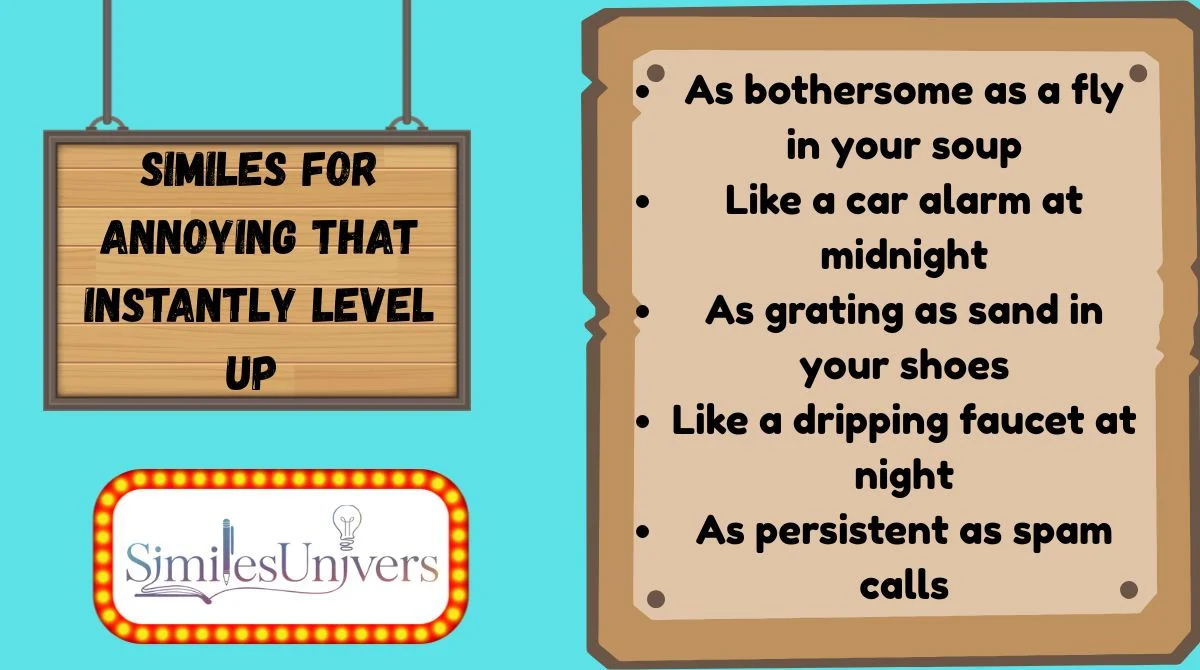
- As bothersome as a fly in your soup
- Like a car alarm at midnight
- As grating as sand in your shoes
- Like a dripping faucet at night
- As persistent as spam calls
- Like a pop-up ad you can’t close
Complete List of Similes for “Annoying” (Grouped by Meaning)
Funny & Lighthearted
As annoying as a mosquito buzzing in your ear
Meaning: Constant small irritation.
A tiny problem that feels huge because it won’t stop.
Example:
She kept tapping her pen, as annoying as a mosquito buzzing in my ear.
His humming was as annoying as a mosquito at bedtime.
Tone: Funny / Casual
Like a broken record
Meaning: Repeating the same thing again and again.
Used when someone won’t stop saying something.
Example:
He kept reminding us about homework like a broken record.
She sounded like a broken record talking about her diet.
Tone: Casual
As bothersome as a fly in your soup
Meaning: Ruins a good moment.
Something small that spoils everything.
Example:
His rude comment was as bothersome as a fly in my soup.
The loud noise was like a fly in their peaceful dinner.
Tone: Funny
Like a car alarm at midnight
Meaning: Loud and impossible to ignore.
Sudden irritation at the worst time.
Example:
Her scream was like a car alarm at midnight.
The dog’s barking felt like a car alarm in my head.
Tone: Dramatic / Funny
Emotional & Deep
As irritating as an itch you can’t scratch
Meaning: Ongoing frustration.
It keeps bothering you without relief.
Example:
The unfinished work felt like an itch I couldn’t scratch.
His lies were as irritating as an itch under a cast.
Tone: Serious
Like sand stuck in your shoes
Meaning: Small but constant discomfort.
Hard to ignore even if tiny.
Example:
Their gossip was like sand stuck in my shoes.
The awkward silence felt like sand rubbing against my thoughts.
Tone: Serious
As draining as a leaky battery
Meaning: Slowly exhausting.
Takes energy bit by bit.
Example:
His complaints were as draining as a leaky battery.
The argument felt like power slipping away.
Tone: Serious
Like smoke that won’t clear
Meaning: Lingering irritation.
Stays in your mind.
Example:
Her criticism hung like smoke that wouldn’t clear.
The memory stuck around like smoke in a closed room.
Tone: Poetic
Dramatic & Intense
Like nails on a chalkboard
Meaning: Sharp and unbearable irritation.
A classic comparison for extreme annoyance.
Example:
His laugh was like nails on a chalkboard.
The screeching brakes sounded like metal tearing through air.
Tone: Dramatic
As relentless as a pounding drum
Meaning: Constant and forceful.
Doesn’t stop.
Example:
The questions came as relentless as a pounding drum.
Her nagging felt like thunder inside my skull.
Tone: Intense
Like thunder trapped in a small room
Meaning: Overwhelming noise or presence.
Feels too big for the space.
Example:
His anger was like thunder trapped in a small room.
The baby’s cry felt like thunder in my ears.
Tone: Dramatic
As sharp as a paper cut
Meaning: Small but surprisingly painful.
Quick and irritating.
Example:
Her comment was as sharp as a paper cut.
The insult stung like a thin slice across skin.
Tone: Serious
Slow & Monotonous
Like a dripping faucet at night
Meaning: Slow but unbearable.
Each moment adds more irritation.
Example:
His tapping was like a dripping faucet at night.
The ticking clock felt endless and slow.
Tone: Casual
As slow as buffering internet
Meaning: Frustrating delay.
Modern and relatable.
Example:
The line moved as slow as buffering internet.
Waiting for the reply felt like a frozen screen.
Tone: Funny
Like a song stuck on repeat
Meaning: Repeating annoyance.
You hear it again and again.
Example:
Her excuse was like a song stuck on repeat.
The same complaint played in my head.
Tone: Casual
As dull as a grey Monday morning
Meaning: Emotionally draining and boring in an irritating way.
Example:
His speech was as dull as a grey Monday morning.
The meeting dragged like fog over the city.
Tone: Serious
Creative & Unique
Like glitter you can’t wash off
Meaning: Annoyance that lingers.
It sticks around no matter what.
Example:
The rumor spread like glitter you can’t wash off.
Her mistake clung to her reputation.
Tone: Creative
As clingy as static on fresh laundry
Meaning: Stubborn irritation.
Example:
His neediness was as clingy as static on fresh laundry.
The problem stuck like fabric to skin.
Tone: Funny
Like a notification that never stops buzzing
Meaning: Constant digital-age annoyance.
Example:
Her texts were like a notification that never stopped buzzing.
The alerts felt endless.
Tone: Casual
As stubborn as gum on your shoe
Meaning: Hard to remove irritation.
Example:
The stain was as stubborn as gum on my shoe.
His bad mood stuck around.
Tone: Casual
Poetic & Literary
Like a storm cloud that won’t pass
Meaning: Ongoing tension.
Example:
His anger hung like a storm cloud that wouldn’t pass.
The mood stayed dark all evening.
Tone: Poetic
As restless as wind in broken windows
Meaning: Uneasy irritation.
Example:
Her thoughts were as restless as wind in broken windows.
The room felt uneasy.
Tone: Poetic
Like a cracked bell that keeps ringing
Meaning: Harsh, repetitive sound.
Example:
His voice rang like a cracked bell.
The echo wouldn’t fade.
Tone: Literary
Fresh and Unique Similes You Won’t Hear Every Day
- As annoying as a password that’s almost right
– That tiny frustration when you’re close but not correct. - Like a chair with one short leg
– Constant imbalance and discomfort. - As irritating as wet socks in winter
– Cold, uncomfortable, impossible to ignore. - Like a puzzle piece that doesn’t fit
– Feels wrong and out of place. - As distracting as a blinking cursor in silence
– Small but mentally loud.
These comparisons feel modern and visual. They create fresh images readers remember.
How to Use These Similes in Writing
In Essays:
Use similes to describe feelings or situations clearly. Example:
The noise pollution was like a car alarm that never stopped.
In Stories:
Show emotion instead of telling it.
Instead of: “She was annoyed.”
Write: She sighed, her patience as thin as a paper cut.
How to Create Your Own Similes (Mini Writing Guide)
Step-by-Step Method
- Pick the feeling (annoyed, frustrated, irritated).
- Think of a physical experience that feels similar.
- Use “like” or “as.”
- Make it visual.
- Keep it simple.
5 Practical Tips
- Use everyday experiences.
- Avoid overused clichés.
- Match tone with context.
- Keep it short.
- Test it aloud.
Transformation Examples
Plain: He was annoying.
Better: He was as annoying as a buzzing fly.
Plain: The wait frustrated me.
Better: The wait felt like buffering internet.
Plain: Her voice irritated me.
Better: Her voice was like a cracked bell in a quiet room.
Common Mistakes When Using Similes
Overuse: Too many similes make writing messy.
Clichés: Some comparisons feel old. Try fresh ones.
Tone mismatch: Don’t use funny similes in serious scenes.
Practice Exercise
Fill in the blanks:
- His whisper was like ________.
- The delay felt as annoying as ________.
- Her complaint stuck like ________.
- The noise was like ________ at midnight.
- His joke was as irritating as ________.
- The argument lingered like ________.
- The tapping sounded like ________.
- Her attitude was as stubborn as ________.
- The rumor spread like ________.
- The wait was as slow as ________.
- His tone was as sharp as ________.
- The silence felt like ________.
Answers (Sample):
- a buzzing mosquito
- buffering internet
- gum on your shoe
- a car alarm
- an itch you can’t scratch
- smoke that won’t clear
- a dripping faucet
- static on laundry
- glitter you can’t wash off
- a frozen screen
- a paper cut
- a storm cloud
FAQs
What are good similes for annoying people?
Try: like a broken record, as clingy as static, or as stubborn as gum on your shoe.
What is the most common simile for annoying?
“Like nails on a chalkboard” is one of the most common.
Are similes good for essays?
Yes. They make ideas clearer and more engaging when used carefully.
Can similes be funny?
Absolutely. Funny similes make writing more relatable.
What is the difference between simile and metaphor?
A simile uses “like” or “as.”
A metaphor says something is something.
How many similes should I use in one paragraph?
Usually one is enough. Too many can feel crowded.
Final Thoughts
Annoyance is a small word for a big feeling.
With the right simile, you can turn everyday irritation into vivid writing. Whether you want something funny, dramatic, poetic, or modern, the right comparison makes your message stick.
Now it’s your turn.
Pick one. Try it. Or create your own.
Because great writing isn’t just clear — it’s memorable.

Daniel Harper
I am simplifies complex literary concepts into clear, practical lessons for students and learners worldwide.
Through SimilesUnivers, he aims to make mastering similes engaging, structured, and academically enriching.