Introduction
Happiness is a feeling that lifts us above the ordinary, making ordinary moments shine like sunlight on water. Yet, describing happiness can be tricky—plain words like “I’m happy” often fall flat.
This is where similes come in: they transform emotions into vivid imagery that readers can see, feel, and remember. A well-crafted simile can make your writing pop, convey joy instantly, and connect with readers on an emotional level.
Whether you’re writing stories, essays, or just expressing your feelings, learning creative ways to describe happiness enriches your language.
In this guide, you’ll discover over 36 similes for being happy, grouped by mood and style, plus fresh, original examples you won’t find anywhere else.
What Is a Simile?
A simile is a figure of speech that compares two different things using “like” or “as” to create vivid imagery. It helps readers picture emotions or actions more clearly.
Example:
- “She was as happy as a puppy in a pile of leaves.”
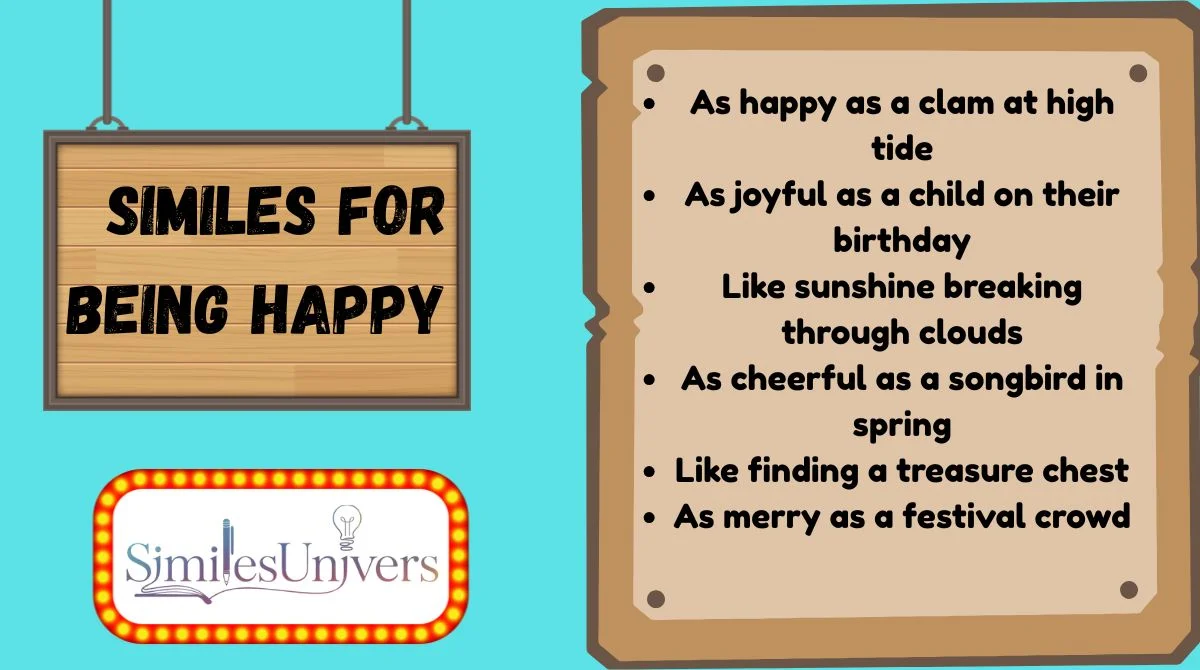
Quick List – Most Popular Similes for Being Happy
- As happy as a clam at high tide
- As joyful as a child on Christmas morning
- Like sunshine after rain
- As pleased as punch
- As happy as a lark
- Like a balloon floating on air
- As cheerful as spring flowers
- Like a kid in a candy store
- As lighthearted as a feather
- Like a song in your heart
Complete List of Similes for Being Happy (Grouped by Meaning)
Funny & Lighthearted
- As happy as a clam at high tide
- Meaning: Extremely happy and content
- Explanation: Clams are considered “safe” during high tide, symbolizing security and joy.
- Examples:
- “After getting her promotion, she was as happy as a clam at high tide.”
- “He grinned, feeling as happy as a clam at high tide.”
- Tone: Funny
- Like a kid in a candy store
- Meaning: Excited and delighted
- Explanation: Imagine a child surrounded by sweets—they’re overwhelmed with joy.
- Examples:
- “When he saw the surprise party, he was like a kid in a candy store.”
- “She felt like a kid in a candy store browsing the new bookstore.”
- Tone: Funny
- As pleased as punch
- Meaning: Satisfied and cheerful
- Explanation: A classic phrase conveying a simple, playful happiness.
- Examples:
- “After solving the puzzle, he was as pleased as punch.”
- “She received the gift and was as pleased as punch.”
- Tone: Funny
- Like a dog wagging its tail
- Meaning: Uncontainable joy
- Explanation: Dogs express happiness openly through tail-wagging.
- Examples:
- “He was like a dog wagging its tail when his friends arrived.”
- “She greeted her family like a dog wagging its tail.”
- Tone: Casual
- As bouncy as a kangaroo
- Meaning: Energetic happiness
- Explanation: The playful hopping of a kangaroo mirrors lively joy.
- Examples:
- “He felt as bouncy as a kangaroo after hearing the good news.”
- “She entered the party as bouncy as a kangaroo.”
- Tone: Funny
Emotional & Deep
- Like sunshine after rain
- Meaning: Relief and joy after sadness
- Explanation: The bright sun symbolizes hope and renewed happiness.
- Examples:
- “Her smile was like sunshine after rain.”
- “After exams were over, he felt like sunshine after rain.”
- Tone: Poetic
- As light as a cloud drifting in the sky
- Meaning: Carefree happiness
- Explanation: Imagery of weightlessness conveys emotional freedom.
- Examples:
- “She floated through the park as light as a cloud drifting in the sky.”
- “His heart was as light as a cloud drifting in the sky.”
- Tone: Poetic
- Like a river in full flow
- Meaning: Joyful momentum
- Explanation: A river moving freely represents natural, unstoppable happiness.
- Examples:
- “Her laughter poured out like a river in full flow.”
- “He felt like a river in full flow after receiving praise.”
- Tone: Serious
- As radiant as a blooming sunflower
- Meaning: Bright and warm happiness
- Explanation: Sunflowers face the sun, symbolizing positivity.
- Examples:
- “She entered the room as radiant as a blooming sunflower.”
- “He smiled at the compliment, as radiant as a blooming sunflower.”
- Tone: Poetic
- Like a heart full of fireworks
- Meaning: Intense, glowing joy
- Explanation: Fireworks explode in color and light, representing emotional bursts.
- Examples:
- “Her heart felt like a heart full of fireworks when she saw him.”
- “He celebrated the success with a feeling like a heart full of fireworks.”
- Tone: Poetic
Dramatic & Intense
- As ecstatic as a champion at the finish line
- Meaning: Triumph-filled happiness
- Explanation: Winning triggers a surge of joy and relief.
- Examples:
- “He raised his arms, as ecstatic as a champion at the finish line.”
- “She screamed, as ecstatic as a champion at the finish line.”
- Tone: Serious
- Like a storm breaking into sunshine
- Meaning: Emotional release and happiness
- Explanation: Dramatic weather shifts mirror emotional highs.
- Examples:
- “Her mood shifted like a storm breaking into sunshine.”
- “He laughed like a storm breaking into sunshine.”
- Tone: Poetic
- As jubilant as a festival crowd
- Meaning: Collective, exuberant joy
- Explanation: Festivals bring intense shared happiness.
- Examples:
- “He felt as jubilant as a festival crowd hearing the music.”
- “She danced through the streets as jubilant as a festival crowd.”
- Tone: Serious
- Like a volcano of laughter
- Meaning: Sudden, explosive joy
- Explanation: A volcano erupts dramatically; so does uncontrolled happiness.
- Examples:
- “The joke hit, and he exploded like a volcano of laughter.”
- “Her joy erupted like a volcano of laughter.”
- Tone: Dramatic
- As thrilled as a skydiver free-falling
- Meaning: Exhilarating happiness
- Explanation: Extreme experiences mirror peak joy.
- Examples:
- “He opened the acceptance letter, as thrilled as a skydiver free-falling.”
- “She felt as thrilled as a skydiver free-falling on stage.”
- Tone: Serious
Slow & Monotonous
(Yes, happiness can be gentle and calm!)
- Like a warm cup of tea on a rainy day
- Meaning: Cozy contentment
- Explanation: Simple pleasures create gentle happiness.
- Examples:
- “She smiled softly, like a warm cup of tea on a rainy day.”
- “His heart felt like a warm cup of tea on a rainy day.”
- Tone: Casual
- As peaceful as a calm lake at dawn
- Meaning: Serene happiness
- Explanation: Calm water symbolizes inner tranquility.
- Examples:
- “He watched the sunrise, as peaceful as a calm lake at dawn.”
- “Her happiness was as peaceful as a calm lake at dawn.”
- Tone: Poetic
- Like butter melting on hot toast
- Meaning: Smooth, satisfying joy
- Explanation: Gradual happiness spreading pleasantly
- Examples:
- “He sank into the chair, feeling like butter melting on hot toast.”
- “The compliment made her feel like butter melting on hot toast.”
- Tone: Casual
- As gentle as a morning breeze
- Meaning: Soft happiness
- Explanation: Light, unnoticed, yet refreshing joy.
- Examples:
- “She walked through the garden, as gentle as a morning breeze.”
- “He hummed, feeling as gentle as a morning breeze.”
- Tone: Poetic
- Like a cozy blanket on a winter night
- Meaning: Comforting contentment
- Explanation: Simple comfort creates happiness.
- Examples:
- “Her smile was like a cozy blanket on a winter night.”
- “He felt like a cozy blanket on a winter night.”
- Tone: Casual
Creative & Unique
- As sparkly as morning dew on spider webs
- Meaning: Delicate, shining joy
- Explanation: Tiny natural beauty representing subtle happiness
- Examples:
- “Her eyes glimmered, as sparkly as morning dew on spider webs.”
- “He felt as sparkly as morning dew on spider webs.”
- Tone: Poetic
- Like confetti raining from the sky
- Meaning: Overflowing celebration
- Explanation: Visualizes exuberant happiness spilling everywhere
- Examples:
- “She skipped down the street like confetti raining from the sky.”
- “He opened the gift, feeling like confetti raining from the sky.”
- Tone: Funny
- As bright as a lighthouse in fog
- Meaning: Guiding, uplifting happiness
- Explanation: Even in uncertainty, happiness shines clearly
- Examples:
- “Her smile was as bright as a lighthouse in fog.”
- “He stood tall, feeling as bright as a lighthouse in fog.”
- Tone: Poetic
- Like a kite soaring on a summer wind
- Meaning: Free-spirited joy
- Explanation: Freedom in movement mirrors joy without constraints
- Examples:
- “He laughed like a kite soaring on a summer wind.”
- “She felt like a kite soaring on a summer wind.”
- Tone: Casual
- As bubbly as soda in a glass
- Meaning: Effervescent happiness
- Explanation: Lively and fun imagery of fizzy joy
- Examples:
- “He entered the room as bubbly as soda in a glass.”
- “Her energy was as bubbly as soda in a glass.”
- Tone: Funny
Poetic & Literary
- Like moonlight on still water
- Meaning: Quiet, reflective happiness
- Explanation: Soft, serene imagery evokes calm joy
- Examples:
- “She sat by the lake, feeling like moonlight on still water.”
- “His heart was like moonlight on still water.”
- Tone: Poetic
- As golden as autumn leaves in sunlight
- Meaning: Warm and rich joy
- Explanation: Nature’s golden hues evoke radiant happiness
- Examples:
- “Her laughter fell like golden autumn leaves in sunlight.”
- “He felt as golden as autumn leaves in sunlight.”
- Tone: Poetic
- Like a secret garden blooming in spring
- Meaning: Hidden, personal joy
- Explanation: Personal happiness that grows quietly and beautifully
- Examples:
- “She smiled, like a secret garden blooming in spring.”
- “His heart felt like a secret garden blooming in spring.”
- Tone: Poetic
- As gentle as a lullaby
- Meaning: Soft, soothing joy
- Explanation: Happiness that calms and comforts
- Examples:
- “Her voice was as gentle as a lullaby.”
- “He hummed, as gentle as a lullaby.”
- Tone: Poetic
- Like a thread of sunlight through a forest
- Meaning: Hopeful happiness breaking through darkness
- Explanation: Brightness in the midst of shadows symbolizes uplift
- Examples:
- “She walked forward, like a thread of sunlight through a forest.”
- “His smile cut through the gloom, like a thread of sunlight through a forest.”
- Tone: Poetic
Fresh and Unique Similes You Won’t Hear Every Day
- Like honey dripping over warm bread – Sweet, slow joy spreading gradually
- As giddy as a swing in a summer storm – Playful, thrilling happiness
- Like laughter bouncing off canyon walls – Joy that echoes and multiplies
- As twinkly as stars in a midnight pond – Subtle, magical delight
- Like bubbles rising in a champagne fountain – Lively, celebratory happiness
How to Use These Similes in Writing
- Essays: Sprinkle similes to explain emotions vividly and connect with readers emotionally.
- Stories: Use similes to paint character moods, enhance settings, and create memorable scenes.
How to Create Your Own Similes
- Identify the emotion you want to express.
- Think of natural or familiar objects/actions that mirror that emotion.
- Use “like” or “as” to connect them.
- Test the simile for clarity and imagery.
- Refine for rhythm and tone.
Tips:
- Avoid clichés.
- Match tone to context.
- Keep it simple.
- Use sensory details.
- Experiment with unusual comparisons.
Examples:
- “Happy like sunlight on snow” → serene joy
- “Happy like a cat in a sunbeam” → relaxed contentment
- “Happy like fireworks in a quiet town” → sudden, intense joy
Common Mistakes When Using Similes
- Overuse: Don’t crowd sentences with similes.
- Clichés: Fresh similes create more impact.
- Tone mismatch: Funny similes in serious scenes can feel jarring.
Practice Exercise
Fill in the blanks with a suitable simile for happiness:
- She smiled ________ after winning the race.
- He felt ________ at the surprise party.
- The child laughed ________ in the playground.
- Her heart soared ________ when she saw the gift.
- He was ________ after the exam results.
- She danced ________ in the rain.
- His eyes sparkled ________ at the news.
- She hummed ________ while cooking.
- The puppy wagged its tail ________.
- He skipped ________ on his birthday.
- Her joy spread ________ through the room.
- He grinned ________ at the joke.
Answers:
- like a kite soaring on a summer wind
- like confetti raining from the sky
- like a kid in a candy store
- like a heart full of fireworks
- as ecstatic as a champion at the finish line
- like sunshine after rain
- as sparkly as morning dew on spider webs
- as gentle as a lullaby
- like a dog wagging its tail
- as bouncy as a kangaroo
- like bubbles rising in a champagne fountain
- as pleased as punch
FAQs
What are similes for happiness?
Similes for happiness are comparisons that describe joy using “like” or “as,” helping readers visualize and feel the emotion.
How many similes should I use in a story?
Use 1–2 per paragraph for clarity and impact; too many can overwhelm readers.
Can similes be funny and serious at the same time?
Generally, tone should match context. Funny similes in serious moments may feel out of place.
Are fresh similes better than common ones?
Yes, fresh similes create originality and make writing more memorable.
Can similes describe subtle happiness?
Absolutely. Gentle comparisons like “as peaceful as a calm lake” capture subtle joy.
How do similes improve writing?
They make abstract feelings tangible, enhance imagery, and engage readers emotionally.
Final Thoughts
Similes are a writer’s secret weapon for expressing happiness vividly. From playful and funny to poetic and serene, the 36+ similes in this guide equip you to describe joy with clarity, originality, and style. Experiment with fresh comparisons, match your tone, and watch your writing come alive. Happiness is universal—your words can make readers feel it too.

Daniel Harper
I am simplifies complex literary concepts into clear, practical lessons for students and learners worldwide.
Through SimilesUnivers, he aims to make mastering similes engaging, structured, and academically enriching.