Introduction
Fear is a universal emotion. Whether it’s the sudden jump at a creaking floorboard or the anxiety of a looming deadline, everyone has felt that rush of fear.
Using similes to describe fear can transform ordinary writing into vivid, immersive experiences that capture the reader’s imagination. Similes allow writers to convey emotion quickly and effectively by comparing fear to familiar sensations.
In this guide, you’ll discover over 36 creative similes for being scared, organized by tone and style, plus tips on how to use them in your writing. By the end, you’ll have a rich toolbox to make your stories, essays, and dialogues more gripping and alive.
What Is a Simile?
A simile is a figure of speech that compares two different things using “like” or “as.” It helps readers picture emotions or situations vividly. For example, “She was as quiet as a mouse” shows someone’s silence clearly and memorably.
Quick List – Most Popular Similes for Being Scared
- As scared as a cat in a room full of rocking chairs
- Like a deer in headlights
- As nervous as a long-tailed cat in a room full of rocking chairs
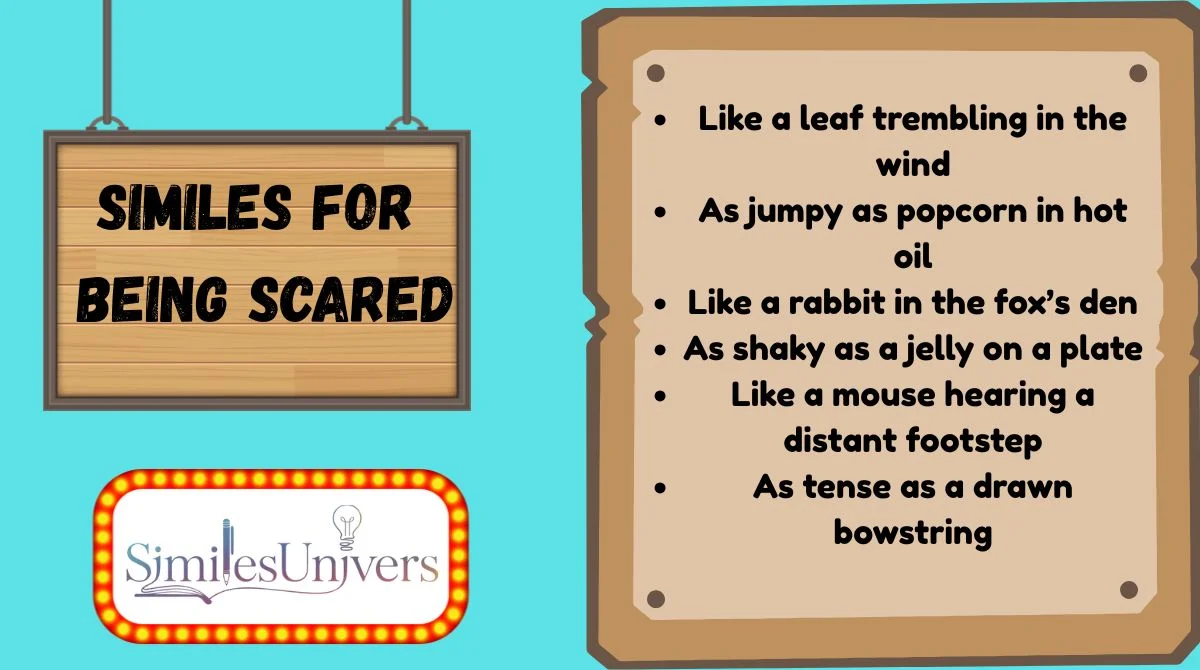
- Like a leaf trembling in the wind
- As jumpy as popcorn in hot oil
- Like a rabbit in the fox’s den
- As shaky as a jelly on a plate
- Like a mouse hearing a distant footstep
- As tense as a drawn bowstring
- Like someone seeing a shadow move in the dark
Complete List of Similes for Being Scared (Grouped by Meaning)
Funny & Lighthearted
As jumpy as popcorn in hot oil
- Meaning: Extremely nervous or startled
- Explanation: Shows quick, unpredictable movements caused by fear
- Examples:
- She was as jumpy as popcorn in hot oil during the haunted house tour.
- His hands trembled like popcorn in hot oil as he opened the creaky door.
- Tone: Funny
As scared as a cat in a room full of rocking chairs
- Meaning: Nervous and fearful
- Explanation: Cats are cautious, and a room full of danger amplifies fear
- Examples:
- I felt as scared as a cat in a room full of rocking chairs before giving my speech.
- He froze, as scared as a cat in a room full of rocking chairs, when the alarm blared.
- Tone: Humorous
Like a kid hearing a monster under the bed
- Meaning: Childlike fear
- Explanation: Evokes innocent, exaggerated imagination
- Examples:
- She peeked around the corner, like a kid hearing a monster under the bed.
- He jumped at the creaking floorboard like a kid hearing a monster under the bed.
- Tone: Funny
Emotional & Deep
Like a leaf trembling in the wind
- Meaning: Subtle, anxious fear
- Explanation: Captures fragility and sensitivity to danger
- Examples:
- Her hands shook like a leaf trembling in the wind as she approached the stage.
- He whispered, like a leaf trembling in the wind, afraid to be heard.
- Tone: Serious
As cold as fear itself
- Meaning: Overwhelmed by fear
- Explanation: Highlights how fear can paralyze and chill
- Examples:
- He felt as cold as fear itself when the lights went out.
- The silence was as cold as fear itself in the abandoned house.
- Tone: Poetic
Like walking on a tightrope over an abyss
- Meaning: Intense anxiety
- Explanation: Shows a delicate, precarious situation that sparks fear
- Examples:
- Every word he spoke felt like walking on a tightrope over an abyss.
- She entered the dark alley, like walking on a tightrope over an abyss.
- Tone: Serious
Dramatic & Intense
As frozen as a statue in a haunted hall
- Meaning: Shocked and immobilized
- Explanation: Extreme fear can stop someone in their tracks
- Examples:
- He stood as frozen as a statue in a haunted hall when the ghost appeared.
- The child clutched the blanket, as frozen as a statue in a haunted hall.
- Tone: Dramatic
Like a rabbit in the fox’s den
- Meaning: Terrified and trapped
- Explanation: Fear is amplified by a sense of danger or predator presence
- Examples:
- She felt like a rabbit in the fox’s den when she entered the dark basement.
- The new recruit was like a rabbit in the fox’s den during the strict inspection.
- Tone: Dramatic
As tense as a drawn bowstring
- Meaning: High alert and ready to react
- Explanation: Builds suspense, shows fear that is physically manifest
- Examples:
- Every sound made him as tense as a drawn bowstring.
- She waited, as tense as a drawn bowstring, for the results.
- Tone: Serious
Slow & Monotonous
As quiet as a mouse in the attic
- Meaning: Fearful and cautious
- Explanation: Fear can make someone hyper-aware and silent
- Examples:
- He crept through the hallway, as quiet as a mouse in the attic.
- She tiptoed, as quiet as a mouse in the attic, to avoid waking anyone.
- Tone: Casual
Like shadows stretching at dusk
- Meaning: Slow-building fear
- Explanation: Subtle fear creeping over time
- Examples:
- Unease settled over him like shadows stretching at dusk.
- The tension in the room grew, like shadows stretching at dusk.
- Tone: Poetic
Creative & Unique
As startled as a candle in a wind tunnel
- Meaning: Sudden and intense fright
- Explanation: Fear causes flinching and instability
- Examples:
- She jumped, as startled as a candle in a wind tunnel.
- His nerves were as fragile as a candle in a wind tunnel.
- Tone: Creative
Like a ghost in broad daylight
- Meaning: Out of place and anxious
- Explanation: Fear can make someone feel exposed
- Examples:
- Walking into the boardroom, he felt like a ghost in broad daylight.
- She moved through the party like a ghost in broad daylight, nervous everyone would notice.
- Tone: Unique
Poetic & Literary
Like a storm trapped in a teacup
- Meaning: Intense emotion contained in a small space
- Explanation: Fear bubbling beneath composure
- Examples:
- His anxiety was like a storm trapped in a teacup.
- She faced the audience, like a storm trapped in a teacup, heart pounding.
- Tone: Poetic
Fresh and Unique Similes You Won’t Hear Every Day
- Like marbles rolling on a marble floor – Fear makes your thoughts jittery and uncontrolled.
- As if a shadow followed your heartbeat – Implies an inescapable feeling of fear.
- Like a cat in a room of laser pointers – Confused, startled, and hyper-aware of surroundings.
- As if the floor dissolved beneath your feet – Heightens anxiety and sudden dread.
- Like a lantern flickering in a cave – Small hope or security threatened by fear.
How to Use These Similes in Writing
- Essays: Add emotional depth, making points more relatable.
- Stories: Bring characters to life and amplify suspense or tension.
How to Create Your Own Similes (Mini Writing Guide)
- Identify the emotion or action.
- Think of objects or scenarios that evoke a similar feeling.
- Use “like” or “as” to link them.
- Test the imagery in a sentence.
- Refine for clarity and impact.
Example Transformations:
- “He was scared” → “He was as jittery as leaves in a storm.”
- “She felt nervous” → “She felt like a candle in a hurricane.”
- “The child froze” → “The child froze, like ice under a winter sun.”
Common Mistakes When Using Similes
- Overuse: Too many similes can overwhelm the reader.
- Clichés: Avoid tired comparisons like “as brave as a lion.”
- Tone mismatch: A humorous simile may not fit a serious scene.
Practice Exercise
Fill in the blanks with a simile from the guide:
- He jumped __________ when the door creaked.
- She froze __________ in the haunted hallway.
- The child trembled __________ under the bed.
- His hands shook __________ before the presentation.
- She moved __________ across the dark alley.
- Anxiety crept in __________ over the room.
- He felt trapped __________ in the predator’s den.
- Her thoughts scattered __________ in fear.
- The silence was __________ in the abandoned house.
- He waited __________ for the news.
- Nerves made her jitter __________ before the test.
- Fear made him quiet __________ in the attic.
Answers:
- as jumpy as popcorn in hot oil
- as frozen as a statue in a haunted hall
- like a kid hearing a monster under the bed
- like a leaf trembling in the wind
- as quiet as a mouse in the attic
- like shadows stretching at dusk
- like a rabbit in the fox’s den
- like marbles rolling on a marble floor
- as cold as fear itself
- as tense as a drawn bowstring
- like a candle in a wind tunnel
- as quiet as a mouse in the attic
FAQs
What is the best simile for being scared?
“Like a deer in headlights” is commonly recognized and instantly understood.
How do I make my similes more original?
Use unusual comparisons from nature, objects, or everyday life. Avoid clichés.
Can similes be used in formal writing?
Yes, sparingly. They work well to add imagery or emotion.
Are similes different from metaphors?
Yes, similes use “like” or “as,” while metaphors imply direct comparison without them.
How many similes should I use in a story?
Use enough to enrich description but not overwhelm—usually 2–3 per paragraph is sufficient.
Do funny similes work in scary stories?
Yes, in moderation, they can provide relief and balance tension.
Final Thoughts
Similes are powerful tools that make writing vivid, emotional, and memorable. From classic comparisons like “like a deer in headlights” to original creations like “like marbles rolling on a marble floor,” the right simile can turn fear into an experience readers feel firsthand. Practice, experiment, and let your imagination guide you to create even more striking comparisons.

Daniel Harper
I am simplifies complex literary concepts into clear, practical lessons for students and learners worldwide.
Through SimilesUnivers, he aims to make mastering similes engaging, structured, and academically enriching.