A good book can feel like magic. It can pull you in, lift you up, or break your heart. But how do you explain that feeling in your own writing?
That’s where similes help.
Similes make your words brighter. They turn plain ideas into pictures your reader can see and feel. Instead of saying “the book was interesting,” you can say “the book was like a door to another world.” That small change makes a big difference.
In this guide, you’ll find more than 20 strong, creative similes for books. Some are funny. Some are deep. Some are fresh and rare.
You’ll also learn how to use them, how to create your own, and how to avoid common mistakes.
Let’s open the pages.
What Is a Simile? (Quick Clear Definition)
A simile is a comparison that uses “like” or “as.”
It shows how two things are similar.
Example:
The book was like a treasure chest full of secrets.
Quick List – Most Popular Similes for “Books”
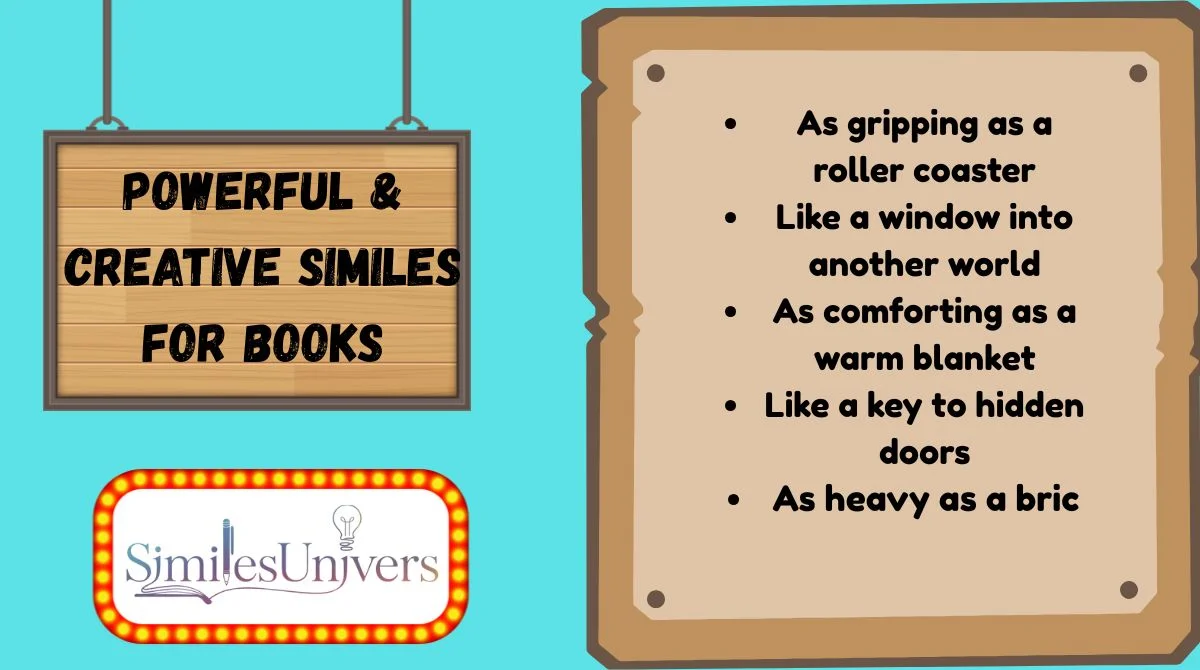
- As gripping as a roller coaster
- Like a window into another world
- As comforting as a warm blanket
- Like a key to hidden doors
- As heavy as a brick
- Like a trusted old friend
- As addictive as chocolate
- Like a maze with no exit
- As bright as a lighthouse
- Like a time machine
Complete List of Similes for “Books” (Grouped by Meaning)
Funny & Lighthearted
Like a snack you can’t stop eating
Meaning: The book is addictive.
Explanation: You keep turning pages just like you keep grabbing chips.
Example sentences:
- The mystery novel was like a snack you can’t stop eating.
- Her romance story felt like a snack I finished in one sitting.
Tone: Funny / Casual
As dramatic as a soap opera
Meaning: Full of big emotions and twists.
Explanation: The story has shocking moments and strong feelings.
Example sentences:
- That fantasy book was as dramatic as a soap opera.
- The characters argued as if they were in a story as dramatic as a soap opera.
Tone: Funny
Like a backpack stuffed with surprises
Meaning: Full of unexpected events.
Explanation: You never know what’s coming next.
Example sentences:
- The adventure book was like a backpack stuffed with surprises.
- Each chapter felt like pulling something new from a backpack stuffed with surprises.
Tone: Lighthearted
As noisy as a classroom before recess
Meaning: Busy and full of action.
Explanation: The story feels lively and chaotic.
Example sentences:
- The battle scenes were as noisy as a classroom before recess.
- The novel felt as noisy as a classroom before recess.
Tone: Funny
Emotional & Deep
Like a mirror for the soul
Meaning: Reflects your feelings.
Explanation: The story makes you think about yourself.
Example sentences:
- That memoir was like a mirror for the soul.
- The poetry book felt like a mirror for the soul.
Tone: Serious
As heavy as a heart full of regret
Meaning: Emotionally intense.
Explanation: The book deals with sadness or guilt.
Example sentences:
- The war novel was as heavy as a heart full of regret.
- The final chapter felt as heavy as a heart full of regret.
Tone: Serious
Like a quiet conversation at midnight
Meaning: Soft, personal, and thoughtful.
Explanation: The book feels intimate and calm.
Example sentences:
- Her diary-style book was like a quiet conversation at midnight.
- The story unfolded like a quiet conversation at midnight.
Tone: Poetic
As comforting as a letter from home
Meaning: Warm and reassuring.
Explanation: The book brings peace and comfort.
Example sentences:
- The children’s story was as comforting as a letter from home.
- That novel felt as comforting as a letter from home.
Tone: Gentle
Dramatic & Intense
Like a storm trapped between covers
Meaning: Powerful and wild.
Explanation: The book is full of strong action and emotion.
Example sentences:
- The thriller was like a storm trapped between covers.
- His writing felt like a storm trapped between covers.
Tone: Intense
As sharp as a blade in the dark
Meaning: Cutting and shocking.
Explanation: The story delivers sudden impact.
Example sentences:
- The ending was as sharp as a blade in the dark.
- That crime novel felt as sharp as a blade in the dark.
Tone: Serious
Like a volcano waiting to erupt
Meaning: Builds tension slowly.
Explanation: The story grows more intense over time.
Example sentences:
- The plot was like a volcano waiting to erupt.
- The final chapters felt like a volcano waiting to erupt.
Tone: Dramatic
Slow & Monotonous
As slow as a turtle crossing the road
Meaning: Very slow pace.
Explanation: The book moves at a lazy speed.
Example sentences:
- That history book was as slow as a turtle crossing the road.
- The first half felt as slow as a turtle crossing the road.
Tone: Casual
Like a train that stops at every station
Meaning: Takes too long.
Explanation: The story pauses often and drags.
Example sentences:
- The novel felt like a train that stops at every station.
- His writing was like a train that stops at every station.
Tone: Casual
Creative & Unique
Like a lighthouse in a foggy mind
Meaning: Brings clarity.
Explanation: The book helps you understand something clearly.
Example sentences:
- The self-help book was like a lighthouse in a foggy mind.
- Her advice felt like a lighthouse in a foggy mind.
Tone: Poetic
As layered as an onion in winter
Meaning: Complex and deep.
Explanation: The story has many hidden layers.
Example sentences:
- The novel was as layered as an onion in winter.
- Each chapter felt as layered as an onion in winter.
Tone: Literary
Like a secret garden behind a locked gate
Meaning: Hidden beauty.
Explanation: The book reveals its magic slowly.
Example sentences:
- That classic felt like a secret garden behind a locked gate.
- The poetry collection was like a secret garden behind a locked gate.
Tone: Poetic
As bright as a match in a dark cave
Meaning: Powerful insight.
Explanation: The book lights up big ideas.
Example sentences:
- The philosophy book was as bright as a match in a dark cave.
- His essay felt as bright as a match in a dark cave.
Tone: Serious
Poetic & Literary
Like a river carrying forgotten dreams
Meaning: Flowing and emotional.
Explanation: The book moves smoothly and touches deep feelings.
Example sentences:
- The novel was like a river carrying forgotten dreams.
- Her story flowed like a river carrying forgotten dreams.
Tone: Poetic
As timeless as the stars
Meaning: Will last forever.
Explanation: The book feels classic and eternal.
Example sentences:
- That novel is as timeless as the stars.
- The message felt as timeless as the stars.
Tone: Literary
Like a bridge between yesterday and tomorrow
Meaning: Connects past and future.
Explanation: The book links history and hope.
Example sentences:
- The biography felt like a bridge between yesterday and tomorrow.
- The story acted like a bridge between yesterday and tomorrow.
Tone: Thoughtful
Fresh and Unique Similes You Won’t Hear Every Day
- Like a compass spinning in a thunderstorm – A confusing but exciting story.
- As fragile as glass warmed by breath – A delicate and emotional book.
- Like a locked diary whispering secrets – A mysterious and personal book.
- As restless as a bird in a small cage – A story full of tension.
- Like footprints fading in fresh snow – A quiet book that leaves a soft but lasting mark.
These similes work because they create strong images. You can see, hear, or feel them.
How to Use These Similes in Writing
In Essays
- Use one or two similes to explain tone.
- Place them after a strong statement.
- Keep them clear and short.
Example:
The novel explores grief. It feels like a mirror for the soul.
In Stories
- Use similes in dialogue.
- Add them during emotional scenes.
- Avoid adding too many in one paragraph.
How to Create Your Own Similes (Mini Writing Guide)
Step-by-Step Method
- Think about the book’s main feeling.
- Pick an object that has the same feeling.
- Connect them using “like” or “as.”
- Make the image simple and clear.
- Test it by reading it out loud.
5 Practical Tips
- Use everyday objects.
- Focus on emotion, not just action.
- Avoid tired clichés.
- Keep it short.
- Make sure it fits the tone.
3 Transformation Examples
Plain: The book was exciting.
Better: The book was like a roller coaster in the dark.
Plain: The novel was sad.
Better: The novel was as heavy as a heart full of regret.
Plain: The story was confusing.
Better: The story was like a maze with no exit.
Common Mistakes When Using Similes
Overuse
Too many similes make writing messy. Use them wisely.
Clichés
Avoid tired comparisons like “as good as gold” unless you refresh them.
Tone Mismatch
A funny simile does not fit a serious war novel.
Practice Exercise
Fill in the blanks:
- The fantasy book was like a _______.
- The novel felt as heavy as _______.
- The thriller moved like _______.
- The poetry flowed like _______.
- The textbook was as slow as _______.
- The memoir felt like _______.
- The ending hit like _______.
- The romance was as warm as _______.
- The mystery was like _______.
- The story sparkled like _______.
- The biography felt as timeless as _______.
- The comic book was as lively as _______.
Sample Answers
- storm trapped between covers
- a heart full of regret
- a volcano waiting to erupt
- a river carrying forgotten dreams
- a turtle crossing the road
- a quiet conversation at midnight
- a blade in the dark
- a letter from home
- a locked diary whispering secrets
- a match in a dark cave
- the stars
- a classroom before recess
FAQs
What are similes for books?
They are comparisons using “like” or “as” to describe books in a vivid way.
Why should I use similes in writing?
They make your writing clearer, stronger, and more emotional.
How many similes should I use in one essay?
Usually one to three is enough.
Can similes improve storytelling?
Yes. They help readers imagine scenes and feelings.
What makes a good simile?
It is clear, fresh, and fits the tone.
Are similes and metaphors the same?
No. Similes use “like” or “as.” Metaphors do not.
Final Thoughts
Books already carry worlds inside them. With the right simile, you can show that world in one bright sentence.
A strong simile makes readers pause. It makes them see, feel, and remember. Whether you want something funny, deep, dramatic, or poetic, the right comparison can lift your writing to the next level.
Now it’s your turn. Open a book. Feel what it gives you. Then compare it to something alive in your own world.
That’s where the magic begins.
Daniel Harper
I am simplifies complex literary concepts into clear, practical lessons for students and learners worldwide.
Through SimilesUnivers, he aims to make mastering similes engaging, structured, and academically enriching.