Death is one of the strongest ideas in language. It can feel heavy, quiet, shocking, or even darkly funny. Writers often struggle to describe it in fresh ways.
Saying “he was dead” works—but it lacks color. Similes bring that color. They help readers see, feel, and understand the moment.
When you compare something “like” or “as” something else, your words come alive. A single sharp simile can turn a plain sentence into something powerful.
In this guide, you’ll discover 27+ high-quality similes for “dead.” Some are dramatic. Some are emotional. Some are playful.
Many are fresh and less common. You’ll also learn how to use them well—and how to create your own.
Let’s dive in.
What Is a Simile? (Quick Clear Definition)
A simile compares two different things using “like” or “as.”
It helps readers picture something clearly.
Example:
He was as quiet as a mouse.
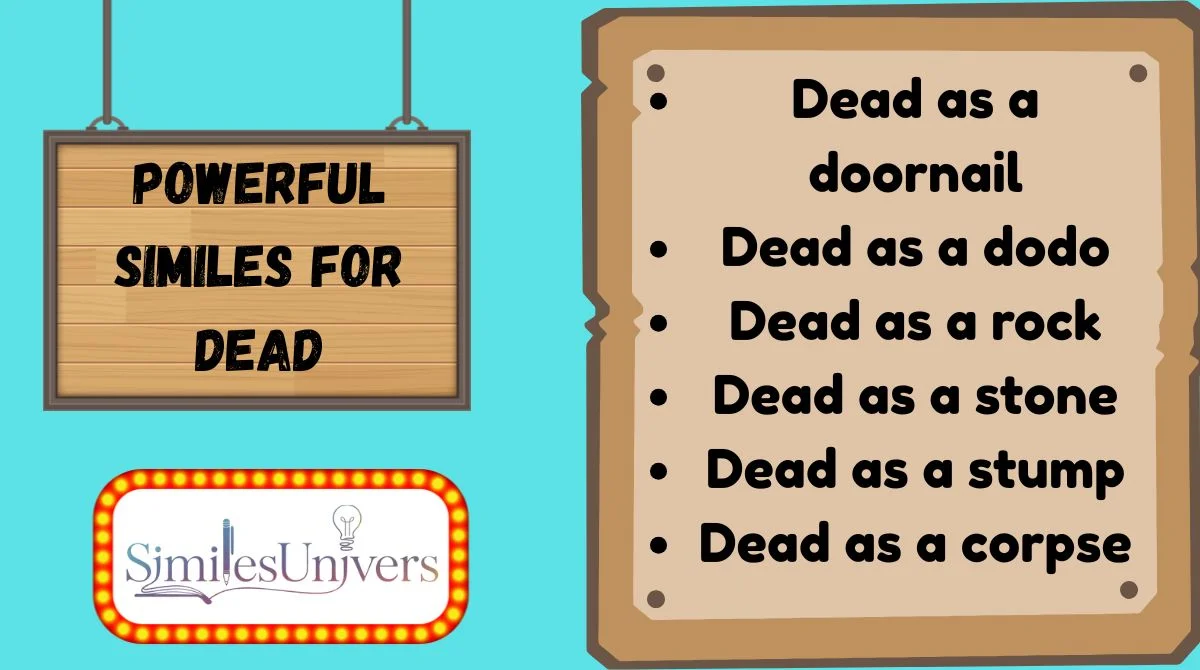
Quick List – Most Popular Similes for “Dead”
- Dead as a doornail
- Dead as a dodo
- Dead as a rock
- Dead as a stone
- Dead as a stump
- Dead as a corpse
- Dead as last winter’s leaves
- Dead as cold ash
- Dead as an unplugged phone
- Dead as silence at midnight
Complete List of Similes for “Dead” (Grouped by Meaning)
Funny & Lighthearted
Dead as a Doornail
Meaning: Completely dead or inactive.
Explanation: A doornail has no life at all—this is a classic humorous exaggeration.
Examples:
- After the long meeting, my brain was dead as a doornail.
- The old battery is dead as a doornail.
Tone: Funny
Dead as a Dodo
Meaning: Extinct or long gone.
Explanation: The dodo bird no longer exists, so the comparison feels playful yet clear.
Examples:
- That fashion trend is dead as a dodo.
- My flip phone is dead as a dodo in today’s world.
Tone: Casual
Dead as a Rock
Meaning: Completely lifeless or still.
Explanation: Rocks do not move or breathe.
Examples:
- He lay on the couch, dead as a rock.
- The engine went dead as a rock after the crash.
Tone: Casual
Dead as an Unplugged Phone
Meaning: Totally out of power.
Explanation: A phone without charge does nothing—modern and relatable.
Examples:
- By 9 p.m., I was dead as an unplugged phone.
- The system froze, dead as an unplugged phone.
Tone: Funny
Emotional & Deep
Dead as Cold Ash
Meaning: Gone with no warmth left.
Explanation: Ash is what remains after fire fades.
Examples:
- His hopes felt dead as cold ash.
- The love between them lay dead as cold ash.
Tone: Serious
Dead as Last Winter’s Leaves
Meaning: Completely lifeless and past.
Explanation: Fallen leaves from last winter are dry and gone.
Examples:
- Their friendship was dead as last winter’s leaves.
- The town’s joy felt dead as last winter’s leaves.
Tone: Poetic
Dead as a Burned-Out Star
Meaning: Once bright, now gone.
Explanation: A star that burns out leaves only darkness.
Examples:
- His dreams were dead as a burned-out star.
- The spotlight faded, dead as a burned-out star.
Tone: Poetic
Dead as a Forgotten Memory
Meaning: Gone from thought and heart.
Explanation: When memory fades, it is like it never lived.
Examples:
- The promise was dead as a forgotten memory.
- His name felt dead as a forgotten memory.
Tone: Emotional
Dramatic & Intense
Dead as a Bullet’s Target
Meaning: Instantly and completely dead.
Explanation: A target hit by a bullet leaves no doubt.
Examples:
- The spy fell dead as a bullet’s target.
- His plan was dead as a bullet’s target.
Tone: Intense
Dead as the Silence After a Scream
Meaning: Sudden and heavy stillness.
Explanation: After a scream ends, the silence feels thick and final.
Examples:
- The room went dead as the silence after a scream.
- The phone line fell dead as the silence after a scream.
Tone: Dramatic
Dead as a Snuffed Candle
Meaning: Life cut off quickly.
Explanation: A candle’s flame disappears in an instant.
Examples:
- The hope was dead as a snuffed candle.
- The light went dead as a snuffed candle.
Tone: Poetic
Dead as a Broken Clock at Midnight
Meaning: Frozen and final.
Explanation: Midnight often symbolizes endings.
Examples:
- The moment hung dead as a broken clock at midnight.
- Their love felt dead as a broken clock at midnight.
Tone: Literary
Slow & Monotonous
Dead as Still Water
Meaning: Unmoving and silent.
Explanation: Still water shows no life or ripple.
Examples:
- The lake was dead as still water.
- The meeting felt dead as still water.
Tone: Calm
Dead as Dust in an Empty Room
Meaning: Forgotten and unmoving.
Explanation: Dust settles in places untouched for years.
Examples:
- The old house felt dead as dust in an empty room.
- His voice was dead as dust in an empty room.
Tone: Serious
Dead as a Library at Dawn
Meaning: Quiet and lifeless.
Explanation: A library early in the morning is silent.
Examples:
- The streets were dead as a library at dawn.
- The party turned dead as a library at dawn.
Tone: Casual
Creative & Unique
Dead as a Map with No Roads
Meaning: Useless and directionless.
Explanation: A map without roads cannot guide you.
Examples:
- The project was dead as a map with no roads.
- His plan sat dead as a map with no roads.
Tone: Creative
Dead as an Echo with No Walls
Meaning: No response or return.
Explanation: An echo needs walls—without them, it vanishes.
Examples:
- My words felt dead as an echo with no walls.
- The call ended dead as an echo with no walls.
Tone: Poetic
Dead as a Seed on Stone
Meaning: No chance of growth.
Explanation: A seed cannot grow on rock.
Examples:
- The idea was dead as a seed on stone.
- His hope lay dead as a seed on stone.
Tone: Serious
Dead as a Song Without Sound
Meaning: Missing its life force.
Explanation: Music without sound has no purpose.
Examples:
- The concert felt dead as a song without sound.
- Their laughter was dead as a song without sound.
Tone: Poetic
Poetic & Literary
Dead as the Moon at Noon
Meaning: Invisible and absent.
Explanation: The moon hides in daylight.
Examples:
- His courage was dead as the moon at noon.
- The stars seemed dead as the moon at noon.
Tone: Poetic
Dead as the Tide at Low Water
Meaning: Drained and empty.
Explanation: Low tide leaves the shore bare.
Examples:
- The harbor lay dead as the tide at low water.
- My energy felt dead as the tide at low water.
Tone: Literary
Dead as Frostbitten Grass
Meaning: Life destroyed by harsh force.
Explanation: Frost kills grass overnight.
Examples:
- The garden was dead as frostbitten grass.
- His excitement turned dead as frostbitten grass.
Tone: Serious
Fresh and Unique Similes You Won’t Hear Every Day
Here are five original similes with vivid imagery:
- Dead as a lighthouse with no sea – A lighthouse has no purpose without water.
- Dead as a locked diary in a burned house – Secrets that will never be read.
- Dead as a shadow at midnight – When darkness swallows even shadows.
- Dead as ink in a shattered pen – Words that can never be written.
- Dead as a bridge to nowhere – A path that leads to nothing.
Each one paints a strong mental picture. That image makes your writing memorable.
How to Use These Similes in Writing
In Essays
Use similes to:
- Add emotional weight
- Clarify a strong argument
- Create vivid descriptions
Example:
The old law was dead as a dodo in modern society.
In Stories
Similes can:
- Show mood
- Deepen scenes
- Reveal character feelings
Example:
The battlefield lay dead as cold ash beneath the gray sky.
How to Create Your Own Similes (Mini Writing Guide)
Step-by-Step Method
- Pick the feeling (final, silent, hopeless, funny).
- Think of an object that shows that feeling.
- Add “like” or “as.”
- Make sure the image is clear.
- Read it out loud.
5 Practical Tips
- Avoid overused clichés unless you want humor.
- Keep images simple.
- Match tone to your story.
- Use concrete objects.
- Don’t stack too many similes together.
3 Transformation Examples
Plain: The idea failed.
Better: The idea was dead as a seed on stone.
Plain: The party ended.
Better: The party went dead as a library at dawn.
Plain: Her hope disappeared.
Better: Her hope faded, dead as a snuffed candle.
Common Mistakes When Using Similes
Overuse
Too many similes can tire readers.
Clichés
“Dead as a doornail” works—but don’t rely on it every time.
Tone Mismatch
Funny similes don’t fit tragic scenes. Choose carefully.
Practice Exercise
Fill in the blanks:
- The town was dead as _______.
- My phone is dead as _______.
- His dreams felt dead as _______.
- The garden lay dead as _______.
- The room went dead as _______.
- Her voice sounded dead as _______.
- The idea was dead as _______.
- The street looked dead as _______.
- My energy felt dead as _______.
- The fire was dead as _______.
- The hope seemed dead as _______.
- The night felt dead as _______.
Answers
- a library at dawn
- an unplugged phone
- a burned-out star
- frostbitten grass
- the silence after a scream
- dust in an empty room
- a seed on stone
- still water
- the tide at low water
- cold ash
- a snuffed candle
- the moon at noon
FAQs
What is the most common simile for dead?
“Dead as a doornail” is the most widely used and recognized.
Are similes for dead always serious?
No. Some are humorous, like “dead as a dodo.”
Can similes replace the word dead?
Yes. They can add emotion and imagery instead of stating it directly.
Are funny similes okay in serious writing?
Only if the tone allows it. Tone matters.
How many similes should I use in one paragraph?
Usually one is enough. Too many can distract readers.
How do I avoid cliché similes?
Create fresh images using specific objects and strong visuals.
Final Thoughts
Similes give power to simple words. Instead of saying something is “dead,” you can show readers exactly how it feels—silent as still water, final as a snuffed candle, or hopeless as a seed on stone.
Strong comparisons stick in the mind. They make writing vivid, emotional, and clear.
Now you have 27+ similes for “dead,” from funny to poetic to deeply dramatic. Use them wisely. Or better yet—create your own.
Your words deserve to feel alive.

Daniel Harper
I am simplifies complex literary concepts into clear, practical lessons for students and learners worldwide.
Through SimilesUnivers, he aims to make mastering similes engaging, structured, and academically enriching.