Hard moments come to everyone. A tough exam. A broken heart. A long day that feels like it will never end. When life feels heavy, plain words often fail us. That’s where similes shine.
Similes help us paint clear pictures. They turn feelings into images. Instead of saying something was “very hard,” you can say it was like climbing a mountain in the rain.
That small change makes your writing stronger, clearer, and more alive.
In this guide, you’ll discover 27 powerful similes for difficult situations. You’ll get short meanings, simple explanations, and natural examples.
You’ll also learn how to create your own similes and avoid common mistakes. By the end, you’ll have a toolkit that makes your writing vivid, emotional, and unforgettable.
What Is a Simile? (Quick Clear Definition)
A simile compares two different things using the words “like” or “as.”
It helps readers understand something by linking it to a familiar image.
Example:
The test was as hard as climbing a steep hill.
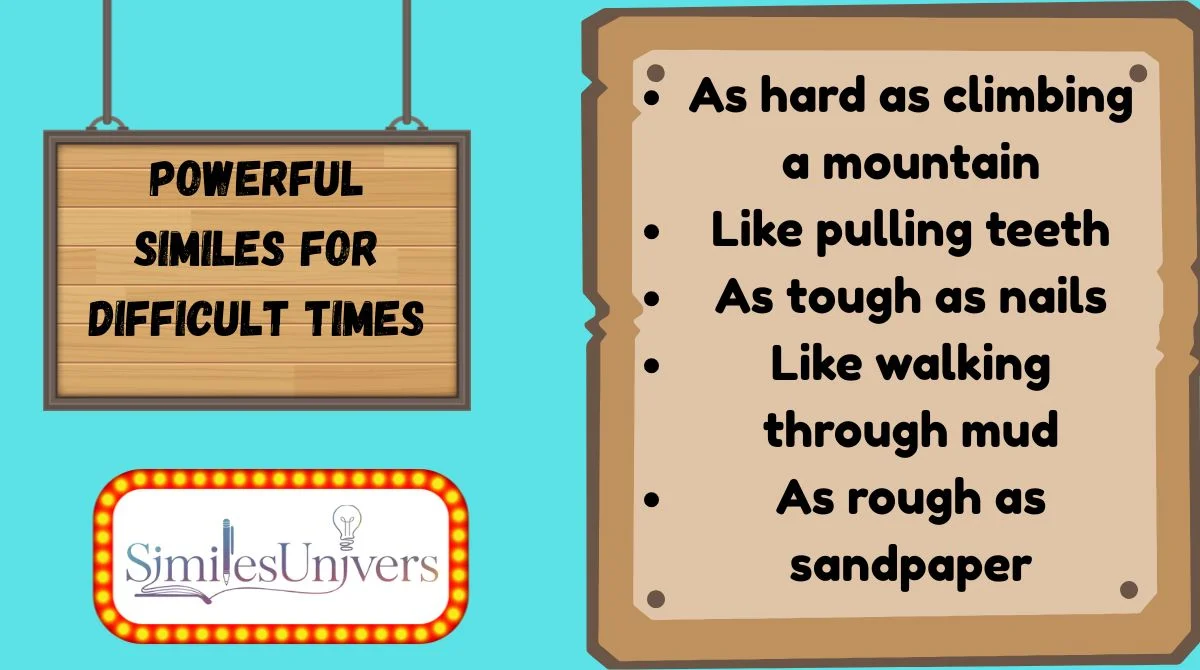
Quick List – Most Popular Similes for “Difficult”
- As hard as climbing a mountain
- Like pulling teeth
- As tough as nails
- Like walking through mud
- As rough as sandpaper
- Like solving a puzzle with missing pieces
- As heavy as a boulder
- Like swimming against the tide
- As tricky as a maze
- Like pushing a stalled car uphill
Complete List of Similes for “Difficult” (Grouped by Meaning)
Funny & Lighthearted
Like Pulling Teeth
Meaning: Extremely frustrating and slow.
Explanation: Getting teeth pulled is unpleasant and stubborn, just like some tasks.
Examples:
It was like pulling teeth to get him to clean his room.
Finishing that group project felt like pulling teeth.
Tone: Funny / Casual
Like Herding Cats
Meaning: Hard to control or organize.
Explanation: Cats don’t move together easily, which makes the image humorous.
Examples:
Managing the kids was like herding cats.
Planning the party felt like herding cats.
Tone: Funny
As Confusing as a Maze
Meaning: Very complicated.
Explanation: A maze has many twists and turns that make it hard to find the way.
Examples:
The new rules were as confusing as a maze.
His instructions sounded like a maze with no exit.
Tone: Casual
Like Trying to Untangle Headphones
Meaning: Annoying and time-consuming.
Explanation: Tangled wires feel simple at first but become frustrating fast.
Examples:
Fixing the computer bug was like trying to untangle headphones.
Their argument felt like untangling wires in the dark.
Tone: Funny
Emotional & Deep
As Heavy as a Boulder
Meaning: Emotionally overwhelming.
Explanation: A boulder represents weight and pressure.
Examples:
The news hit her heart like a boulder.
Grief felt as heavy as a boulder on his chest.
Tone: Serious
Like Walking Through Thick Fog
Meaning: Mentally unclear or uncertain.
Explanation: Fog blocks vision, just like confusion blocks understanding.
Examples:
After the loss, each day felt like walking through thick fog.
Making that choice was like walking through fog without a map.
Tone: Poetic
As Fragile as Glass Under Pressure
Meaning: Easily broken by stress.
Explanation: Glass cracks quickly when pressure rises.
Examples:
His patience was as fragile as glass under pressure.
Their friendship felt fragile like glass ready to shatter.
Tone: Serious
Like Carrying the World on Your Shoulders
Meaning: Feeling responsible for too much.
Explanation: The image shows extreme burden.
Examples:
She felt like she was carrying the world on her shoulders.
He walked into the meeting like he held the world up alone.
Tone: Emotional
Dramatic & Intense
As Hard as Climbing a Mountain in a Storm
Meaning: Extremely difficult.
Explanation: Mountains are tough; storms make them worse.
Examples:
Starting over was as hard as climbing a mountain in a storm.
The final round felt like scaling a stormy peak.
Tone: Dramatic
Like Swimming Against the Tide
Meaning: Fighting strong opposition.
Explanation: Water pushes back, making progress slow.
Examples:
Changing the policy felt like swimming against the tide.
He argued like someone battling a strong current.
Tone: Serious
As Sharp as a Knife’s Edge
Meaning: Dangerous and tense.
Explanation: A knife’s edge suggests risk and precision.
Examples:
The tension was as sharp as a knife’s edge.
Negotiations felt like walking on a blade.
Tone: Intense
Like Standing in the Path of a Storm
Meaning: Facing unavoidable trouble.
Explanation: Storms are powerful and unstoppable.
Examples:
Confronting him felt like standing in the path of a storm.
The criticism hit her like storm winds.
Tone: Dramatic
Slow & Monotonous
Like Walking Through Mud
Meaning: Slow and exhausting.
Explanation: Mud makes each step heavy.
Examples:
The project moved like walking through mud.
His recovery felt like trudging through wet ground.
Tone: Casual
As Slow as a Snail on a Cold Day
Meaning: Painfully slow.
Explanation: Snails move slowly; cold slows them more.
Examples:
The line moved as slow as a snail on a cold day.
Progress felt frozen and slow.
Tone: Funny
Like Watching Paint Dry
Meaning: Boring and slow.
Explanation: Paint drying is uneventful and dull.
Examples:
The lecture was like watching paint dry.
Waiting for results felt endless.
Tone: Casual
Creative & Unique
Like Building a Bridge from Toothpicks
Meaning: Nearly impossible with weak tools.
Explanation: Toothpicks cannot support heavy weight.
Examples:
Fixing that system felt like building a bridge from toothpicks.
Their plan seemed fragile from the start.
Tone: Creative
As Tricky as Catching Smoke
Meaning: Hard to control or grasp.
Explanation: Smoke slips through fingers.
Examples:
The truth was as tricky as catching smoke.
Her feelings felt hard to hold onto.
Tone: Poetic
Like Solving a Puzzle with Missing Pieces
Meaning: Incomplete and frustrating.
Explanation: Missing parts prevent clarity.
Examples:
Understanding him was like solving a puzzle with missing pieces.
The report felt incomplete.
Tone: Casual
As Unsteady as a Chair with One Leg
Meaning: Unstable and unreliable.
Explanation: A broken chair cannot stand firm.
Examples:
Their plan was as unsteady as a one-legged chair.
The deal felt shaky from day one.
Tone: Serious
Poetic & Literary
Like a Thorn Beneath the Skin
Meaning: Constant irritation or pain.
Explanation: A hidden thorn hurts with every move.
Examples:
Regret stayed like a thorn beneath her skin.
The memory pricked him daily.
Tone: Poetic
As Dark as a Moonless Night
Meaning: Full of uncertainty or fear.
Explanation: Without the moon, there is no light.
Examples:
His thoughts were as dark as a moonless night.
The future looked dim.
Tone: Poetic
Like a River Carving Through Stone
Meaning: Slow but persistent struggle.
Explanation: Water slowly shapes rock over time.
Examples:
Change came like a river carving through stone.
Her effort shaped success slowly.
Tone: Literary
As Tangled as Roots Beneath the Earth
Meaning: Deeply complicated.
Explanation: Roots twist invisibly underground.
Examples:
Their history was as tangled as roots.
The problem ran deeper than it seemed.
Tone: Poetic
Fresh and Unique Similes You Won’t Hear Every Day
- Like stitching torn fabric with shaking hands – Shows stress and fear while trying to fix something broken.
- As stubborn as rust on old iron – Rust clings tightly and resists removal.
- Like lighting a fire in the rain – Effort keeps failing despite trying hard.
- As fragile as ice under thin sunlight – Something that looks solid but may melt fast.
- Like carrying a backpack filled with stones you cannot see – Hidden emotional weight.
These images feel fresh because they move beyond clichés and create strong visual scenes.
How to Use These Similes in Writing
In Essays
Use similes to explain complex ideas simply.
Example:
Solving climate change is like swimming against the tide.
This helps readers feel the challenge clearly.
In Stories
Similes show emotion without long explanation.
Instead of saying a character is stressed, write:
Her thoughts tangled like roots beneath the earth.
Keep similes short and natural.
How to Create Your Own Similes (Mini Writing Guide)
Step-by-Step Method
- Pick the feeling (stress, fear, confusion).
- Think of a physical image that matches it.
- Connect them using “like” or “as.”
- Check if the image is clear.
- Read it aloud to test flow.
5 Practical Tips
- Use everyday images.
- Avoid overused clichés.
- Match tone to mood.
- Keep it simple.
- Make sure comparison makes sense.
3 Transformation Examples
Plain: The task was hard.
Better: The task was like climbing a steep hill.
Plain: She felt stressed.
Better: She felt like she was carrying the world on her shoulders.
Plain: The plan was unstable.
Better: The plan was as unsteady as a chair with one leg.
Common Mistakes When Using Similes
Overuse
Too many similes can overwhelm readers. Use them with purpose.
Clichés
“As busy as a bee” feels tired. Try fresh images.
Tone Mismatch
Do not use funny similes in serious scenes.
Example: Avoid “like herding cats” in a tragic moment.
Practice Exercise
Fill in the blanks:
- The homework felt like __________ through mud.
- His mind was as dark as __________.
- Managing the team was like __________ cats.
- The problem was as tricky as __________ smoke.
- Waiting felt like watching __________ dry.
- The grief was as heavy as __________.
- Her patience was fragile like __________.
- The meeting felt like standing in a __________.
- The plan was as unsteady as a __________.
- Solving it was like building a bridge from __________.
- The truth slipped away like __________.
- The journey was as hard as climbing a __________.
Answers
- walking
- a moonless night
- herding
- catching
- paint
- a boulder
- glass
- storm
- one-legged chair
- toothpicks
- smoke
- mountain
FAQs
What is a good simile for something very difficult?
“As hard as climbing a mountain in a storm” shows extreme challenge.
What simile describes emotional difficulty?
“As heavy as a boulder” clearly shows emotional weight.
Are similes good for essays?
Yes. They make complex ideas easier to understand.
How many similes should I use in one paragraph?
Usually one is enough. Too many can distract readers.
What is the difference between a simile and a metaphor?
A simile uses “like” or “as.” A metaphor does not.
Can children use similes in writing?
Yes. Simple similes make writing clearer and more fun.
Final Thoughts
Difficult times are part of life. But with the right words, we can describe them in powerful ways. Similes turn plain sentences into vivid images.
They help readers see, feel, and understand struggle.
Whether you’re writing an essay, a story, or a speech, these 27 similes give you fresh tools. Use them wisely. Keep them clear. Make them fit your tone.
And when in doubt, create your own image. The strongest similes are the ones that feel real to you.

Daniel Harper
I am simplifies complex literary concepts into clear, practical lessons for students and learners worldwide.
Through SimilesUnivers, he aims to make mastering similes engaging, structured, and academically enriching.