Sadness is one of the strongest feelings we know. It can be quiet like a sigh, or loud like a storm. But saying “she was sad” feels flat. It does not show the reader the weight of that feeling.
That’s where similes help.
Similes paint pictures. They turn plain emotion into something we can see, hear, and feel. Instead of telling readers someone is sad, you show them how sad they are.
In this guide, you’ll find 21+ powerful similes for sad, grouped by tone and meaning. Some are classic. Many are fresh and creative.
You’ll also learn how to use them in essays and stories, how to create your own, and how to avoid common mistakes.
Let’s turn simple sadness into strong, moving writing.
What Is a Simile? (Quick Clear Definition)
A simile is a comparison between two different things using the words “like” or “as.”
It helps readers picture a feeling or idea more clearly.
Example:
She was as quiet as a mouse.
Quick List – Most Popular Similes for “Sad”
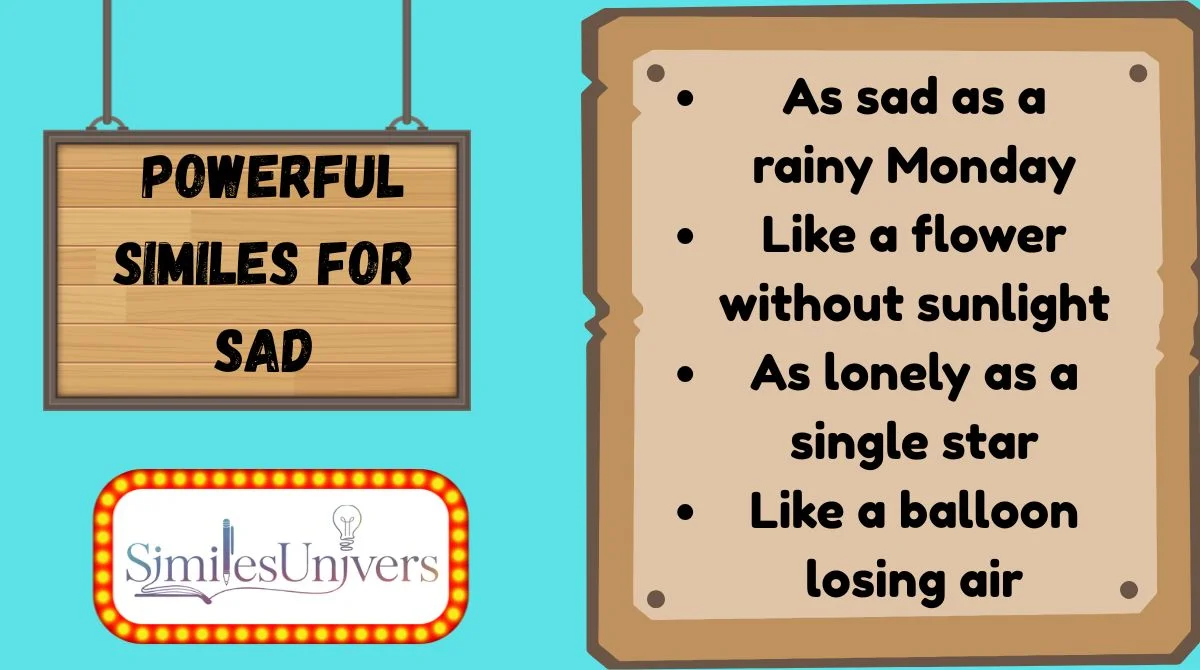
- As sad as a rainy Monday
- Like a flower without sunlight
- As lonely as a single star
- Like a balloon losing air
- As heavy as a stone in the chest
- Like a song played in a minor key
- As empty as an abandoned house
- Like a dog waiting at a closed door
- As gray as a cloudy sky
- Like tears falling in slow motion
Complete List of Similes for “Sad” (Grouped by Meaning)
Funny & Lighthearted
As sad as a cupcake with no frosting
Meaning: Slightly disappointed but not deeply hurt.
Explanation: A cupcake without frosting is still okay, but it feels incomplete.
Example 1: I felt as sad as a cupcake with no frosting when the party got canceled.
Example 2: He looked as sad as a cupcake with no frosting after losing the game.
Tone: Funny
Like a puppy that missed the treat jar
Meaning: Mild, childlike sadness.
Explanation: A puppy looks confused and let down when it does not get what it wants.
Example 1: She stared at her empty plate like a puppy that missed the treat jar.
Example 2: He sighed like a puppy that missed the treat jar.
Tone: Casual
As sad as a deflated birthday balloon
Meaning: Cheerful mood suddenly gone.
Explanation: A flat balloon shows a party is over.
Example 1: The room felt as sad as a deflated birthday balloon after everyone left.
Example 2: He looked as sad as a deflated birthday balloon when she said goodbye.
Tone: Light
Emotional & Deep
As heavy as a stone in the chest
Meaning: Deep emotional pain.
Explanation: Sadness can feel physical, like weight pressing down.
Example 1: Her heart felt as heavy as a stone in her chest.
Example 2: The news sat as heavy as a stone in his chest all day.
Tone: Serious
Like a tree losing its last leaf
Meaning: Loss and loneliness.
Explanation: A tree without leaves feels empty and exposed.
Example 1: She stood there like a tree losing its last leaf.
Example 2: After the move, he felt like a tree losing its last leaf.
Tone: Poetic
As lonely as the moon at dawn
Meaning: Quiet isolation.
Explanation: The moon fades when the sun rises, alone in the sky.
Example 1: He felt as lonely as the moon at dawn.
Example 2: She sat by the window, as lonely as the moon at dawn.
Tone: Poetic
Like a song stuck on the saddest note
Meaning: Emotion that lingers.
Explanation: A long sad note hangs in the air and will not fade.
Example 1: Her voice sounded like a song stuck on the saddest note.
Example 2: The memory felt like a song stuck on the saddest note.
Tone: Serious
Dramatic & Intense
As dark as a sky before a storm
Meaning: Strong emotional tension.
Explanation: The sky before a storm feels heavy and threatening.
Example 1: His mood was as dark as a sky before a storm.
Example 2: The room grew as dark as a sky before a storm after the news.
Tone: Dramatic
Like a mirror shattered on the floor
Meaning: Emotional break or heartbreak.
Explanation: A broken mirror cannot be made whole again.
Example 1: Her trust lay like a mirror shattered on the floor.
Example 2: He felt like a mirror shattered on the floor after the fight.
Tone: Serious
As silent as a graveyard at midnight
Meaning: Deep, eerie sadness.
Explanation: Graveyards at night feel empty and still.
Example 1: The house was as silent as a graveyard at midnight.
Example 2: She felt as silent as a graveyard at midnight inside.
Tone: Dramatic
Slow & Monotonous
Like rain tapping on the same window all day
Meaning: Sadness that does not stop.
Explanation: Constant rain feels dull and endless.
Example 1: His sadness was like rain tapping on the same window all day.
Example 2: The thought returned like rain tapping on the same window.
Tone: Serious
As gray as an empty sidewalk
Meaning: Dull and lifeless mood.
Explanation: An empty sidewalk feels cold and plain.
Example 1: Her voice sounded as gray as an empty sidewalk.
Example 2: The afternoon felt as gray as an empty sidewalk.
Tone: Casual
Like a clock ticking in a quiet room
Meaning: Slow, lonely sadness.
Explanation: A ticking clock reminds you of time passing.
Example 1: He sat there like a clock ticking in a quiet room.
Example 2: Her thoughts moved like a clock ticking in a quiet room.
Tone: Serious
Creative & Unique
As wilted as a sunflower at sunset
Meaning: Energy drained away.
Explanation: Sunflowers droop when the sun fades.
Example 1: She felt as wilted as a sunflower at sunset.
Example 2: After the argument, he looked as wilted as a sunflower at sunset.
Tone: Poetic
Like ink bleeding through thin paper
Meaning: Sadness spreading inside.
Explanation: Ink slowly spreads and stains the page.
Example 1: Grief spread like ink bleeding through thin paper.
Example 2: The silence grew like ink bleeding through thin paper.
Tone: Literary
As hollow as a drum with no sound
Meaning: Empty inside.
Explanation: A drum without sound feels useless and vacant.
Example 1: He felt as hollow as a drum with no sound.
Example 2: Her laugh sounded as hollow as a drum with no sound.
Tone: Serious
Poetic & Literary
Like autumn leaves drifting away
Meaning: Gentle sadness.
Explanation: Leaves falling show change and quiet loss.
Example 1: Her tears fell like autumn leaves drifting away.
Example 2: The year ended like autumn leaves drifting away.
Tone: Poetic
As pale as winter sunlight
Meaning: Faint and fragile sadness.
Explanation: Winter sunlight is weak and cold.
Example 1: Her smile was as pale as winter sunlight.
Example 2: His hope felt as pale as winter sunlight.
Tone: Literary
Like a lighthouse with no ships to guide
Meaning: Feeling useless or forgotten.
Explanation: A lighthouse without ships has no purpose.
Example 1: He stood there like a lighthouse with no ships to guide.
Example 2: She felt like a lighthouse with no ships to guide.
Tone: Poetic
Fresh and Unique Similes You Won’t Hear Every Day
- As sad as a bookmark left in a closed book
Imagery: A story paused and forgotten. - Like a snow globe after the shaking stops
Imagery: Everything settles into quiet stillness. - As empty as a playground at dusk
Imagery: Joy has left, and silence remains. - Like a candle smoking after it goes out
Imagery: The light is gone, but the hurt lingers. - As lost as a shadow without light
Imagery: Without hope, even a shadow disappears.
These are less common and feel fresh. They avoid clichés while still being clear.
How to Use These Similes in Writing
In Essays
- Use similes to describe emotions in narrative essays.
- Add one strong simile instead of three weak sentences.
- Place similes after key moments for impact.
Example:
Instead of “I was very sad,” write:
I felt as heavy as a stone in my chest when I read the letter.
In Stories
- Match the simile to the scene mood.
- Use poetic ones in reflective scenes.
- Use lighthearted ones in children’s stories.
Strong writing shows emotion instead of telling it.
How to Create Your Own Similes (Mini Writing Guide)
Step-by-Step Method
- Pick the emotion (sad).
- Ask: What does it feel like? Heavy? Empty? Slow?
- Think of objects that match that feeling.
- Connect them using “like” or “as.”
- Read it aloud to test the sound.
5 Practical Tips
- Use everyday objects for clarity.
- Avoid clichés like “crying like a baby.”
- Keep it short and sharp.
- Match tone to context.
- Do not stack too many in one paragraph.
3 Transformation Examples
Plain: She felt sad.
Better: She felt as lonely as the moon at dawn.
Plain: He was very upset.
Better: He stood there like a mirror shattered on the floor.
Plain: The room felt depressing.
Better: The room was as silent as a graveyard at midnight.
Common Mistakes When Using Similes
Overuse
Too many similes confuse readers. Use one strong image at a time.
Clichés
“As sad as a clown” feels tired. Fresh images feel stronger.
Tone Mismatch
Do not use funny similes in serious scenes.
Example: A breakup scene should not compare sadness to a cupcake.
Practice Exercise
Fill in the blanks with suitable similes for sad.
- She felt as heavy as _______.
- His smile was as pale as _______.
- The house was as silent as _______.
- She stood there like _______.
- The afternoon felt as gray as _______.
- His heart felt like _______.
- She looked as wilted as _______.
- The memory stayed like _______.
- He felt as lonely as _______.
- Her voice sounded like _______.
- The playground was as empty as _______.
- His hope faded like _______.
Answers
- a stone in her chest
- winter sunlight
- a graveyard at midnight
- a lighthouse with no ships to guide
- an empty sidewalk
- a mirror shattered on the floor
- a sunflower at sunset
- rain tapping on the same window
- the moon at dawn
- a song stuck on the saddest note
- a playground at dusk
- autumn leaves drifting away
FAQs
What is a good simile for sad?
A good simile for sad is “as heavy as a stone in the chest.” It shows emotional pain clearly.
What is a creative simile for sadness?
“Like ink bleeding through thin paper” is creative and vivid.
Can similes improve essay writing?
Yes. Similes make writing more descriptive and emotional.
How many similes should I use in a paragraph?
Usually one strong simile is enough.
Are similes good for kids’ writing?
Yes. Simple similes help young writers express feelings clearly.
What is the difference between a simile and a metaphor?
A simile uses “like” or “as.” A metaphor compares directly without those words.
Final Thoughts
Sadness is not simple. It can be soft, sharp, slow, or sudden. The right simile helps readers feel that emotion instead of just reading about it.
Use classic ones when you need clarity. Use fresh ones when you want originality. Most important, match the image to the mood.
Strong writing does not say “she was sad.”
It shows sadness like rain tapping on the same window all day.
And that is what makes readers feel.

Daniel Harper
I am simplifies complex literary concepts into clear, practical lessons for students and learners worldwide.
Through SimilesUnivers, he aims to make mastering similes engaging, structured, and academically enriching.