Shock is a fast, sharp emotion. It can freeze you. It can shake you. It can leave your mouth open and your mind blank.
But saying “I was shocked” feels flat. It doesn’t show the feeling. It doesn’t let readers feel it with you.
That’s where similes help.
A strong simile paints a picture. It turns a simple reaction into a vivid moment. Instead of telling readers you were shocked, you show them how it felt—like lightning striking, like ice water pouring down your back, like the ground dropping away.
In this guide, you’ll find over 25 powerful similes for shocked—funny ones, dramatic ones, deep ones, and fresh creative ones.
You’ll also learn how to use them well and how to create your own.
Let’s bring your writing to life.
What Is a Simile? (Quick Clear Definition)
A simile is a comparison using the words “like” or “as.”
It shows how something feels by comparing it to something else.
Example:
She was as quiet as a mouse.
Quick List – Most Popular Similes for “Shocked”
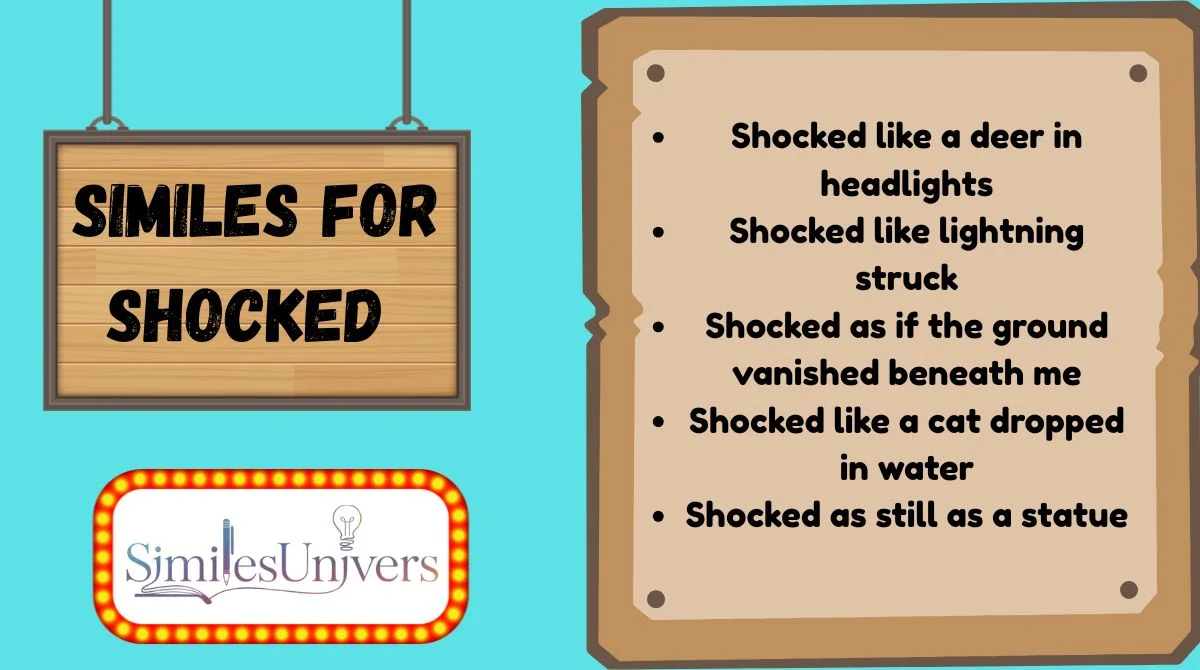
- Shocked like a deer in headlights
- Shocked like lightning struck
- Shocked as if the ground vanished beneath me
- Shocked like a cat dropped in water
- Shocked as still as a statue
- Shocked like ice water down my back
- Shocked as wide-eyed as a child
- Shocked like a balloon popping
- Shocked as frozen as winter glass
- Shocked like a door slammed in the dark
Complete List of Similes for “Shocked” (Grouped by Meaning)
Funny & Lighthearted
Shocked like a deer in headlights
Meaning: Frozen in sudden surprise.
This simile shows someone caught off guard and unable to move.
Example 1: When my name was called, I stood there shocked like a deer in headlights.
Example 2: He looked shocked like a deer in headlights when the teacher asked him to explain.
Tone: Casual
Shocked like a cat dropped in water
Meaning: Startled and confused.
Cats hate water, so this shows sudden panic and surprise.
Example 1: She was shocked like a cat dropped in water when the balloon burst.
Example 2: He jumped back, shocked like a cat dropped in water.
Tone: Funny
Shocked like popcorn in a hot pan
Meaning: Jumping from surprise.
Popcorn pops fast and wild, just like a sudden reaction.
Example 1: I jumped shocked like popcorn in a hot pan.
Example 2: The loud bang made her move shocked like popcorn.
Tone: Funny
Shocked like a balloon that just popped
Meaning: Sudden and sharp reaction.
A popping balloon makes everyone jump.
Example 1: The crash left him shocked like a balloon that just popped.
Example 2: She blinked, shocked like a balloon bursting near her ear.
Tone: Casual
Emotional & Deep
Shocked like the ground vanished beneath my feet
Meaning: Feeling unstable and shaken.
It suggests the world no longer feels steady.
Example 1: When I heard the news, I felt shocked like the ground vanished beneath my feet.
Example 2: He stood there, shocked like the earth had opened up.
Tone: Serious
Shocked like ice water poured down my spine
Meaning: Sudden chill of fear or disbelief.
It shows a physical reaction to emotional shock.
Example 1: Her words hit me shocked like ice water down my spine.
Example 2: I felt shocked like freezing water had soaked me.
Tone: Serious
Shocked as silent as a graveyard at midnight
Meaning: Deep, heavy stillness.
The silence shows how shock can stop sound.
Example 1: The room went shocked and silent as a graveyard at midnight.
Example 2: He stood shocked, as silent as a graveyard.
Tone: Poetic
Shocked like a heart missing a beat
Meaning: Sudden emotional jolt.
It connects shock to a physical feeling in the chest.
Example 1: I felt shocked like my heart skipped a beat.
Example 2: Her confession left him shocked like a heartbeat gone wrong.
Tone: Serious
Dramatic & Intense
Shocked like lightning striking twice
Meaning: Powerful and unexpected.
Lightning is sudden and bright—shock can feel the same.
Example 1: The verdict hit him shocked like lightning striking twice.
Example 2: She gasped, shocked like lightning had touched her.
Tone: Dramatic
Shocked like glass shattering
Meaning: Sudden break in reality.
Glass breaking is sharp and loud—just like shocking news.
Example 1: His world felt shocked like glass shattering.
Example 2: The truth broke over her shocked like shattered glass.
Tone: Dramatic
Shocked as frozen as winter glass
Meaning: Completely still and stiff.
Cold glass does not move—neither does someone in shock.
Example 1: He stood shocked, as frozen as winter glass.
Example 2: She remained shocked and still as icy glass.
Tone: Serious
Shocked like a door slammed in the dark
Meaning: Sudden fright.
A door slamming without warning creates fear.
Example 1: The shout hit me shocked like a door slammed in the dark.
Example 2: She spun around, shocked like a bang in the night.
Tone: Dramatic
Creative & Unique
Shocked like a candle blown out mid-wish
Meaning: Hope cut off suddenly.
The image shows joy stopped in one breath.
Example 1: I felt shocked like a candle blown out mid-wish.
Example 2: His smile faded, shocked like a candle gone dark.
Tone: Poetic
Shocked like a clock that suddenly stopped ticking
Meaning: Time feels frozen.
Shock can make the world feel paused.
Example 1: The room felt shocked like a clock that stopped ticking.
Example 2: She stared, shocked like time had quit.
Tone: Poetic
Shocked like stepping into thin air
Meaning: Unexpected drop or surprise.
It suggests sudden loss of balance.
Example 1: I felt shocked like I stepped into thin air.
Example 2: He blinked, shocked like the floor .
Tone: Serious
Shocked like ink spilled across clean paper
Meaning: Sudden disruption.
The clean page is ruined in a second.
Example 1: The news spread shocked like ink across paper.
Example 2: Her thoughts scattered, shocked like spilled ink.
Tone: Poetic
Poetic & Literary
Shocked as pale as moonlight
Meaning: Face drained of color.
Moonlight is soft and pale, like someone stunned.
Example 1: She stood shocked, as pale as moonlight.
Example 2: He turned shocked and pale as the moon.
Tone: Poetic
Shocked like thunder rolling over calm skies
Meaning: Sudden break in peace.
Thunder ruins quiet calm.
Example 1: The news came shocked like thunder over calm skies.
Example 2: His words struck shocked like thunder.
Tone: Dramatic
Shocked like a mirror cracking down the middle
Meaning: Reality split apart.
A cracked mirror shows a broken view.
Example 1: I felt shocked like a mirror cracking down the middle.
Example 2: Her trust broke, shocked like shattered glass.
Tone: Serious
Fresh and Unique Similes You Won’t Hear Every Day
- Shocked like a book dropping from numb hands
Imagery: You lose control without meaning to. - Shocked like a bird flying into clear glass
Imagery: You didn’t see it coming. - Shocked like sunlight flashing off a blade
Imagery: Sudden brightness that hurts the eyes. - Shocked like a secret shouted in church
Imagery: A quiet place broken by surprise. - Shocked like footprints ending at a cliff
Imagery: You expect more, but the path stops.
How to Use These Similes in Writing
In Essays
Use similes to explain emotional reactions in personal essays. Keep them simple. Use only one strong simile per key moment.
Example:
When I opened the results, I felt shocked like lightning striking twice.
In Stories
Place similes in action scenes, arguments, or turning points. Let them show emotion instead of telling it.
Example:
She read the letter, shocked like a clock that suddenly stopped ticking.
How to Create Your Own Similes (Mini Writing Guide)
Step-by-Step Method
- Think about the emotion (shock).
- Ask: What does it feel like in the body? (cold, frozen, jumpy).
- Think of objects that act that way.
- Connect them using “like” or “as.”
- Test it in a sentence.
5 Practical Tips
- Keep it short.
- Avoid tired clichés.
- Use strong images.
- Match tone to mood.
- Don’t overuse them.
3 Transformation Examples
Plain: I was shocked.
Better: I was shocked like ice water down my back.
Plain: He felt surprised.
Better: He felt shocked like a door slammed in the dark.
Plain: She couldn’t move.
Better: She stood shocked as frozen as winter glass.
Common Mistakes When Using Similes
Overuse
Too many similes make writing messy. Use them for key moments.
Clichés
“Deer in headlights” is common. Try fresh images too.
Tone Mismatch
Don’t use funny similes in serious scenes.
Practice Exercise
Fill in the blanks:
- I stood shocked like _______.
- She felt shocked as _______.
- The news hit him like _______.
- He froze like _______.
- Her face turned pale as _______.
- I jumped like _______.
- The room went silent as _______.
- My heart felt like _______.
- He blinked like _______.
- She stepped back like _______.
- The truth struck like _______.
- Time felt like _______.
Answers (Sample)
- lightning striking twice
- winter glass
- thunder rolling over calm skies
- a statue
- moonlight
- popcorn in a hot pan
- a graveyard at midnight
- a heart missing a beat
- a bird hitting glass
- stepping into thin air
- glass shattering
- a clock that stopped ticking
FAQs
What is a good simile for shocked?
“Shocked like lightning striking twice” is strong and vivid.
What is a funny simile for shocked?
“Shocked like a cat dropped in water” adds humor.
Can I use similes in formal writing?
Yes, but use them sparingly and keep them clear.
Are similes and metaphors the same?
No. Similes use “like” or “as.” Metaphors do not.
How many similes should I use in one paragraph?
Usually one is enough.
Why do similes improve writing?
They create images that readers can see and feel.
Final Thoughts
Shock is sharp. It stops time. It shakes the body and mind. The right simile can make that moment feel real on the page.
Instead of telling readers someone was shocked, show it. Make them see the lightning. Make them hear the glass shatter. Make them feel the cold rush down the spine.
That’s the power of a strong simile.
Use them wisely. Use them clearly. And let your writing spark like thunder in a quiet sky.

Daniel Harper
I am simplifies complex literary concepts into clear, practical lessons for students and learners worldwide.
Through SimilesUnivers, he aims to make mastering similes engaging, structured, and academically enriching.