Tears are small, but they carry big feelings. Joy. Pain. Fear. Relief. Love. A single tear can say more than a full speech.
That’s why strong writers don’t just say “she cried.” They paint a picture.
Similes help you do that. They turn plain emotion into something readers can see, feel, and remember.
A well-placed simile makes your writing softer, sharper, deeper—or even funnier.
In this complete guide, you’ll find over 24 high-quality similes for tears.
Some are classic. Many are fresh and creative. Each one comes with meaning, examples, and tone guidance so you can use them with confidence.
Let’s make your writing unforgettable.
What Is a Simile? (Quick Clear Definition)
A simile compares two different things using “like” or “as.”
It helps readers understand a feeling or image by connecting it to something familiar.
Example:
Her smile was as bright as the sun.
Quick List – Most Popular Similes for “Tears”
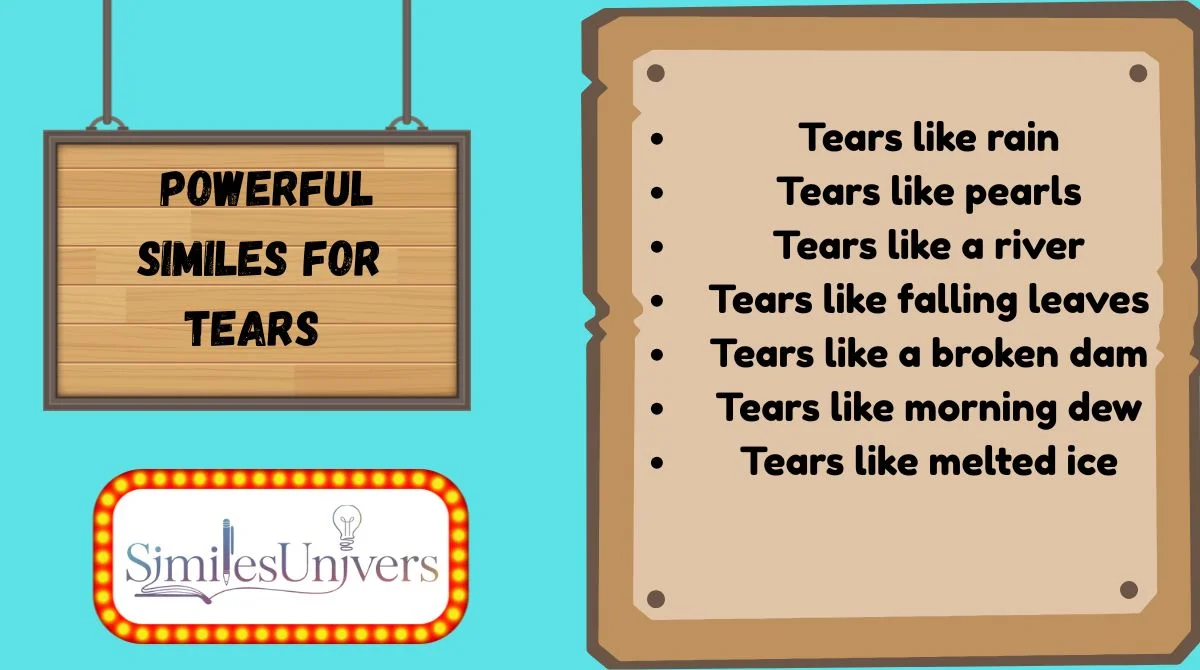
- Tears like rain
- Tears like pearls
- Tears like a river
- Tears like falling leaves
- Tears like a broken dam
- Tears like morning dew
- Tears like melted ice
- Tears like silver beads
- Tears like a summer storm
- Tears like dripping candles
Complete List of Similes for “Tears” (Grouped by Meaning)
Emotional & Deep
Tears like rain on a lonely window
Meaning: Quiet, steady sadness.
This shows soft but constant crying.
Her tears fell like rain on a lonely window.
He stared outside, tears sliding like rain on glass.
Tone: Serious
Tears like a river that won’t stop flowing
Meaning: Strong, unstoppable emotion.
Used when feelings are overwhelming.
Her tears ran like a river that wouldn’t stop.
After the news, his tears flowed like a wild river.
Tone: Serious
Tears like pearls slipping from a broken necklace
Meaning: Precious but scattered emotion.
It shows beauty mixed with sadness.
Tears fell like pearls from a broken necklace.
Each tear slipped like a lost pearl.
Tone: Poetic
Tears like morning dew on fragile petals
Meaning: Soft, delicate sadness.
Best for gentle scenes.
Her tears rested like morning dew on petals.
Tiny tears shimmered like dew in early light.
Tone: Poetic
Tears like melted ice from a frozen heart
Meaning: Emotional release after holding back.
Great for healing scenes.
His tears fell like melted ice from a frozen heart.
At last, the ice broke, and tears melted free.
Tone: Serious
Dramatic & Intense
Tears like a broken dam
Meaning: Sudden emotional explosion.
Used when crying begins all at once.
Her tears burst like a broken dam.
He tried to stay strong, but tears broke free like a dam.
Tone: Intense
Tears like a summer storm crashing down
Meaning: Loud, emotional crying.
Shows power and chaos.
Tears came like a summer storm.
She sobbed, tears falling like heavy rain.
Tone: Dramatic
Tears like lava from a volcano
Meaning: Pain mixed with anger.
Hot, intense emotion.
His tears burned like lava.
She cried, tears flowing like fire from a volcano.
Tone: Intense
Tears like arrows piercing the silence
Meaning: Painful and sharp sadness.
Used for tense scenes.
Each tear fell like an arrow in the quiet room.
Her tears cut through the silence like sharp arrows.
Tone: Serious
Tears like thunder without sound
Meaning: Powerful but silent crying.
Deep inner pain.
He cried, tears falling like silent thunder.
Her face shook, tears loud even in silence.
Tone: Poetic
Funny & Lighthearted
Tears like a leaky faucet
Meaning: Annoying or slow crying.
Often playful.
He sniffed, tears dripping like a leaky faucet.
She cried over the movie, tears leaking slowly.
Tone: Funny
Tears like spilled soup
Meaning: Messy and dramatic crying.
Best for humor.
He cried like someone spilled his soup.
Her tears ran everywhere like spilled soup.
Tone: Casual
Tears like a cartoon rain cloud
Meaning: Over-the-top crying.
Playful and exaggerated.
She stood there, tears falling like a cartoon rain cloud.
He cried as if a tiny storm followed him.
Tone: Funny
Tears like squeezed ketchup from a bottle
Meaning: Forced or sudden crying.
Comic effect.
Tears popped out like ketchup from a bottle.
He pushed out tears like ketchup on fries.
Tone: Funny
Poetic & Literary
Tears like silver threads in moonlight
Meaning: Beautiful, glowing sadness.
Perfect for lyrical writing.
Tears shimmered like silver threads.
Moonlight caught her tears like fine silver lines.
Tone: Poetic
Tears like falling stars in the night
Meaning: Rare, powerful emotion.
Suggests beauty in sadness.
Her tears fell like shooting stars.
Each tear burned bright like a falling star.
Tone: Poetic
Tears like ink spreading in water
Meaning: Emotion slowly taking over.
Visual and artistic.
Tears spread like ink in clear water.
Sadness bloomed like dark ink in her eyes.
Tone: Literary
Tears like frost forming on glass
Meaning: Quiet and cold sadness.
Good for lonely scenes.
Tears formed like frost on glass.
Cold tears gathered like winter frost.
Tone: Serious
Creative & Unique
Tears like coins dropped in a wishing well
Meaning: Hope mixed with sadness.
Shows emotional prayer or wish.
Her tears fell like coins in a wishing well.
He cried softly, each tear like a wish.
Tone: Poetic
Tears like sand slipping through fingers
Meaning: Grief you can’t hold onto.
Loss and helplessness.
Tears slipped like sand through fingers.
His sorrow fell away like loose sand.
Tone: Serious
Tears like seeds planted in silent soil
Meaning: Pain that leads to growth.
Good for transformation scenes.
Her tears fell like seeds in soil.
Each tear planted something new inside her.
Tone: Hopeful
Tears like glass beads rolling across a table
Meaning: Visible and delicate sadness.
Clear imagery.
Tears rolled like tiny glass beads.
He watched them scatter like beads on wood.
Tone: Casual
Tears like snow melting at sunrise
Meaning: Sadness fading away.
Perfect for healing.
Her tears melted like snow in the sun.
Morning came, and her tears faded like winter snow.
Tone: Hopeful
Fresh and Unique Similes You Won’t Hear Every Day
Here are five original similes with strong imagery:
- Tears like unread letters sliding from an envelope
Suggests emotions never spoken. - Tears like cracked mirrors reflecting broken memories
Shows pain tied to the past. - Tears like tiny ships lost at sea
Each tear carries a story drifting away. - Tears like piano notes falling in an empty hall
Quiet but echoing sadness. - Tears like candle wax sealing a goodbye
Emotion marking the end of something.
These work best in stories and poems where imagery matters.
How to Use These Similes in Writing
In Essays
Use similes to:
- Add emotional depth to narratives
- Make descriptive writing vivid
- Strengthen personal reflection essays
Example:
My disappointment fell like a broken dam after the results were announced.
In Stories
- Show feelings without saying “she was sad.”
- Create mood.
- Match similes to the scene’s tone.
How to Create Your Own Similes (Mini Writing Guide)
Step-by-Step Method
- Identify the emotion (sadness, relief, anger).
- Think of something visual with the same feeling.
- Connect them using “like” or “as.”
- Keep it simple.
- Read it aloud.
5 Practical Tips
- Use nature for strong imagery.
- Avoid clichés unless writing for children.
- Match tone carefully.
- Don’t overuse more than one per paragraph.
- Be specific, not vague.
3 Transformation Examples
Plain: She cried.
Better: She cried like a broken dam.
Plain: He was quietly sad.
Better: His tears fell like frost on glass.
Plain: She felt relief.
Better: Her tears melted like snow at sunrise.
Common Mistakes When Using Similes
Overuse
Too many similes make writing heavy. Use them with care.
Clichés
“Tears like rain” is common. Try something fresher.
Tone Mismatch
Don’t use funny similes in serious funeral scenes.
Practice Exercise
Fill in the blanks:
- Her tears fell like _______.
- His sadness spread like _______.
- Tears rolled like _______.
- She cried like _______.
- His tears burned like _______.
- Tears shimmered like _______.
- They fell like _______.
- Her sorrow flowed like _______.
- Tears slipped like _______.
- They formed like _______.
- His tears echoed like _______.
- They melted like _______.
Answers
- rain on glass
- ink in water
- glass beads
- a broken dam
- lava
- silver threads
- falling stars
- a river
- sand through fingers
- frost on glass
- piano notes
- snow at sunrise
FAQs
What are good similes for tears?
Good similes include tears like a broken dam, tears like pearls, and tears like ink in water.
Are similes better than metaphors?
Similes are clearer because they use “like” or “as.” They are easier for young readers.
Can I use similes in academic writing?
Yes, but only in narrative or reflective essays—not formal research papers.
How many similes should I use in one paragraph?
One strong simile per paragraph is usually enough.
Are funny similes appropriate for serious scenes?
No. Match the tone carefully.
How do I avoid cliché similes?
Create fresh comparisons based on unique imagery.
Final Thoughts
Tears are small drops, but they hold deep meaning. When you use the right simile, you turn simple crying into a powerful image.
Strong similes:
- Show emotion
- Create mood
- Make readers feel
Now you have over 24 similes for tears—funny, poetic, intense, and creative. Use them wisely. And when you write, don’t just describe tears.
Make readers see them.

Daniel Harper
I am simplifies complex literary concepts into clear, practical lessons for students and learners worldwide.
Through SimilesUnivers, he aims to make mastering similes engaging, structured, and academically enriching.