We all know the feeling. Your shirt is too tight. The room is too quiet.
Someone asks a question you don’t want to answer. Suddenly, everything feels… uncomfortable.
But saying “It was uncomfortable” is flat. It doesn’t paint a picture.
That’s where similes come in.
Similes make writing vivid. They turn simple feelings into images readers can see and feel.
Instead of telling your reader something is awkward or tense, you show it.
In this guide, you’ll discover 24+ powerful similes for uncomfortable — funny ones, deep ones, dramatic ones, and fresh creative ones you won’t hear every day.
You’ll also learn how to use them in essays, stories, and everyday writing.
Let’s make your words impossible to ignore.
What Is a Simile? (Quick Clear Definition)
A simile compares two different things using “like” or “as.”
It helps readers understand a feeling or idea by connecting it to something familiar.
Example:
He was as nervous as a cat in a room full of rocking chairs.
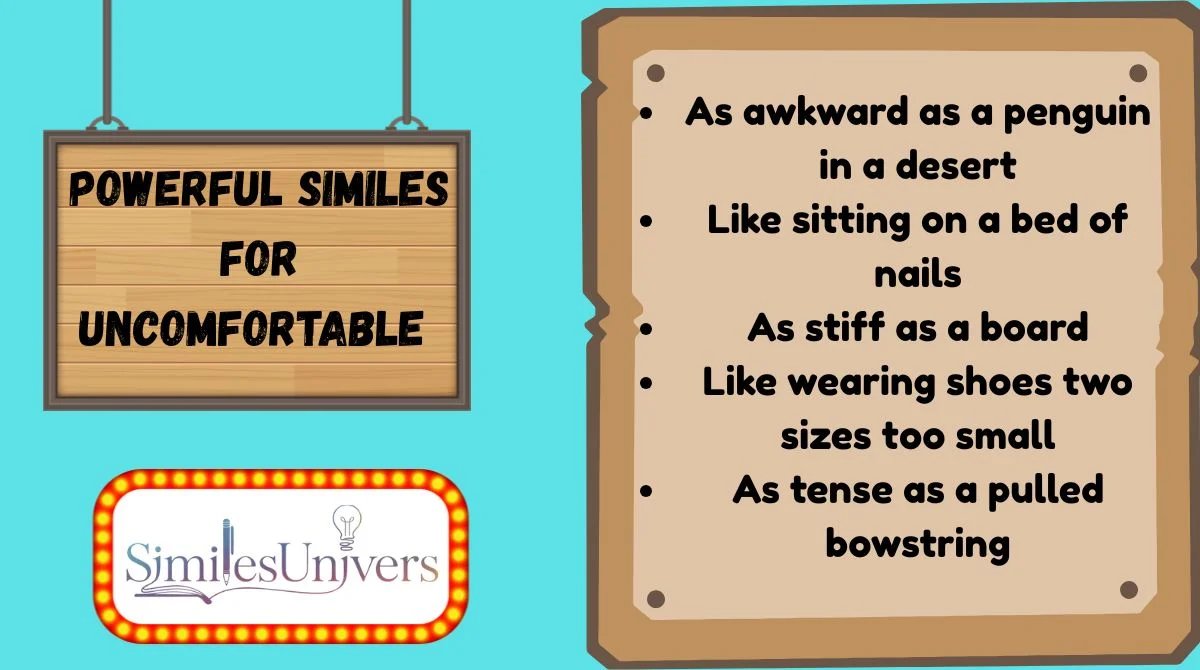
Quick List – Most Popular Similes for “Uncomfortable”
- As awkward as a penguin in a desert
- Like sitting on a bed of nails
- As stiff as a board
- Like wearing shoes two sizes too small
- As tense as a pulled bowstring
- Like a fish out of water
- As uneasy as a deer in headlights
- Like sitting in a silent elevator
- As tight as a collar in summer
- Like being watched by invisible eyes
Complete List of Similes for “Uncomfortable” (Grouped by Meaning)
Funny & Lighthearted
As awkward as a giraffe in a phone booth
Meaning: Extremely out of place.
Explanation: A giraffe simply doesn’t fit inside a tiny booth.
Examples:
- I felt as awkward as a giraffe in a phone booth at the fancy dinner.
- He stood there, as awkward as a giraffe in a phone booth, not knowing where to put his hands.
Tone: Funny
Like wearing shoes two sizes too small
Meaning: Physically or emotionally uneasy.
Explanation: Tight shoes cause constant discomfort.
Examples:
- The tight schedule felt like wearing shoes two sizes too small.
- That chair was like wearing shoes two sizes too small.
Tone: Casual
As stiff as a robot low on battery
Meaning: Moving in an awkward, unnatural way.
Explanation: A low-battery robot moves slowly and stiffly.
Examples:
- He danced as stiff as a robot low on battery.
- I felt as stiff as a robot low on battery during the interview.
Tone: Funny
Like a cat in a bathtub
Meaning: Very uneasy and tense.
Explanation: Cats hate baths and try to escape.
Examples:
- She looked like a cat in a bathtub during the speech.
- I felt like a cat in a bathtub at my first job meeting.
Tone: Funny
Emotional & Deep
As uneasy as a deer in headlights
Meaning: Frozen with fear or stress.
Explanation: A deer caught in headlights freezes in shock.
Examples:
- He stood there as uneasy as a deer in headlights.
- I felt as uneasy as a deer in headlights when my name was called.
Tone: Serious
Like sitting on a secret that might explode
Meaning: Holding tension inside.
Explanation: Secrets create emotional pressure.
Examples:
- She felt like sitting on a secret that might explode.
- I was like sitting on a secret that might explode during dinner.
Tone: Serious
As tight as a chest before bad news
Meaning: Heavy emotional discomfort.
Explanation: Bad news makes the body tense.
Examples:
- The silence felt as tight as a chest before bad news.
- My heart was as tight as a chest before bad news.
Tone: Serious
Like walking on thin ice
Meaning: In a risky, tense situation.
Explanation: Thin ice can crack anytime.
Examples:
- Talking to him felt like walking on thin ice.
- The meeting was like walking on thin ice.
Tone: Serious
Dramatic & Intense
As tense as a pulled bowstring
Meaning: Ready to snap.
Explanation: A stretched bowstring holds pressure.
Examples:
- The room was as tense as a pulled bowstring.
- He stood as tense as a pulled bowstring before the race.
Tone: Dramatic
Like sitting on a bed of nails
Meaning: Extremely uncomfortable.
Explanation: Nails are sharp and painful.
Examples:
- That chair felt like sitting on a bed of nails.
- Waiting there was like sitting on a bed of nails.
Tone: Intense
As suffocating as a room without windows
Meaning: Overwhelming discomfort.
Explanation: A closed room feels airless.
Examples:
- The silence was as suffocating as a room without windows.
- I felt as suffocating as a room without windows.
Tone: Serious
Like being trapped in a shrinking box
Meaning: Feeling pressured and stuck.
Explanation: A shrinking space creates panic.
Examples:
- The argument felt like being trapped in a shrinking box.
- I was like being trapped in a shrinking box during the exam.
Tone: Dramatic
Slow & Monotonous
As dull as a ticking clock in a quiet room
Meaning: Uncomfortable silence.
Explanation: The ticking grows louder and awkward.
Examples:
- The pause was as dull as a ticking clock in a quiet room.
- It felt as dull as a ticking clock in a quiet room.
Tone: Casual
Like sitting in a silent elevator
Meaning: Awkward quiet with others.
Explanation: Elevators can feel painfully silent.
Examples:
- The break room felt like sitting in a silent elevator.
- I stood there like sitting in a silent elevator.
Tone: Casual
As dry as a joke no one laughs at
Meaning: Social discomfort.
Explanation: A failed joke creates tension.
Examples:
- The mood was as dry as a joke no one laughs at.
- I felt as dry as a joke no one laughs at.
Tone: Funny
Creative & Unique
As out of place as snow in summer
Meaning: Clearly not fitting in.
Explanation: Snow doesn’t belong in heat.
Examples:
- I felt as out of place as snow in summer.
- He looked as out of place as snow in summer.
Tone: Casual
Like wearing someone else’s skin
Meaning: Deep emotional discomfort.
Explanation: It feels unnatural and wrong.
Examples:
- The role felt like wearing someone else’s skin.
- I walked in like wearing someone else’s skin.
Tone: Poetic
As shaky as a chair with one short leg
Meaning: Unstable and uneasy.
Explanation: The chair wobbles constantly.
Examples:
- My voice was as shaky as a chair with one short leg.
- I felt as shaky as a chair with one short leg.
Tone: Casual
Like standing under a flickering light
Meaning: Uneasy and unsettled.
Explanation: Flickering lights create tension.
Examples:
- The hallway felt like standing under a flickering light.
- I waited like standing under a flickering light.
Tone: Poetic
Poetic & Literary
As fragile as glass in a storm
Meaning: Emotionally vulnerable.
Explanation: Storms easily shatter glass.
Examples:
- She felt as fragile as glass in a storm.
- His smile was as fragile as glass in a storm.
Tone: Poetic
Like a shadow that doesn’t belong
Meaning: Feeling unwanted.
Explanation: A strange shadow feels wrong.
Examples:
- I stood there like a shadow that doesn’t belong.
- He felt like a shadow that doesn’t belong.
Tone: Poetic
As restless as wind in a closed jar
Meaning: Trapped and uneasy.
Explanation: Wind cannot move freely inside a jar.
Examples:
- She felt as restless as wind in a closed jar.
- I was as restless as wind in a closed jar.
Tone: Poetic
Fresh and Unique Similes You Won’t Hear Every Day
- As misplaced as a comma in the wrong sentence
Imagery: Small, but changes everything. - Like a sweater knitted from static electricity
Imagery: It clings and shocks. - As uneasy as a password you almost remember
Imagery: Close, but frustrating. - Like a smile taped onto a tired face
Imagery: Forced and unnatural. - As uncomfortable as a question with no safe answer
Imagery: Emotional pressure.
How to Use These Similes in Writing
In Essays
Use similes to describe emotions in narratives. Instead of writing “The interview was uncomfortable,” say:
The room felt as tense as a pulled bowstring.
In Stories
Similes help readers feel what characters feel. Use them in dialogue, action, and description.
How to Create Your Own Similes (Mini Writing Guide)
Step-by-Step Method
- Identify the feeling.
- Think of a physical experience.
- Connect them using “like” or “as.”
- Make it visual.
- Keep it short.
5 Practical Tips
- Use simple images.
- Avoid overused clichés.
- Match tone to mood.
- Keep comparisons clear.
- Test it out loud.
3 Transformations
Boring: I felt nervous.
Better: I felt as nervous as a deer in headlights.
Boring: The silence was awkward.
Better: The silence was like sitting in a silent elevator.
Boring: He felt out of place.
Better: He felt as out of place as snow in summer.
Common Mistakes When Using Similes
Overuse
Too many similes weaken writing.
Clichés
Avoid tired phrases readers have seen a thousand times.
Tone Mismatch
A funny simile in a tragic scene feels wrong.
Practice Exercise
Fill in the blanks:
- I felt as awkward as ________.
- The silence was like ________.
- She stood as tense as ________.
- It felt like ________ during the test.
- He looked as uneasy as ________.
- The room was as suffocating as ________.
- I felt like ________ at the party.
- The mood was as dry as ________.
- She was as fragile as ________.
- It felt like ________ when he asked that question.
- I stood there like ________.
- My voice was as shaky as ________.
Answers
(Answers may vary. Suggested responses:)
- a giraffe in a phone booth
- sitting in a silent elevator
- a pulled bowstring
- sitting on a bed of nails
- a deer in headlights
- a room without windows
- snow in summer
- a joke no one laughs at
- glass in a storm
- walking on thin ice
- a shadow that doesn’t belong
- a chair with one short leg
FAQs
What is a good simile for feeling uncomfortable?
“As tense as a pulled bowstring” clearly shows pressure and stress.
What is a funny simile for awkward?
“As awkward as a giraffe in a phone booth” adds humor.
Are similes good for essays?
Yes. They make descriptions vivid and engaging.
How many similes should I use in writing?
Use them sparingly. One strong simile is better than five weak ones.
What is the difference between a simile and a metaphor?
A simile uses “like” or “as.” A metaphor does not.
Can I create my own similes?
Yes. Fresh similes make your writing unique.
Final Thoughts
Uncomfortable moments are part of life. But in writing, they don’t have to feel flat or boring.
With the right simile, you can turn tension into an image. You can turn awkward silence into something readers feel in their bones.
Use these 24+ similes wisely. Create your own. Make your writing breathe.
Because strong writing doesn’t just tell.
It shows.

Daniel Harper
I am simplifies complex literary concepts into clear, practical lessons for students and learners worldwide.
Through SimilesUnivers, he aims to make mastering similes engaging, structured, and academically enriching.