Black is more than a color—it’s emotion, mystery, and depth. From the inky midnight sky to the sleek elegance of a classic suit, black has inspired writers for centuries.
Using similes to describe black transforms ordinary sentences into vivid imagery, making your writing more memorable and impactful.
Whether you’re crafting a story, poem, or essay, the right simile can instantly capture attention and convey mood.
In this guide, you’ll discover over 34 high-quality similes for black, including popular choices, fresh creative ideas, and ways to craft your own.
By the end, you’ll not only enrich your vocabulary but also gain practical strategies to make your writing more vivid and captivating. Let’s turn the simple concept of black into a canvas of imagination.
What Is a Simile? (Quick Clear Definition)
A simile is a figure of speech that compares two different things using “like” or “as”. It helps readers visualize abstract ideas.
Example:
“Her hair was black like the raven’s wing.”
Here, black hair is compared to a raven’s wing to create a clear image.
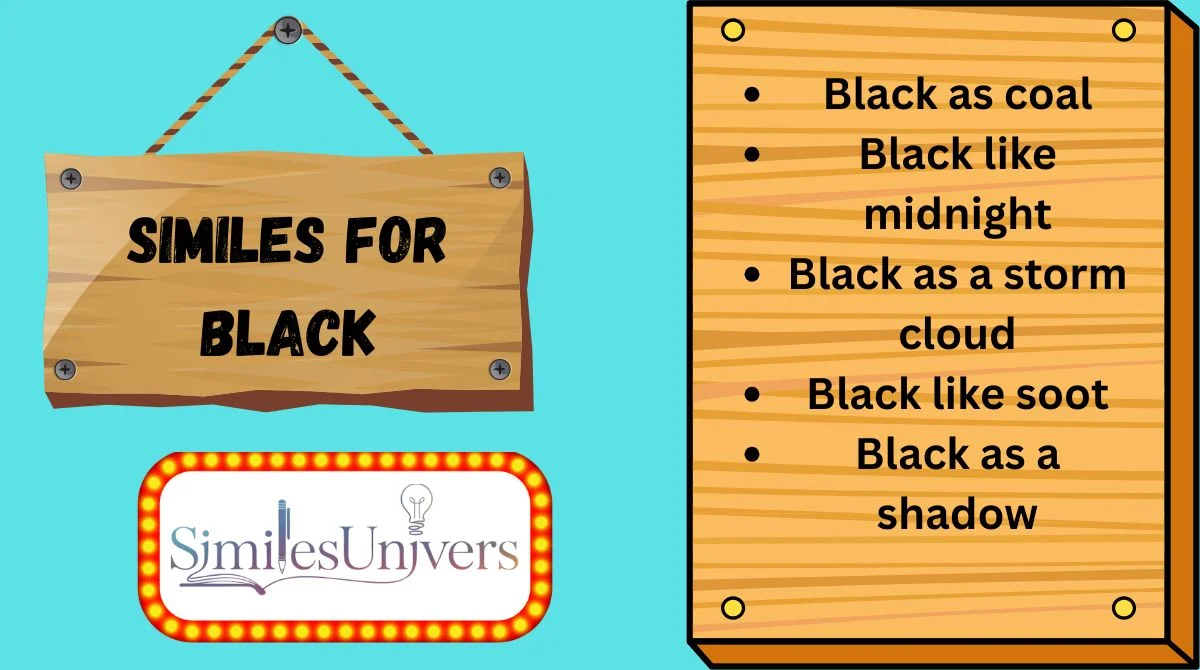
Quick List – Most Popular Similes for Black
- Black as coal
- Black like midnight
- Black as a storm cloud
- Black like soot
- Black as a shadow
- Black like obsidian
- Black as a crow
- Black like a panther
- Black as ink
- Black like licorice
Complete List of Similes for Black (Grouped by Meaning)
Funny & Lighthearted
Black as a burned marshmallow
Meaning: Dark with a humorous twist
Explanation: Suggests extreme darkness in a playful way
Examples:
- “His socks were black as a burned marshmallow after laundry mishaps.”
- “The cat’s fur was black as a burned marshmallow, almost glowing in the kitchen light.”
Tone: Funny
Black like a mischievous raccoon
Meaning: Dark and playful
Explanation: Compares blackness to the cunning, dark markings of a raccoon
Examples:
- “Her hoodie was black like a mischievous raccoon sneaking through the night.”
- “The spilled ink looked black like a mischievous raccoon had tiptoed over the paper.”
Tone: Funny
Black as overcooked toast
Meaning: Slightly exaggerated humor
Explanation: Emphasizes darkness with a kitchen analogy
Examples:
- “His shoes were black as overcooked toast after the hike.”
- “The tire tracks were black as overcooked toast, impossible to miss.”
Tone: Funny
Emotional & Deep
Black like a mourning veil
Meaning: Represents grief or sadness
Explanation: Connects the darkness of black to sorrow
Examples:
- “Her dress was black like a mourning veil, reflecting her silent heartache.”
- “The room felt black like a mourning veil, heavy with unspoken loss.”
Tone: Serious
Black as a starless night
Meaning: Deep darkness, emptiness
Explanation: Suggests a profound and consuming darkness
Examples:
- “The forest was black as a starless night, every sound amplified in the void.”
- “His thoughts were black as a starless night, full of uncertainty.”
Tone: Poetic
Black like the abyss
Meaning: Symbolizes fear, unknown, or mystery
Explanation: Implies a void that is intimidating or limitless
Examples:
- “Her eyes were black like the abyss, impossible to read.”
- “The cave was black like the abyss, swallowing all light.”
Tone: Serious
Dramatic & Intense
Black as volcanic rock
Meaning: Dark and intense, elemental
Explanation: Evokes strength and raw power
Examples:
- “The knight’s armor was black as volcanic rock, gleaming under the sun.”
- “The lava’s cooling edges were black as volcanic rock, jagged and dangerous.”
Tone: Dramatic
Black like a raven’s wing
Meaning: Classic elegance and darkness
Explanation: Uses the sleek, natural black of a raven to create imagery
Examples:
- “Her cloak was black like a raven’s wing, fluttering in the wind.”
- “The night was black like a raven’s wing, mysterious and quiet.”
Tone: Poetic
Black as a thundercloud
Meaning: Dark and threatening
Explanation: Suggests imminent intensity or danger
Examples:
- “The sky was black as a thundercloud, ready to burst with rain.”
- “His expression was black as a thundercloud, full of silent fury.”
Tone: Dramatic
Slow & Monotonous
Black like tar
Meaning: Thick, slow-moving darkness
Explanation: Evokes a sense of heaviness and monotony
Examples:
- “The hallway was black like tar, each step echoing endlessly.”
- “The ink spread across the page black like tar, stubborn and slow.”
Tone: Serious
Black as spilled oil
Meaning: Dense darkness
Explanation: Suggests a sticky, unrelenting black
Examples:
- “The water turned black as spilled oil under the night light.”
- “His boots sank into the mud black as spilled oil, resisting each step.”
Tone: Serious
Creative & Unique
Black like the inside of a magician’s hat
Meaning: Magical, mysterious
Explanation: Evokes hidden depths and surprise
Examples:
- “The attic was black like the inside of a magician’s hat, full of secrets.”
- “Her thoughts were black like the inside of a magician’s hat, unpredictable and curious.”
Tone: Creative
Black as the silence of space
Meaning: Infinite darkness
Explanation: Conveys awe-inspiring emptiness
Examples:
- “The galaxy felt black as the silence of space, both beautiful and terrifying.”
- “His solitude was black as the silence of space, complete and deep.”
Tone: Poetic
Black like old velvet curtains
Meaning: Soft but deep darkness
Explanation: Combines texture with color to create a sensory image
Examples:
- “The theater was black like old velvet curtains, waiting for the show to begin.”
- “Her gown fell black like old velvet curtains, draping elegance over her figure.”
Tone: Creative
Poetic & Literary
Black as the poet’s pen
Meaning: Intellectual, expressive darkness
Explanation: Connects black with writing and creativity
Examples:
- “His thoughts poured black as the poet’s pen across the page.”
- “The ink spilled black as the poet’s pen, carrying emotions untold.”
Tone: Poetic
Black like a night-blooming flower
Meaning: Rare, mysterious beauty
Explanation: Suggests elegance emerging from darkness
Examples:
- “Her hair was black like a night-blooming flower, catching moonlight.”
- “The garden smelled black like a night-blooming flower, intoxicating and secretive.”
Tone: Poetic
Black as obsidian glass
Meaning: Smooth, sharp darkness
Explanation: Represents sleek, reflective black
Examples:
- “The blade was black as obsidian glass, cutting through the morning light.”
- “His eyes were black as obsidian glass, cold and reflective.”
Tone: Poetic
Fresh and Unique Similes You Won’t Hear Every Day
- Black like spilled starlight on coal – Imagery of scattered brightness in darkness
- Black as a librarian’s whispers – Quiet, serious, and mysterious
- Black like a theater at midnight – Depth and anticipation
- Black as chocolate after midnight – Smooth, rich darkness
- Black like a shadow hiding from moonlight – Elusive, poetic
These fresh similes evoke rare images, making descriptions memorable and unique.
How to Use These Similes in Writing
- Essays: Use emotional similes to create strong imagery and connect with readers. Example: “The night was black as a starless night, mirroring the uncertainty of the city.”
- Stories: Apply dramatic and creative similes to set mood and tension. Example: “Her cloak flowed black like the inside of a magician’s hat as she disappeared into the alley.”
How to Create Your Own Similes (Mini Writing Guide)
- Identify the object or feeling you want to describe.
- Think of similar visual or sensory experiences.
- Connect them using “like” or “as.”
- Add context for clarity.
- Test it in a sentence.
Tips:
- Avoid clichés.
- Use sensory details.
- Experiment with humor or drama.
- Consider metaphorical comparisons.
- Keep it concise.
Examples:
- Original: Black like spilled starlight on coal → transforms night sky into visual poetry.
- Black as hidden ink in a diary → secretive mood.
- Black like whispers in a cave → mysterious and intimate.
Common Mistakes When Using Similes
- Overuse: Too many similes can overwhelm readers.
- Clichés: Avoid overly common phrases like “black as night.”
- Tone mismatch: Match simile tone with your writing style.
Practice Exercise
Fill in the blanks with the correct simile:
- The cat’s fur was _________.
- Her dress was _________, reflecting her grief.
- The hallway looked _________, heavy and silent.
- The ink spilled on the page was _________.
- The forest felt _________, deep and mysterious.
- His shoes were _________ after the hike.
- The sky turned _________ before the storm.
- Her cloak floated _________ as she walked.
- The chocolate cake was _________ in the dim light.
- The cave was _________, swallowing all sound.
- The theater backstage was _________, full of secrets.
- His eyes were _________, unreadable and cold.
Answers:
- Black as a burned marshmallow
- Black like a mourning veil
- Black like tar
- Black as spilled oil
- Black like the abyss
- Black as overcooked toast
- Black as a thundercloud
- Black like the inside of a magician’s hat
- Black as chocolate after midnight
- Black like a theater at midnight
- Black like a librarian’s whispers
- Black as obsidian glass
FAQs
Q1: What is the easiest way to remember similes for black?
A: Visualize objects that are naturally black—like coal, ravens, or night skies—and compare them using “like” or “as.”
Q2: Can similes for black be humorous?
A: Absolutely! Lighthearted comparisons like “black as overcooked toast” add fun imagery.
Q3: Are similes for black only used in poetry?
A: No, they enhance essays, stories, dialogues, and even marketing copy.
Q4: How many similes should I use in one paragraph?
A: 1–2 similes per paragraph is usually enough to avoid clutter.
Q5: What’s the difference between a simile and a metaphor?
A: A simile uses “like” or “as,” while a metaphor implies comparison without those words.
Q6: Can I make my own similes?
A: Yes! Combine your observations with imagination using “like” or “as.”
Final Thoughts
Similes turn ordinary descriptions into vivid, memorable images. With these 34+ similes for black, you now have a toolkit to enhance your writing, evoke emotion, and captivate readers. Experiment with humor, drama, and poetry, and don’t hesitate to invent your own. The deeper you explore, the richer your writing becomes.

Daniel Harper
I am simplifies complex literary concepts into clear, practical lessons for students and learners worldwide.
Through SimilesUnivers, he aims to make mastering similes engaging, structured, and academically enriching.