Books are magical—they transport us to other worlds, spark emotions, and expand our minds. But sometimes, describing them can feel tricky.
That’s where similes come in. Similes make writing vivid, relatable, and memorable by comparing one thing to another using “like” or “as.” Imagine telling a friend, “This book is like a cozy blanket on a rainy day”—instantly, they feel what you mean.
Whether you’re a writer, student, or book lover, mastering similes for books can elevate your descriptions and hook readers.
In this guide, you’ll discover 34+ similes for books, from funny and lighthearted to dramatic and poetic, plus tips to craft your own. Get ready to make your writing sparkle!
What Is a Simile? (Quick Clear Definition)
A simile is a figure of speech that compares two things using “like” or “as” to make descriptions more vivid.
Example: A book is like a treasure chest of secrets.
Quick List – Most Popular Similes for Books
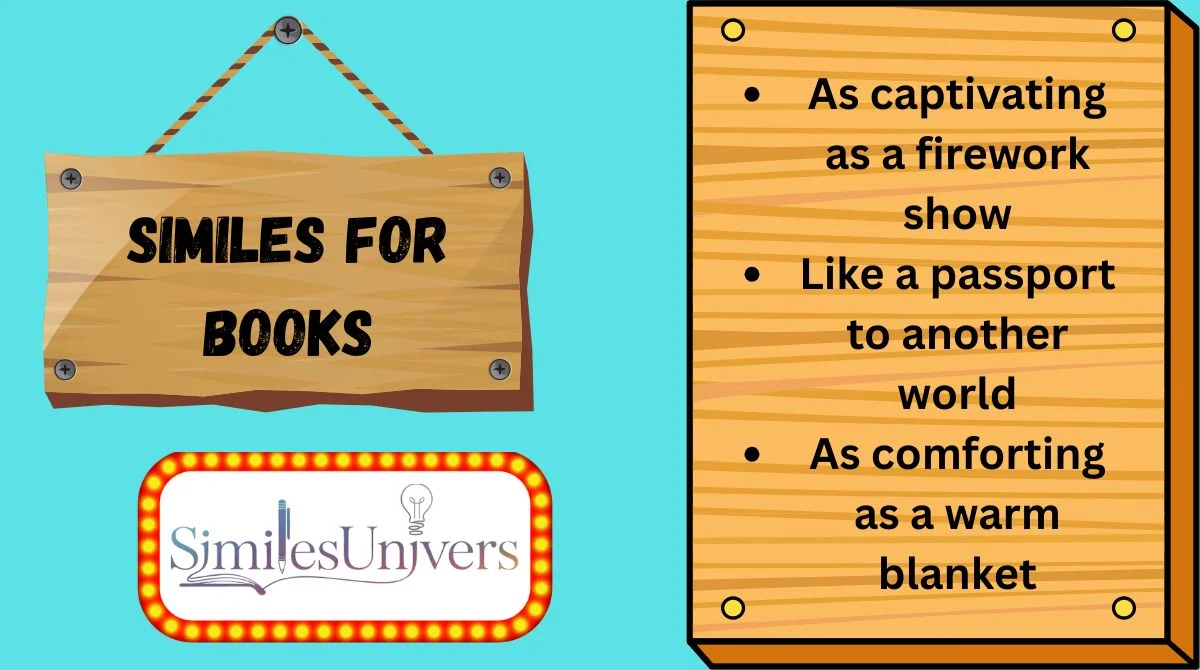
- As captivating as a firework show
- Like a passport to another world
- As comforting as a warm blanket
- Like a lighthouse in a storm
- As heavy as a backpack full of knowledge
- Like a key to hidden doors
- As addictive as chocolate
- Like a river flowing through your mind
- As mysterious as a locked diary
- Like a puzzle waiting to be solved
Complete List of Similes for Books (Grouped by Meaning)
Funny & Lighthearted
As unpredictable as a cat in a library
- Meaning: The book keeps you guessing
- Explanation: Just like a mischievous cat, the story jumps around in fun ways
- Examples:
- Reading this novel is as unpredictable as a cat in a library—it never sits still!
- Her latest mystery is as unpredictable as a cat in a library; I laughed and gasped on every page.
- Tone: Funny
Like a bowl of popcorn on movie night
- Meaning: Fun and entertaining
- Explanation: Every chapter pops with surprises and enjoyment
- Examples:
- The children’s book was like a bowl of popcorn on movie night—light, fun, and impossible to put down.
- I devoured the story like a bowl of popcorn on movie night.
- Tone: Casual
Emotional & Deep
Like a mirror to the soul
- Meaning: Reflects emotions deeply
- Explanation: Books that resonate with personal feelings feel like they’re looking into your heart
- Examples:
- The poetry collection was like a mirror to the soul; every line echoed my own thoughts.
- Her memoir acted like a mirror to the soul, leaving me teary and reflective.
- Tone: Serious
As heart-wrenching as a last goodbye
- Meaning: Emotionally moving
- Explanation: The story’s impact is deeply felt, like losing something precious
- Examples:
- The final chapter hit me as heart-wrenching as a last goodbye.
- Reading the novel felt as heart-wrenching as a last goodbye with an old friend.
- Tone: Serious
Dramatic & Intense
Like a storm tearing through the mind
- Meaning: Powerful and intense
- Explanation: The narrative overwhelms with emotions or action
- Examples:
- The thriller hit like a storm tearing through the mind.
- Her suspense novel swept me like a storm tearing through the mind.
- Tone: Dramatic
As gripping as a vice
- Meaning: Impossible to put down
- Explanation: The plot or characters hold the reader tightly
- Examples:
- This detective story was as gripping as a vice; I stayed up all night reading.
- Her fantasy series was as gripping as a vice, twisting and turning with every page.
- Tone: Dramatic
Slow & Monotonous
As slow as watching paint dry
- Meaning: Boring or dull
- Explanation: Some books drag and feel painfully slow
- Examples:
- The textbook felt as slow as watching paint dry.
- His historical novel was as slow as watching paint dry, but eventually, it picked up.
- Tone: Casual
Like trudging through mud
- Meaning: Difficult to read or heavy
- Explanation: Dense, long-winded books that require effort
- Examples:
- The philosophical treatise was like trudging through mud.
- Reading that chapter felt like trudging through mud, but the payoff was worth it.
- Tone: Serious
Creative & Unique
Like a key to a secret garden
- Meaning: Unlocks imagination
- Explanation: Books can open worlds you never knew existed
- Examples:
- Each fantasy novel felt like a key to a secret garden.
- The story acted like a key to a secret garden, unlocking new adventures.
- Tone: Poetic
As colorful as a rainbow after rain
- Meaning: Vivid and full of life
- Explanation: Books that are visually, emotionally, or conceptually rich
- Examples:
- Her illustrations made the picture book as colorful as a rainbow after rain.
- The narrative was as colorful as a rainbow after rain, brightening my imagination.
- Tone: Poetic
Poetic & Literary
Like a whisper of forgotten dreams
- Meaning: Gentle, nostalgic
- Explanation: Books that evoke subtle emotions or memories
- Examples:
- Reading her poems was like a whisper of forgotten dreams.
- The novel unfolded like a whisper of forgotten dreams, delicate and haunting.
- Tone: Poetic
As timeless as the stars
- Meaning: Classic, enduring
- Explanation: Some stories never lose their value or impact
- Examples:
- Shakespeare’s works are as timeless as the stars.
- The novel felt as timeless as the stars, speaking across generations.
- Tone: Poetic
Fresh and Unique Similes You Won’t Hear Every Day
- Like a lantern in a cave – Illuminates dark ideas or mysteries.
- As tangled as yarn in a kitten’s paws – Complex, playful storylines.
- Like rain dripping through a skylight – Slow revelations, subtle emotions.
- As spicy as a secret recipe – Adds excitement or unexpected twists.
- Like wind stirring autumn leaves – Gentle movement, stirring reflections.
How to Use These Similes in Writing
- Essays: Make abstract ideas concrete.
- Stories: Bring scenes, characters, and emotions to life.
- Use similes to evoke feelings and paint vivid pictures.
How to Create Your Own Similes (Mini Writing Guide)
- Identify the emotion or quality you want to describe.
- Think of something familiar that shares that trait.
- Connect using “like” or “as.”
- Experiment with unusual comparisons for creativity.
- Revise for clarity and impact.
Tips:
- Avoid clichés
- Match tone to audience
- Keep it simple
Transformation Examples:
- “The book is interesting” → “The book is like a magnet for curiosity.”
- “It’s slow” → “It drags like clouds on a windy day.”
- “It’s funny” → “It’s like a clown sneaking into your classroom.”
Common Mistakes When Using Similes
- Overuse: Can overwhelm readers.
- Clichés: Avoid phrases everyone knows.
- Tone mismatch: A funny simile in a serious scene can confuse.
Practice Exercise
Fill in the blanks with a suitable simile for books:
- The novel gripped me __________.
- Her story was as colorful as __________.
- The poem was gentle like __________.
- Reading the textbook felt __________.
- The plot twisted like __________.
- The ending was as shocking as __________.
- The character was bold like __________.
- The chapter dragged __________.
- The dialogue was as witty as __________.
- The fantasy world shone like __________.
- The suspense built like __________.
- The love story unfolded like __________.
Answers (Sample)
- as gripping as a vice
- a rainbow after rain
- a whisper of forgotten dreams
- watching paint dry
- a rollercoaster
- a lightning strike
- a lion in the jungle
- trudging through mud
- a clever fox
- a jewel in sunlight
- a rising storm
- petals in the wind
FAQs
Q: What makes a good simile for a book?
A: It clearly conveys emotion, imagery, or experience in a relatable way.
Q: Can similes be humorous?
A: Yes, funny similes make writing playful and engaging.
Q: How many similes should I use in one essay?
A: 2–3 strong similes per paragraph are usually enough.
Q: What’s the difference between a simile and a metaphor?
A: A simile uses “like” or “as”; a metaphor states the comparison directly.
Q: Can similes improve storytelling?
A: Absolutely. They make scenes vivid and help readers feel emotions.
Q: How can I avoid clichés in similes?
A: Think creatively, combine unexpected ideas, and use fresh imagery.
Final Thoughts
Similes are a writer’s secret weapon, turning ordinary descriptions into vivid experiences. By using these 34+ similes for books, experimenting with your own comparisons, and avoiding common mistakes, you can make your writing unforgettable. Whether funny, dramatic, or poetic, the right simile can make readers laugh, cry, and fall in love with your words.
Daniel Harper
I am simplifies complex literary concepts into clear, practical lessons for students and learners worldwide.
Through SimilesUnivers, he aims to make mastering similes engaging, structured, and academically enriching.