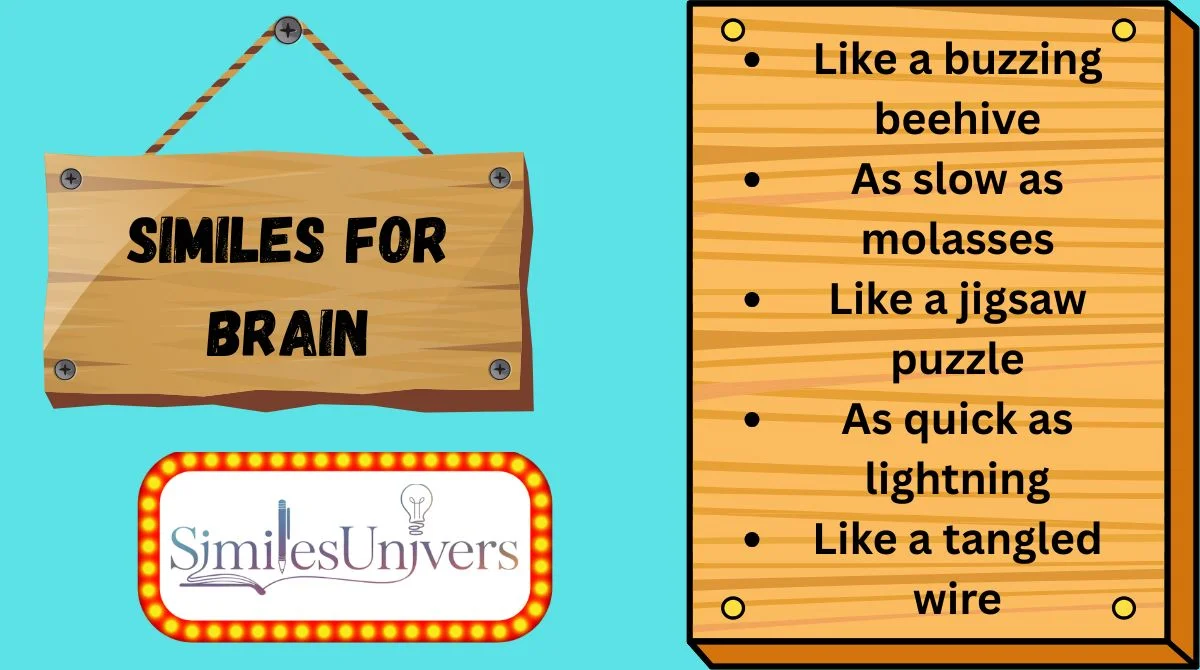
The human brain is a marvel, yet finding the right words to describe it can be tricky. That’s where similes come in—tiny linguistic bridges that make abstract ideas vivid.
Using similes for the brain can turn dull descriptions into colorful snapshots, making your writing more memorable and relatable.
Whether you’re crafting a story, an essay, or just want to impress with witty comparisons, these similes bring mental imagery to life.
In this guide, you’ll discover over 34 unique similes for the brain, grouped by tone and style, plus expert tips on using and creating your own. By the end, your writing will sparkle with clarity and creativity.
Similes for a Smart and Intelligent Brain
As sharp as a razor
Meaning: Extremely intelligent and quick-thinking.
Explanation: A razor suggests sharpness and precision, making it useful for describing a brain that quickly understands difficult ideas.
Examples:
- Her brain was as sharp as a razor when solving complex problems.
- His thinking was as sharp as a razor during the debate.
Tone: Serious
Like a well-oiled machine
Meaning: Efficient, organized, and highly capable.
Explanation: A well-oiled machine works smoothly, just like a brain that processes information quickly and effectively.
Examples:
- His brain worked like a well-oiled machine during the exam.
- She handled every challenge like a well-oiled machine.
Tone: Casual
As bright as a spark
Meaning: Quick, clever, and full of ideas.
Explanation: A spark represents sudden light and energy, making it a good comparison for fast and creative thinking.
Examples:
- His brain was as bright as a spark, always producing new ideas.
- Her mind was as bright as a spark when the solution finally appeared.
Tone: Poetic
Like a master key
Meaning: Able to unlock difficult problems or understand complex situations.
Explanation: A master key opens many locks, just as an intelligent mind can find solutions to many different problems.
Examples:
- Her brain was like a master key, unlocking every difficult puzzle.
- His way of thinking worked like a master key for complicated problems.
Tone: Creative
As quick as lightning
Meaning: Extremely fast at understanding or reacting.
Explanation: Lightning appears almost instantly, making it a vivid comparison for rapid thinking.
Examples:
- His brain was as quick as lightning when the teacher asked a question.
- She made the connection as quick as lightning.
Tone: Dramatic
What Is a Simile?
A simile is a figure of speech that compares two things using “like” or “as.” It makes ideas more vivid and relatable. For example: Her mind was like a sponge, soaking up every detail. Simple, clear, and imaginative.
Quick List – Most Popular Similes for Brain
- As sharp as a tack
- Like a steel trap
- As empty as a vacuum
- Like a buzzing beehive
- As slow as molasses
- Like a jigsaw puzzle
- As quick as lightning
- Like a tangled wire
- As cloudy as fog
- Like a locked treasure chest
Complete List of Similes for Brain (Grouped by Meaning)
Funny & Lighthearted
As scrambled as eggs
- Meaning: Confused or chaotic thoughts.
- Explanation: Visualizes a brain in disarray like scrambled eggs in a pan.
- Example: After staying up all night, my brain was as scrambled as eggs.
He tried to solve the puzzle, but his thoughts were as scrambled as eggs. - Tone: Funny
Like a hamster on a wheel
- Meaning: Constant overthinking.
- Explanation: Compares busy mental activity to a hamster running endlessly.
- Example: Her mind was like a hamster on a wheel, always chasing one worry after another.
I can’t focus; my thoughts are like a hamster on a wheel. - Tone: Funny
Emotional & Deep
As fragile as glass
- Meaning: Sensitive or vulnerable thinking.
- Explanation: Suggests that ideas or emotions can shatter easily.
- Example: After the argument, his confidence felt as fragile as glass.
She handled criticism carefully; her brain was as fragile as glass. - Tone: Serious
Like a library at midnight
- Meaning: Quiet, reflective, or thoughtful mind.
- Explanation: Evokes calmness and depth, like a library in stillness.
- Example: His mind was like a library at midnight, filled with quiet thoughts.
She pondered the problem, her brain like a library at midnight. - Tone: Poetic
Dramatic & Intense
Like a battlefield
- Meaning: Chaotic, conflicted thoughts.
- Explanation: Conveys mental struggle, similar to a war scene.
- Example: Her brain was like a battlefield during the argument.
Decision-making felt impossible; my thoughts were like a battlefield. - Tone: Serious
As sharp as a scalpel
- Meaning: Extremely precise or analytical thinking.
- Explanation: A scalpel symbolizes precision and acute awareness.
- Example: He cut through the data as sharp as a scalpel.
Her arguments were as sharp as a scalpel, leaving no room for doubt. - Tone: Serious
Slow & Monotonous
As foggy as a London morning
- Meaning: Confused or unclear thoughts.
- Explanation: Imagery of fog mirrors mental haziness.
- Example: I woke up, my brain as foggy as a London morning.
After the medication, his mind felt as foggy as a London morning. - Tone: Casual
Like molasses in January
- Meaning: Very slow thinking.
- Explanation: Molasses flows slowly, representing delayed thought processes.
- Example: Solving that problem was like molasses in January.
Her reaction was as slow as molasses in January. - Tone: Funny
Creative & Unique
Like a kaleidoscope
- Meaning: Ever-changing and colorful thoughts.
- Explanation: A kaleidoscope reflects constantly shifting patterns, similar to imagination.
- Example: His ideas spun in his mind like a kaleidoscope.
Her creativity was like a kaleidoscope, vivid and unpredictable. - Tone: Poetic
Like tangled Christmas lights
- Meaning: Confused, messy thoughts.
- Explanation: Tangled lights symbolize chaotic mental connections.
- Example: My brain felt like tangled Christmas lights after the lecture.
His explanation left my thoughts like tangled Christmas lights. - Tone: Funny
Poetic & Literary
As deep as the ocean
- Meaning: Profound thinking.
- Explanation: Compares mental depth to the vastness of the ocean.
- Example: Her mind was as deep as the ocean, holding endless ideas.
He contemplated life, his thoughts as deep as the ocean. - Tone: Poetic
Like ink spilling on paper
- Meaning: Rapid, flowing thoughts.
- Explanation: Suggests creative ideas streaming out freely.
- Example: Her imagination poured like ink spilling on paper.
Ideas came to him like ink spilling on paper. - Tone: Poetic
Fresh and Unique Similes You Won’t Hear Every Day
- Like a cat juggling yarn – Multitasking in a playful, clumsy way.
- As sharp as a sushi knife – Precision with elegance.
- Like a clockwork jellyfish – Strange but rhythmic thought patterns.
- As slippery as liquid mercury – Hard to grasp thoughts.
- Like a music box on overdrive – Rapid, whimsical ideas.
How to Use These Similes in Writing
- Essays: Add relatable comparisons to clarify complex ideas.
- Stories: Use similes to develop characters’ mental states or emotions.
How to Create Your Own Similes (Mini Writing Guide)
- Identify the feeling or quality you want to describe.
- Think of tangible objects or experiences with a similar trait.
- Use “like” or “as” to link them.
- Keep it simple and vivid.
- Avoid clichés.
Practical Tips:
- Observe nature and daily life.
- Combine unusual concepts.
- Make it emotional.
- Test the imagery in a sentence.
- Revise for clarity.
Examples:
- “Her focus was like a lighthouse cutting through fog.”
- “His thoughts moved like shadows on a sundial.”
- “The idea hit him like a snowball rolling downhill.”
Common Mistakes When Using Similes
- Overuse: Too many similes overwhelm the reader.
- Clichés: Avoid tired phrases like “as busy as a bee.”
- Tone mismatch: Ensure the simile fits the story’s mood.
Similes for an Overactive and Busy Brain
Like a room full of buzzing flies
Meaning: Filled with distracting and restless thoughts.
Explanation: Buzzing flies create constant movement and noise, similar to a mind that refuses to slow down.
Examples:
- My brain felt like a room full of buzzing flies before the exam.
- Her thoughts were like a room full of buzzing flies at bedtime.
Tone: Funny
Like a train that never stops
Meaning: Constantly producing thoughts without a break.
Explanation: A nonstop train represents a mind that keeps moving from one thought to another.
Examples:
- His brain was like a train that never stops.
- My thoughts raced like a train that never stops.
Tone: Casual
As busy as a city intersection
Meaning: Filled with many thoughts happening at once.
Explanation: A crowded intersection is full of movement and activity, much like an overactive mind.
Examples:
- Her brain was as busy as a city intersection after midnight.
- My mind felt as busy as a city intersection before the presentation.
Tone: Creative
Like a computer with too many tabs open
Meaning: Overloaded with thoughts, tasks, or information.
Explanation: Too many open tabs can make a computer feel crowded and slow, creating a relatable image for mental overload.
Examples:
- My brain was like a computer with too many tabs open.
- After a long day, her mind felt like a computer with too many tabs open.
Tone: Funny
Like a storm of flying thoughts
Meaning: Extremely restless and difficult to organize.
Explanation: A storm creates movement and confusion, making it a strong image for rapidly changing thoughts.
Examples:
- His brain was like a storm of flying thoughts before the big decision.
- Her mind felt like a storm of flying thoughts as she tried to sleep.
Tone: Poetic
Practice Exercise
Fill in the blanks:
- My mind was _________ after the all-nighter.
- Thoughts ran _________ like a racing river.
- Her creativity flowed _________ like paint on canvas.
- His memory was _________, hard to retrieve.
- I felt as _________ as foggy morning.
- My ideas were like _________ on a windy day.
- The problem seemed as _________ as a tangled wire.
- He focused _________, sharp as a scalpel.
- Her mind felt _________, like jelly in a jar.
- My brain raced _________ like lightning.
- Emotions poured _________ like stormy waves.
- Thinking slowly, my brain moved _________ like molasses.
Answers:
- scrambled eggs
- fast
- freely
- elusive
- foggy
- leaves
- knotted
- precisely
- wobbly
- rapidly
- turbulently
- slowly
FAQs
What is a simile for brain that is easy to remember?
- “As sharp as a tack” is short and vivid.
How can similes improve writing?
- They make abstract ideas relatable and memorable.
Are there funny similes for brain?
- Yes, e.g., “like a hamster on a wheel.”
Can I make my own brain similes?
- Absolutely! Observe, compare, and use “like” or “as.”
Do similes work in formal writing?
- Yes, but choose ones that fit tone and clarity.
Why use uncommon similes?
- Unique similes capture attention and stand out.
Final Thoughts
Similes transform writing by connecting abstract thoughts to vivid images. With over 34 fresh similes for the brain, plus tips on using and creating your own, you’re ready to enrich essays, stories, and everyday descriptions.
Keep experimenting, observe the world, and let your imagination turn mental concepts into unforgettable imagery.

Daniel Harper
I am simplifies complex literary concepts into clear, practical lessons for students and learners worldwide.
Through SimilesUnivers, he aims to make mastering similes engaging, structured, and academically enriching.