Death is a universal experience, yet it remains one of the hardest things to describe in words.
Writers often struggle to capture its weight, subtlety, or finality. That’s where similes come in—comparing death to something familiar helps readers connect emotionally while enhancing your writing’s vividness.
Whether you want to convey sadness, fear, or even a touch of dark humor, the right simile can transform a sentence from flat to unforgettable.
In this guide, you’ll discover over 33 carefully crafted similes for death, grouped by tone and style. You’ll find both classic expressions and fresh, unexpected comparisons you won’t see anywhere else.
By the end, you’ll not only have a treasure trove of similes at your fingertips but also the knowledge to create your own. Writing about death doesn’t have to be morbid—it can be powerful, poetic, and deeply moving.
Similes for the Final Moments of Life
- Like a candle burning down to its last flame — Describes life slowly reaching its final moment.
- As quiet as the last breath before sleep — Suggests a peaceful and gentle passing.
- Like a sunset fading beyond the horizon — Shows life gradually disappearing from view.
- Like a clock stopping at midnight — Represents a final moment that cannot be reversed.
- Like a bird taking its final flight — Gives a gentle, poetic image of leaving life behind.
- Like a wave disappearing into the shore — Suggests a quiet ending and return to nature.
What Is a Simile?
A simile is a figure of speech that compares two unlike things using “like” or “as”. It paints a vivid picture for the reader and makes abstract ideas easier to understand.
Example:
“Life is like a candle flickering in the wind.”
Here, life is compared to a candle to illustrate its fragility. Similes work the same way when describing death—they give shape to the invisible.
Quick List – Most Popular Similes for Death
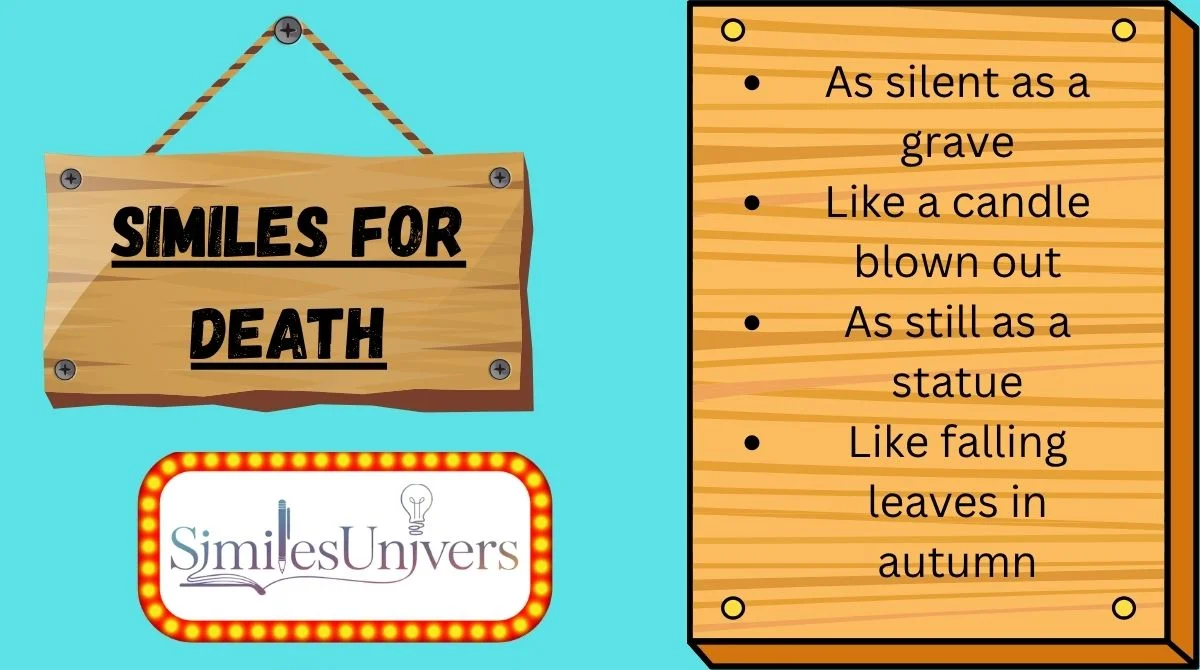
- As silent as a grave
- Like a candle blown out
- As still as a statue
- Like falling leaves in autumn
- As fleeting as a shadow
- Like the last breath of winter
- As quiet as a tomb
- Like a star disappearing at dawn
- As inevitable as nightfall
- Like smoke fading in the air
Complete List of Similes for Death (Grouped by Meaning)
Funny & Lighthearted
Like a computer running out of battery
Meaning: Death as an inevitable shutdown
Explanation: Just as a device eventually dies without power, so does life reach its end.
Examples:
- Grandpa went to sleep like a computer running out of battery.
- The candle burned low, like a computer running out of battery, until it finally went dark.
Tone: Funny
Like a balloon losing air
Meaning: Gradual fading away
Explanation: Life deflates slowly, not with a crash but a quiet loss of energy.
Examples:
- He slipped away like a balloon losing air during the party.
- Her voice disappeared like a balloon losing air.
Tone: Funny
Like a TV turning off mid-show
Meaning: Abrupt, surprising end
Explanation: Death can feel sudden, cutting life’s story short.
Examples:
- He fell silent like a TV turning off mid-show.
- The candle died like a TV turning off mid-show.
Tone: Casual
Emotional & Deep
Like a leaf drifting to the river
Meaning: Life moving toward its natural end
Explanation: Evokes gentle surrender, following nature’s course.
Examples:
- She passed away like a leaf drifting to the river.
- His life flowed on, like a leaf drifting to the river, until it reached the sea.
Tone: Poetic
As quiet as snowfall at midnight
Meaning: Peaceful passing
Explanation: Emphasizes serenity and the hush that death can bring.
Examples:
- Grandma left us as quiet as snowfall at midnight.
- The world seemed still, as quiet as snowfall at midnight, when he breathed his last.
Tone: Poetic
Like a candle’s last flicker
Meaning: Life fading out
Explanation: Represents the slow dimming of energy before the end.
Examples:
- Her life ended like a candle’s last flicker.
- He slipped away, like a candle’s last flicker in the dark.
Tone: Serious
Dramatic & Intense
Like a star collapsing in the sky
Meaning: Sudden and cosmic finality
Explanation: Evokes awe and the unstoppable force of death.
Examples:
- He vanished like a star collapsing in the sky.
- The hero fell, like a star collapsing in the sky, leaving darkness behind.
Tone: Dramatic
As final as the last tick of a clock
Meaning: Irreversible end
Explanation: Nothing can reverse time; once life ends, it is done.
Examples:
- She was gone, as final as the last tick of a clock.
- His departure felt as final as the last tick of a clock.
Tone: Serious
Like waves crashing against a cliff
Meaning: Death as a forceful, unstoppable event
Explanation: Death can overwhelm without warning, much like nature’s power.
Examples:
- He was taken like waves crashing against a cliff.
- Her end came, like waves crashing against a cliff, relentless and unyielding.
Tone: Dramatic
Slow & Monotonous
Like winter stretching endlessly
Meaning: Gradual, cold fading of life
Explanation: Suggests life slipping away slowly and unemotionally.
Examples:
- He aged like winter stretching endlessly, until his last breath.
- Her life faded like winter stretching endlessly across the land.
Tone: Serious
Like ink drying on paper
Meaning: Life’s slow disappearance
Explanation: Quiet, gradual, inevitable end
Examples:
- His existence vanished like ink drying on paper.
- She left the world, like ink drying on paper, unnoticed by most.
Tone: Poetic
Like a candle melting in the sun
Meaning: Life gradually fading
Explanation: Suggests gentle dissolution under constant pressure.
Examples:
- He slipped away like a candle melting in the sun.
- Her warmth faded like a candle melting in the sun.
Tone: Poetic
Creative & Unique
Like a shadow swallowed by night
Meaning: Complete disappearance
Explanation: The shadow, once visible, is gone—life vanishes similarly.
Examples:
- His presence ended like a shadow swallowed by night.
- She faded, like a shadow swallowed by night, leaving only memories.
Tone: Poetic
Like a book closing mid-chapter
Meaning: Abrupt, unfinished end
Explanation: Life sometimes ends before the story concludes.
Examples:
- He was gone, like a book closing mid-chapter.
- Her tale ended like a book closing mid-chapter, leaving questions unanswered.
Tone: Creative
Like a candle flickering in a storm
Meaning: Fragile life under pressure
Explanation: Death can arrive unexpectedly when life is most vulnerable.
Examples:
- He held on like a candle flickering in a storm.
- Her spirit dimmed like a candle flickering in a storm.
Tone: Creative
Poetic & Literary
Like petals falling in slow motion
Meaning: Graceful, inevitable end
Explanation: Death is part of nature, as petals naturally fall.
Examples:
- She passed away like petals falling in slow motion.
- His life ended like petals falling in slow motion.
Tone: Poetic
Like dawn slipping into night
Meaning: Transition from life to death
Explanation: Suggests natural, cyclical change
Examples:
- His consciousness faded like dawn slipping into night.
- She vanished like dawn slipping into night.
Tone: Poetic
Like a poem left unfinished
Meaning: Life cut short
Explanation: Highlights potential lost and unfinished stories
Examples:
- He left the world like a poem left unfinished.
- Her story ended like a poem left unfinished, echoing in silence.
Tone: Poetic
Fresh and Unique Similes You Won’t Hear Every Day
- Like fireflies extinguishing at sunrise – Evokes delicate, fleeting life vanishing quietly.
- Like footprints washed from sand – Life erased, leaving barely a trace.
- Like a clock unwinding in reverse – Time ending, life undoing itself.
- Like smoke curling from a cold hearth – Suggests lingering presence slowly fading.
- Like a key turning in an empty lock – Something essential comes to its final, silent stop.
How to Use These Similes in Writing
- Essays: Enhance descriptive passages and convey abstract concepts.
- Stories: Give depth to character deaths, or set a tone in pivotal scenes.
How to Create Your Own Similes (Mini Writing Guide)
Step-by-Step:
- Identify the emotion you want to convey.
- Think of objects or phenomena with similar traits.
- Compare using “like” or “as.”
- Test readability; keep it simple.
- Refine for tone and imagery.
Practical Tips:
- Use nature for universal imagery.
- Avoid clichés.
- Match tone to context.
- Experiment with sensory comparisons.
- Keep it concise.
Examples of Transformation:
- Life is fragile → Life is like a paper boat in a storm.
- Death is silent → Death is like snow falling in an empty forest.
- Life ends suddenly → Life is like a candle snuffed by the wind.
Common Mistakes When Using Similes
- Overuse: Too many similes dilute impact.
- Clichés: Avoid “as dead as a doornail.”
- Tone mismatch: Funny similes in tragic scenes can confuse readers.
Similes for Grief, Loss, and Saying Goodbye
- Like an empty chair at the family table — Shows the painful absence left by someone who has died.
- Like rain falling on a silent window — Creates an image of quiet, lasting sadness.
- Like a shadow that follows you everywhere — Describes grief that remains long after the loss.
- Like a song missing its final note — Suggests an unfinished feeling after someone’s death.
- Like a photograph fading with age — Represents memories that remain while slowly changing over time.
- Like a house suddenly missing its light — Shows how deeply someone’s absence can change a familiar place.
Practice Exercise
Fill in the blanks using similes for death:
- He slipped away ________ (like smoke).
- Her life faded ________ (like a candle).
- He disappeared ________ (like footprints).
- The old man was gone ________ (as silent as).
- She passed ________ (like petals).
- The hero fell ________ (like a star).
- His presence ended ________ (like a shadow).
- Life slipped ________ (like leaves).
- He left ________ (like a poem).
- The soul vanished ________ (like fireflies).
- The child’s laughter died ________ (like a balloon).
- Memory of her vanished ________ (like dawn).
Answers:
- like smoke curling from a cold hearth
- like a candle’s last flicker
- like footprints washed from sand
- as silent as a grave
- like petals falling in slow motion
- like a star collapsing in the sky
- like a shadow swallowed by night
- like leaves drifting to the river
- like a poem left unfinished
- like fireflies extinguishing at sunrise
- like a balloon losing air
- like dawn slipping into night
FAQs
What are some creative ways to describe death?
Use similes that compare death to nature, objects, or processes—fresh imagery engages readers.
Why are similes effective in writing about death?
They turn abstract concepts into tangible images, evoking emotion and clarity.
Can similes for death be humorous?
Yes, humor works if tone and context are consistent.
How do I avoid clichés when writing similes for death?
Think of unique comparisons rather than overused phrases like “dead as a doornail.”
How many similes should I use in a story?
Use sparingly; 1–2 powerful similes per scene often suffice.
Can similes change the tone of a scene?
Absolutely. A poetic simile creates reflection, while a dramatic one adds tension.
Final Thoughts
Similes are powerful tools that breathe life—and sometimes death—into your writing. From poetic whispers to dramatic finales, the right simile can evoke emotion, clarify meaning, and leave a lasting impression.
With over 33 examples here, plus guidance on creating your own, you now have everything needed to write about death with originality, depth, and impact.

Daniel Harper
I am simplifies complex literary concepts into clear, practical lessons for students and learners worldwide.
Through SimilesUnivers, he aims to make mastering similes engaging, structured, and academically enriching.