Memory is a strange and powerful thing. It can be soft and sweet. It can be sharp and painful. Sometimes it fades. Sometimes it sticks like glue.
Writers often struggle to describe memory in a way that feels real. That’s where similes help. A strong simile turns an abstract idea into something we can see, touch, or feel.
It makes writing clearer and more emotional at the same time.
This guide gives you 25+ similes for memory that are creative, fresh, and easy to use. You’ll find funny ones, deep ones, poetic ones, and even rare, original comparisons you won’t hear every day.
By the end, you’ll know how to use them—and how to create your own.
What Is a Simile? (Quick Clear Definition)
A simile compares two different things using “like” or “as.”
It helps readers understand one thing by comparing it to something familiar.
Example:
Her memory was like a locked box.
Quick List – Most Popular Similes for “Memory”
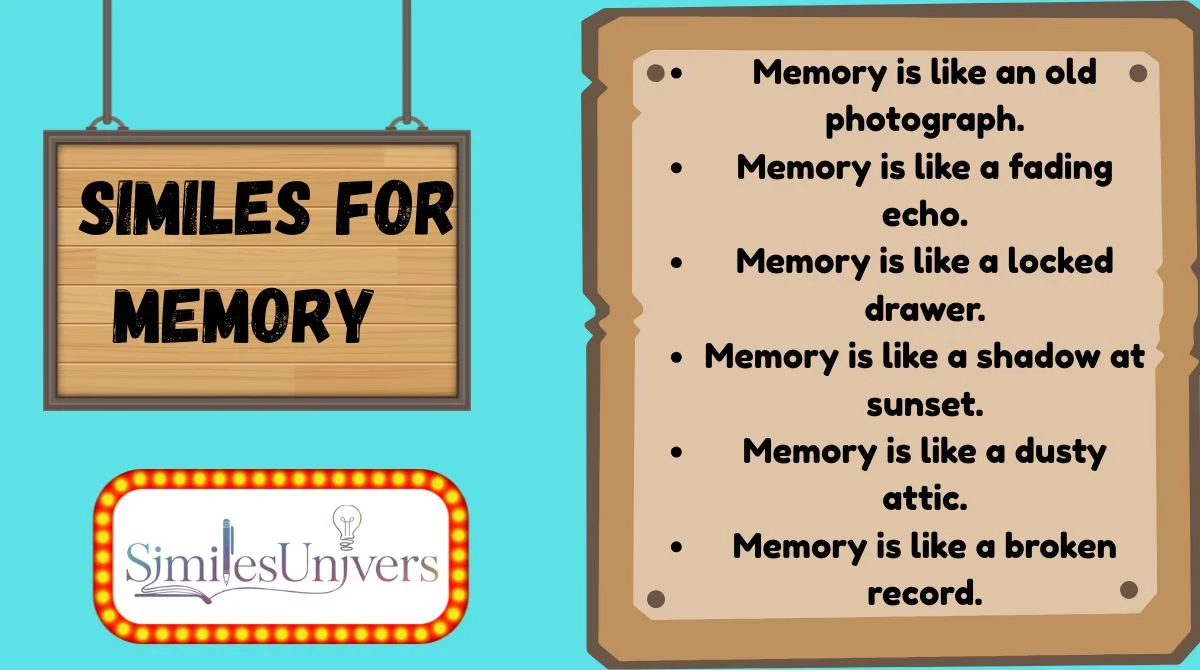
- Memory is like an old photograph.
- Memory is like a fading echo.
- Memory is like a locked drawer.
- Memory is like a shadow at sunset.
- Memory is like a dusty attic.
- Memory is like a broken record.
- Memory is like a time machine.
- Memory is like writing in sand.
- Memory is like a mirror with cracks.
- Memory is like a hidden treasure.
Complete List of Similes for “Memory” (Grouped by Meaning)
Funny & Lighthearted Similes for Memory
Memory is like a browser with too many tabs open.
Meaning: Overloaded and messy.
Explanation: Just like a browser slows down with many tabs, memory can get cluttered.
Examples:
- My brain feels like a browser with too many tabs open.
- His memory is like a browser with too many tabs, freezing at the worst time.
Tone: Funny
Memory is like a cat—comes when it wants.
Meaning: Unpredictable.
Explanation: You can’t always control when memories appear.
Examples:
- The answer didn’t come; my memory is like a cat.
- Her memory is like a cat, ignoring her during exams.
Tone: Funny
Memory is like a leaky bucket.
Meaning: Easily forgotten.
Explanation: Information slips away quickly.
Examples:
- My memory is like a leaky bucket after summer break.
- His memory is like a leaky bucket during math class.
Tone: Casual
Memory is like a scratched CD.
Meaning: Repeats or skips parts.
Explanation: Some memories replay again and again.
Examples:
- The fight plays in my head like a scratched CD.
- Her memory is like a scratched CD stuck on that day.
Tone: Casual
Emotional & Deep Similes for Memory
Memory is like an old photograph.
Meaning: Preserved but fading.
Explanation: Photos hold moments, but colors fade with time.
Examples:
- That day feels like an old photograph in my mind.
- His smile lives in my memory like an old photograph.
Tone: Poetic
Memory is like a fading echo.
Meaning: Growing weaker.
Explanation: Echoes slowly disappear, just like memories.
Examples:
- Her voice is like a fading echo in my memory.
- The laughter became a fading echo over time.
Tone: Poetic
Memory is like a scar.
Meaning: Painful but lasting.
Explanation: Even when healed, it stays.
Examples:
- That loss sits in me like a scar.
- The accident lives in his memory like a scar.
Tone: Serious
Memory is like a fragile glass ornament.
Meaning: Easy to break.
Explanation: One shock can distort or damage it.
Examples:
- Childhood feels like a fragile glass ornament in my mind.
- His memory of her is like glass—beautiful but breakable.
Tone: Poetic
Dramatic & Intense Similes for Memory
Memory is like a storm that won’t pass.
Meaning: Overwhelming and powerful.
Explanation: Some memories stay loud and strong.
Examples:
- The war remains like a storm in his mind.
- Her guilt is like a storm that won’t pass.
Tone: Dramatic
Memory is like fire under ashes.
Meaning: Hidden but alive.
Explanation: It may seem gone, but it can flare up.
Examples:
- His anger slept like fire under ashes.
- That memory burns like fire under ashes.
Tone: Serious
Memory is like a knife in the dark.
Meaning: Sudden and painful.
Explanation: It can appear unexpectedly.
Examples:
- The breakup hit like a knife in the dark.
- The news lives like a blade in her memory.
Tone: Intense
Slow & Fading Similes for Memory
Memory is like writing in sand.
Meaning: Easily erased.
Explanation: Time washes it away.
Examples:
- Names fade like writing in sand.
- The details disappeared like sand at the shore.
Tone: Poetic
Memory is like mist in the morning.
Meaning: Light and vanishing.
Explanation: Clear for a moment, then gone.
Examples:
- The dream faded like morning mist.
- Her face blurred like mist at sunrise.
Tone: Poetic
Memory is like a candle burning low.
Meaning: Slowly weakening.
Explanation: It dims over time.
Examples:
- His childhood glows like a candle burning low.
- The memory flickers like a dying candle.
Tone: Serious
Creative & Unique Similes for Memory
Memory is like a hidden attic filled with boxes.
Meaning: Stored and forgotten things.
Explanation: Some memories are buried deep.
Examples:
- My mind feels like a hidden attic.
- Her memory is like boxes waiting to be opened.
Tone: Creative
Memory is like a snow globe shaken by time.
Meaning: Distorted by emotion.
Explanation: Events swirl and blur.
Examples:
- The past looks like a shaken snow globe.
- His memory spins like falling snow inside glass.
Tone: Poetic
Memory is like a cracked mirror.
Meaning: Incomplete or distorted.
Explanation: You see parts, not the whole.
Examples:
- The event feels like a cracked mirror.
- Her memory reflects like broken glass.
Tone: Serious
Memory is like a locked diary.
Meaning: Private and secret.
Explanation: Not shared with others.
Examples:
- His past stays like a locked diary.
- The truth sits like a sealed journal in her mind.
Tone: Serious
Poetic & Literary Similes for Memory
Memory is like a river that never stops flowing.
Meaning: Continuous and alive.
Explanation: Time moves, but memory flows on.
Examples:
- The past moves like a river in her thoughts.
- His memory flows like water through seasons.
Tone: Poetic
Memory is like a time machine.
Meaning: Takes you back.
Explanation: It returns you to old moments.
Examples:
- That song is like a time machine.
- Her scent works like a time machine in his heart.
Tone: Casual
Memory is like a pressed flower in a book.
Meaning: Preserved and delicate.
Explanation: Saved carefully for years.
Examples:
- Their love rests like a pressed flower.
- The letter stays like a flower between pages.
Tone: Poetic
Fresh and Unique Similes You Won’t Hear Every Day
- Memory is like a lighthouse in thick fog.
Imagery: Even when life is unclear, some memories guide you. - Memory is like a playlist on shuffle.
Imagery: Moments pop up without warning. - Memory is like footprints under fresh snow.
Imagery: Still there, just hidden. - Memory is like ink bleeding through thin paper.
Imagery: The past seeps into the present. - Memory is like a key that only fits one door.
Imagery: Each memory unlocks one specific moment.
How to Use These Similes in Writing
In Essays:
Use similes to explain ideas about childhood, history, trauma, or learning. They make abstract thoughts easier to understand.
In Stories:
Similes build mood. A soft simile creates warmth. A sharp one builds tension. Choose one that matches your scene.
How to Create Your Own Similes (Mini Writing Guide)
Step-by-Step Method
- Pick the feeling (happy, sad, fading, painful).
- Think of a physical object that acts the same way.
- Connect them using “like” or “as.”
- Test if it paints a clear picture.
- Keep it simple.
5 Practical Tips
- Use everyday objects.
- Avoid clichés.
- Match tone to mood.
- Keep it short.
- Read it out loud.
3 Transformation Examples
Plain: I forgot her name.
Simile: Her name slipped away like soap in water.
Plain: I remember the day clearly.
Simile: The day shines in my mind like noon sunlight.
Plain: The memory hurt.
Simile: The memory cut like cold wind on bare skin.
Common Mistakes When Using Similes
Overuse: Too many similes slow writing.
Clichés: Avoid tired comparisons like “busy as a bee.”
Tone mismatch: Don’t use funny similes in tragic scenes.
Practice Exercise
Fill in the blanks:
- Memory is like ______ in the wind.
- His childhood felt like ______ in a book.
- The moment faded like ______.
- Her voice echoed like ______.
- My thoughts are like ______ tabs open.
- The pain sits like ______ under ashes.
- The dream vanished like ______ at sunrise.
- That song works like a ______ machine.
- His past is like a locked ______.
- The memory flickers like a ______ burning low.
- The truth hides like ______ in fog.
- The image cracked like a ______ mirror.
Answers:
- writing in sand
- a pressed flower
- mist
- a fading echo
- too many
- fire
- morning mist
- time
- diary
- candle
- lighthouse
- broken
FAQs
What are good similes for memory in essays?
Use clear ones like “memory is like a fading echo” or “memory is like a time machine.” They are easy to understand.
What is a deep simile for memory?
“Memory is like a scar.” It shows pain that remains.
What is a poetic simile for memory?
“Memory is like a pressed flower in a book.” It feels gentle and lasting.
Can similes improve storytelling?
Yes. They add emotion and strong images.
How many similes should I use in one paragraph?
Usually one or two is enough.
Are similes better than metaphors?
Both are strong. Similes are clearer because they use “like” or “as.”
Final Thoughts
Memory shapes who we are. It can glow like a candle or sting like a scar. The right simile makes your writing vivid and alive.
Use these 25+ similes for memory to add emotion, clarity, and beauty to your work. Then try creating your own. When you compare memory to something real, readers won’t just understand it—they’ll feel it.

Daniel Harper
I am simplifies complex literary concepts into clear, practical lessons for students and learners worldwide.
Through SimilesUnivers, he aims to make mastering similes engaging, structured, and academically enriching.