Good writing feels alive. It pulls you in like a magnet and paints pictures in your mind. But flat writing? It sits on the page like a stone.
That’s where similes come in.
Similes make your words shine. They turn plain ideas into bright images. They help readers see, feel, and remember what you say.
A single strong simile can make a sentence glow like a light in the dark.
In this guide, you’ll discover 25+ powerful similes for writing—funny ones, deep ones, dramatic ones, and fresh new ones you won’t hear every day.
You’ll also learn how to use them, how to create your own, and how to avoid common mistakes.
Let’s make your writing sparkle.
Similes for Creative Writing and Storytelling
Creative writing becomes more engaging when words create strong pictures in the reader’s mind. These similes can help describe stories, characters, ideas, and scenes in a memorable way.
Writing like a painter with a blank canvas
Meaning: Creative and full of possibilities.
Explanation: This simile compares writing to painting, where each word adds a new detail to the picture.
Examples:
- Her novel was like a painter with a blank canvas, turning simple ideas into vivid scenes.
- His imagination worked like a painter with a blank canvas, creating something new with every sentence.
Tone: Creative
Storytelling like a journey through unknown lands
Meaning: Adventurous and full of discovery.
Explanation: It suggests that a good story takes readers somewhere new and unexpected.
Examples:
- Her storytelling felt like a journey through unknown lands.
- The novel carried us like a journey through unknown lands, with surprises at every turn.
Tone: Poetic
Writing like a camera capturing every detail
Meaning: Highly descriptive and vivid.
Explanation: This simile shows writing that helps readers clearly picture people, places, and actions.
Examples:
- His descriptions were like a camera capturing every detail.
- The author wrote like a camera capturing every detail of the busy city.
Tone: Descriptive
A story like a door to another world
Meaning: Imaginative and immersive.
Explanation: It suggests that the story allows readers to escape into a completely different place.
Examples:
- Her fantasy novel was like a door to another world.
- The opening chapter felt like a door to another world waiting to be explored.
Tone: Magical
Ideas flowing like sparks from a fire
Meaning: Full of energy and creativity.
Explanation: The comparison suggests that new ideas appear quickly and keep the writing lively.
Examples:
- His notebook filled with ideas flowing like sparks from a fire.
- Her creative process was like sparks from a fire, producing one idea after another.
Tone: Energetic
What Is a Simile? (Quick Clear Definition)
A simile compares two different things using “like” or “as.”
It helps readers picture something more clearly.
Example:
Her words flowed like a river.
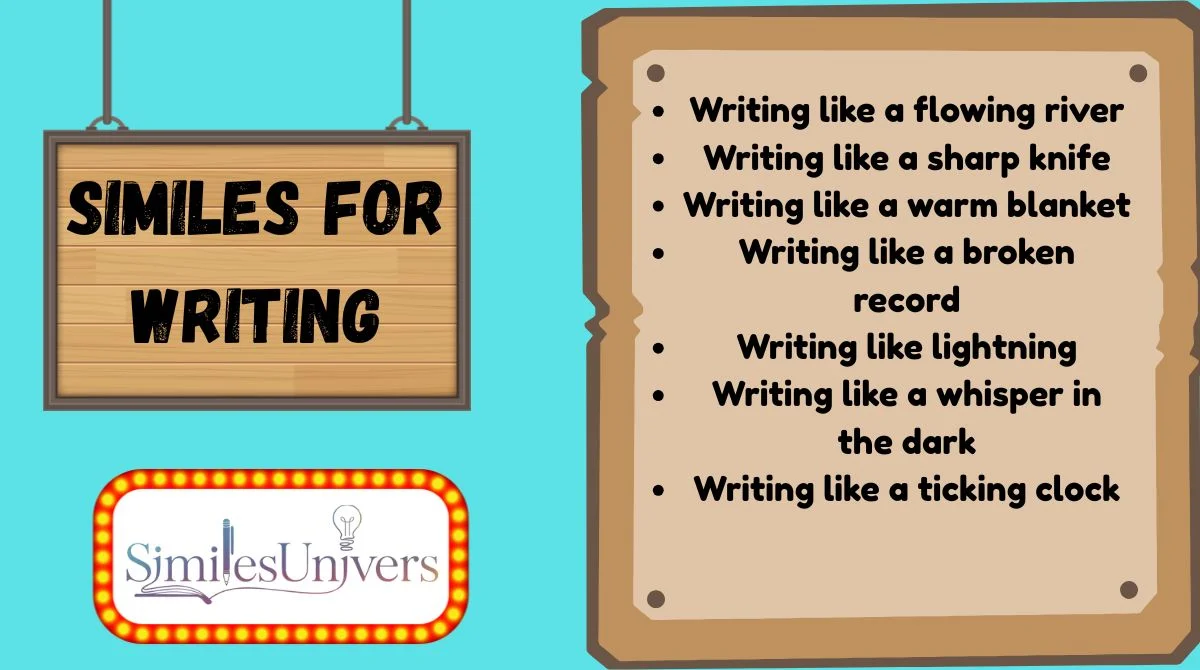
Quick List – Most Popular Similes for “Writing”
- Writing like a flowing river
- Writing like a sharp knife
- Writing like a warm blanket
- Writing like a broken record
- Writing like lightning
- Writing like a whisper in the dark
- Writing like a ticking clock
- Writing like a blooming flower
- Writing like a heavy rain
- Writing like a slow-moving snail
Complete List of Similes for “Writing” (Grouped by Meaning)
Funny & Lighthearted
Writing like a broken record
Meaning: Repetitive and dull.
Explanation: The same ideas are repeated again and again.
Examples:
- His essay sounded like a broken record.
- The blog post felt like a broken record repeating one idea.
Tone: Funny
Writing like a sleepy cat in the sun
Meaning: Lazy and relaxed.
Explanation: It moves slowly without much energy.
Examples:
- Her story drifted like a sleepy cat in the sun.
- The article stretched like a lazy cat on a warm roof.
Tone: Casual
Writing like a spilled bowl of spaghetti
Meaning: Messy and tangled.
Explanation: Ideas are mixed up and hard to follow.
Examples:
- His paragraph looked like a spilled bowl of spaghetti.
- The report read like noodles scattered everywhere.
Tone: Funny
Writing like popcorn popping
Meaning: Energetic and full of surprises.
Explanation: Ideas jump quickly and excite readers.
Examples:
- Her dialogue popped like popcorn in a hot pan.
- The comedy script felt like kernels bursting with fun.
Tone: Funny
Emotional & Deep
Writing like an open wound
Meaning: Raw and painful.
Explanation: The emotions feel honest and exposed.
Examples:
- His poem felt like an open wound.
- The memoir read like pain laid bare.
Tone: Serious
Writing like a warm hug
Meaning: Comforting and kind.
Explanation: It makes readers feel safe and calm.
Examples:
- Her words wrapped around me like a warm hug.
- The children’s book felt soft and gentle.
Tone: Gentle
Writing like falling autumn leaves
Meaning: Soft and reflective.
Explanation: It carries quiet beauty and thought.
Examples:
- The story drifted like falling autumn leaves.
- His letter settled softly on my heart.
Tone: Poetic
Writing like a candle in the dark
Meaning: Hopeful and guiding.
Explanation: It brings light during hard times.
Examples:
- Her speech shone like a candle in the dark.
- The article felt like a small flame of hope.
Tone: Poetic
Dramatic & Intense
Writing like lightning across the sky
Meaning: Fast and powerful.
Explanation: It strikes quickly and leaves impact.
Examples:
- His thriller moved like lightning across the sky.
- The final chapter hit like a flash of light.
Tone: Dramatic
Writing like a roaring wildfire
Meaning: Fierce and unstoppable.
Explanation: It spreads quickly and grabs attention.
Examples:
- Her argument spread like a roaring wildfire.
- The article burned with bold ideas.
Tone: Intense
Writing like a ticking time bomb
Meaning: Full of tension.
Explanation: It builds suspense.
Examples:
- The story felt like a ticking time bomb.
- Each page added more pressure.
Tone: Serious
Writing like crashing waves
Meaning: Powerful and emotional.
Explanation: It hits with force again and again.
Examples:
- The speech rolled like crashing waves.
- His words struck the crowd hard.
Tone: Dramatic
Slow & Monotonous
Writing like a slow-moving snail
Meaning: Very slow.
Explanation: It drags and feels heavy.
Examples:
- The textbook crawled like a slow-moving snail.
- The chapter felt endless.
Tone: Casual
Writing like a ticking clock in an empty room
Meaning: Repetitive and quiet.
Explanation: It lacks energy and excitement.
Examples:
- The essay ticked like a lonely clock.
- The report echoed without life.
Tone: Serious
Writing like dry toast
Meaning: Bland and plain.
Explanation: It lacks flavor or detail.
Examples:
- His report tasted like dry toast.
- The paragraph needed more spice.
Tone: Casual
Creative & Unique
Writing like ink dancing on water
Meaning: Fluid and artistic.
Explanation: Words move in a graceful way.
Examples:
- Her poem flowed like ink dancing on water.
- The sentences curved gently.
Tone: Poetic
Writing like a key turning in a lock
Meaning: Precise and satisfying.
Explanation: Every word fits perfectly.
Examples:
- His lines clicked like a key turning in a lock.
- The ending felt just right.
Tone: Serious
Writing like a bridge over fog
Meaning: Clarifying.
Explanation: It helps readers understand confusion.
Examples:
- Her guide worked like a bridge over fog.
- The article cleared my doubts.
Tone: Helpful
Writing like starlight on still water
Meaning: Calm yet beautiful.
Explanation: It shines quietly.
Examples:
- The essay shimmered like starlight on still water.
- His style felt peaceful.
Tone: Poetic
Poetic & Literary
Writing like a blooming flower
Meaning: Gradually beautiful.
Explanation: It unfolds gently.
Examples:
- The story opened like a blooming flower.
- Each chapter revealed new color.
Tone: Poetic
Writing like a violin in a silent hall
Meaning: Emotional and clear.
Explanation: It stands out strongly.
Examples:
- Her voice read like a violin in a silent hall.
- The poem echoed in my mind.
Tone: Poetic
Writing like morning sunlight
Meaning: Fresh and bright.
Explanation: It feels new and hopeful.
Examples:
- His blog sparkled like morning sunlight.
- The message felt full of life.
Tone: Gentle
Fresh and Unique Similes You Won’t Hear Every Day
- Writing like a compass in a storm – It guides readers through chaos.
- Writing like seeds in wet soil – Ideas grow over time.
- Writing like glass under pressure – Clear but fragile.
- Writing like footsteps in fresh snow – Every word leaves a mark.
- Writing like a kite pulling against the wind – Full of tension and lift.
These similes work because they create clear pictures. They help readers see action, growth, strength, and emotion.
How to Use These Similes in Writing
In Essays:
- Use them to explain complex ideas simply.
- Add one strong simile per key point.
In Stories:
- Use similes to show feelings.
- Add them during emotional or dramatic scenes.
Keep them natural. Let them fit the mood.
How to Create Your Own Similes (Mini Writing Guide)
Step-by-Step Method
- Pick what you want to describe.
- Think about how it feels.
- Find an object with the same feeling.
- Connect using “like” or “as.”
- Keep it short and clear.
5 Practical Tips
- Use simple images.
- Avoid overused phrases.
- Match the tone.
- Read it out loud.
- Cut extra words.
3 Transformation Examples
Plain: The writing was clear.
Simile: The writing was clear like clean glass.
Plain: The story was sad.
Simile: The story felt like rain on a funeral day.
Plain: The article was exciting.
Simile: The article moved like a race car on fire.
Common Mistakes When Using Similes
Overuse: Too many similes confuse readers.
Clichés: Avoid “busy as a bee.” It feels tired.
Tone Mismatch: A funny simile won’t fit a serious speech.
Similes for Clear and Powerful Writing
Clear writing helps readers understand ideas quickly, while powerful writing makes those ideas stay in their minds. These similes are useful when describing strong, direct, and easy-to-understand writing.
Writing like a clean window
Meaning: Clear and easy to understand.
Explanation: A clean window lets you see through it without distraction, just like simple writing makes an idea easy to grasp.
Examples:
- Her explanation was like a clean window, making everything easy to understand.
- The article was written like a clean window with no confusing language.
Tone: Clear
Writing like a sharp arrow
Meaning: Direct and focused.
Explanation: A sharp arrow moves toward its target, making this simile useful for precise and purposeful writing.
Examples:
- His argument was like a sharp arrow aimed directly at the main issue.
- Her sentences moved like sharp arrows, wasting no words.
Tone: Powerful
Words like stepping stones across a river
Meaning: Clear and easy to follow.
Explanation: Stepping stones create a safe path across water, just as well-organized words guide readers from one idea to another.
Examples:
- Her explanation used words like stepping stones across a river.
- The essay guided readers like stepping stones across a river.
Tone: Helpful
Writing like a hammer striking a nail
Meaning: Strong and forceful.
Explanation: This simile describes writing that delivers its message with confidence and impact.
Examples:
- His final sentence landed like a hammer striking a nail.
- The writer’s argument hit like a hammer striking a nail.
Tone: Dramatic
Writing like a bright beam of light
Meaning: Powerful and illuminating.
Explanation: A beam of light reveals what was hidden, making it a strong comparison for writing that brings clarity to difficult ideas.
Examples:
- Her explanation was like a bright beam of light in a confusing discussion.
- The article worked like a bright beam of light, making the complex topic easier to understand.
Tone: Inspirational
Practice Exercise
Fill in the blanks:
- The poem flowed like _______.
- His report felt like _______.
- The story hit like _______.
- Her blog sparkled like _______.
- The chapter dragged like _______.
- His speech burned like _______.
- The essay opened like _______.
- The message shone like _______.
- The novel crawled like _______.
- The script popped like _______.
- The article drifted like _______.
- The ending clicked like _______.
Answers:
- a river
- dry toast
- lightning
- morning sunlight
- a snail
- wildfire
- a blooming flower
- a candle in the dark
- a snail
- popcorn
- autumn leaves
- a key in a lock
FAQs
What are similes in writing?
Similes compare two things using “like” or “as” to create clear images.
Why are similes important?
They make writing vivid and easy to imagine.
How many similes should I use?
Use them sparingly—one or two per page is often enough.
What is the difference between a simile and a metaphor?
A simile uses “like” or “as.” A metaphor does not.
Can similes improve SEO writing?
Yes. They increase engagement and time on page.
Are similes good for academic essays?
Yes, if used carefully and professionally.
Final Thoughts
Strong writing paints pictures. Similes help you do that with ease. They turn simple sentences into bright scenes. Whether you want funny, deep, dramatic, or poetic, the right simile can transform your words.
Use them wisely. Keep them fresh. Let your writing shine like sunlight after rain.

Daniel Harper
I am simplifies complex literary concepts into clear, practical lessons for students and learners worldwide.
Through SimilesUnivers, he aims to make mastering similes engaging, structured, and academically enriching.