Fear is a feeling everyone experiences, from the tiniest worry to heart-pounding terror. But describing fear in writing can be tricky—just saying “I was scared” feels flat.
That’s where similes come in. Similes help you paint a vivid picture, making readers feel what your characters feel. Imagine your audience gripping their seats because they understand the fear—thanks to your choice of words.
This guide will give you 28+ similes for scared, grouped by mood and style, plus fresh, original comparisons you won’t find anywhere else.
By the end, you’ll have a toolkit of expressive language to enhance stories, essays, and even casual writing. Say goodbye to boring descriptions and hello to writing that truly sparks emotion.
What Is a Simile? (Quick Clear Definition)
A simile is a figure of speech that compares two different things using “like” or “as.” It makes writing vivid and easy to imagine.
Example: Her hands shook like leaves in the wind.
Quick List – Most Popular Similes for Scared
- As nervous as a cat in a room full of rocking chairs
- Like a deer caught in headlights
- As jumpy as a popcorn kernel in hot oil
- Like a mouse hearing a distant footstep
- As shaky as jelly on a plate
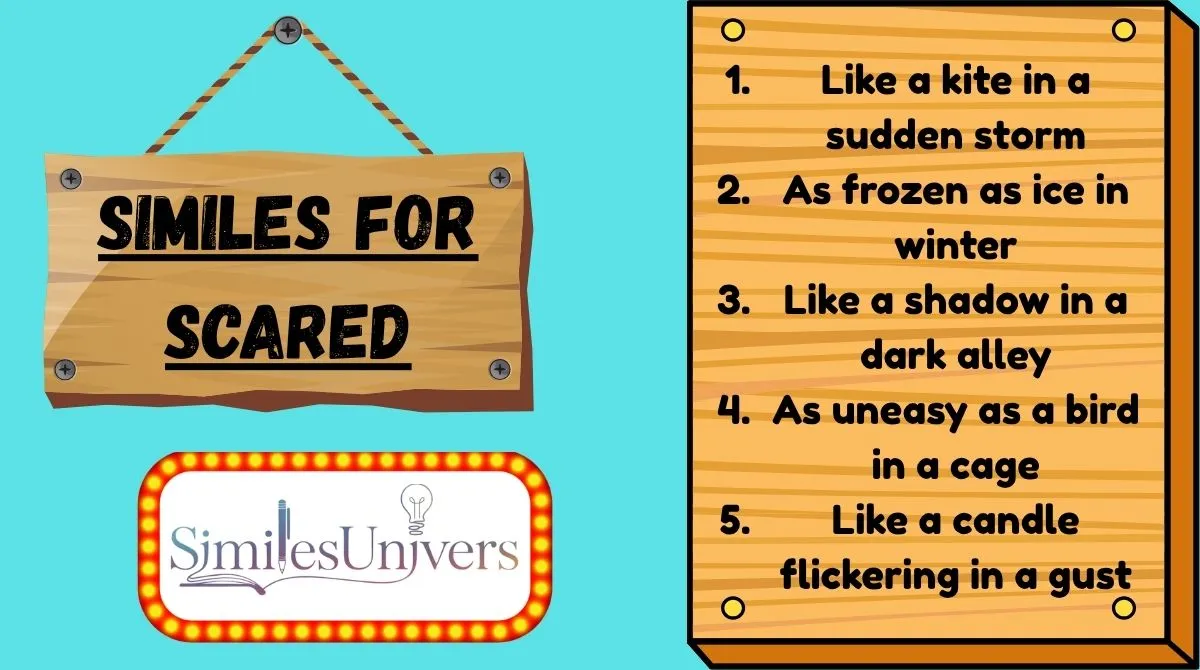
- Like a kite in a sudden storm
- As frozen as ice in winter
- Like a shadow in a dark alley
- As uneasy as a bird in a cage
- Like a candle flickering in a gust
Complete List of Similes for Scared (Grouped by Meaning)
Funny & Lighthearted
As nervous as a squirrel on espresso
- Meaning: Extremely jittery or anxious
- Explanation: Shows fear with a humorous, hyperactive image
- Examples:
- Tom was as nervous as a squirrel on espresso before his first school play.
- She fidgeted, as nervous as a squirrel on espresso, while waiting for the results.
- Tone: Funny
Like a cat in a bathtub
- Meaning: Uncomfortable and fearful
- Explanation: Evokes a common funny image of feline panic
- Examples:
- I felt like a cat in a bathtub walking into the crowded gym.
- He darted from the teacher, like a cat in a bathtub, avoiding eye contact.
- Tone: Funny
As jumpy as toast popping from the toaster
- Meaning: Easily startled
- Explanation: Combines fear with a common, everyday object
- Examples:
- Every loud bang made her as jumpy as toast popping from the toaster.
- He flinched, as jumpy as toast popping from the toaster, when the balloon popped.
- Tone: Funny
Emotional & Deep
Like a shadow creeping over a sunny field
- Meaning: A subtle, creeping fear
- Explanation: Fear growing slowly, emotionally heavy
- Examples:
- A chill ran down her spine, like a shadow creeping over a sunny field.
- His heart sank, like a shadow creeping over a sunny field, as he read the letter.
- Tone: Serious
As fragile as a whispered secret
- Meaning: Vulnerable and fearful
- Explanation: Evokes fear tied to sensitivity and uncertainty
- Examples:
- She felt as fragile as a whispered secret stepping into the crowded room.
- He was as fragile as a whispered secret, unsure who to trust.
- Tone: Poetic
Like ice forming over a warm pond
- Meaning: Sudden cold fear
- Explanation: Emotional contrast conveys shock and dread
- Examples:
- Fear crept in, like ice forming over a warm pond.
- Her courage froze, like ice forming over a warm pond, when she saw the message.
- Tone: Poetic
Dramatic & Intense
Like a deer caught in headlights
- Meaning: Completely stunned by fear
- Explanation: Classic intense fear imagery
- Examples:
- He froze, like a deer caught in headlights, as the car screeched toward him.
- Her eyes widened, like a deer caught in headlights, facing the unexpected explosion.
- Tone: Serious
As if trapped in a nightmare
- Meaning: Fear feels inescapable
- Explanation: Dramatic depiction of intense terror
- Examples:
- He ran, as if trapped in a nightmare, from the dark forest.
- She screamed silently, as if trapped in a nightmare, watching the fire spread.
- Tone: Serious
Like a puppet with cut strings
- Meaning: Helpless and fearful
- Explanation: Extreme loss of control creates terror imagery
- Examples:
- She felt like a puppet with cut strings, staring at the empty hallway.
- He froze in panic, like a puppet with cut strings, when the lights went out.
- Tone: Dramatic
Slow & Monotonous
As tense as a rubber band about to snap
- Meaning: Gradually building fear
- Explanation: Slow suspense and tension captured in one image
- Examples:
- The room felt as tense as a rubber band about to snap.
- Waiting for the verdict, he was as tense as a rubber band about to snap.
- Tone: Serious
Like a clock ticking in a silent room
- Meaning: Creeping fear, awareness of time
- Explanation: Slow, haunting imagery
- Examples:
- She waited, like a clock ticking in a silent room, hearing every footstep.
- His heart beat, like a clock ticking in a silent room, as the shadows grew.
- Tone: Poetic
Creative & Unique
As startled as a firefly in a jar
- Meaning: Unexpected fear
- Explanation: Visual and unusual, fresh imagery
- Examples:
- He jumped, as startled as a firefly in a jar, when the door creaked.
- She looked around, as startled as a firefly in a jar, hearing whispers behind her.
- Tone: Creative
Like a teacup trembling on a high shelf
- Meaning: Fragile fear, easily shaken
- Explanation: Everyday objects evoke vivid imagination
- Examples:
- Her confidence was like a teacup trembling on a high shelf.
- He approached, like a teacup trembling on a high shelf, uncertain and scared.
- Tone: Creative
Poetic & Literary
Like fog rolling over a cliff at dawn
- Meaning: Quiet, enveloping fear
- Explanation: Evocative imagery for literary writing
- Examples:
- Anxiety settled in her chest, like fog rolling over a cliff at dawn.
- He moved cautiously, like fog rolling over a cliff at dawn.
- Tone: Poetic
As fleeting as a moth’s shadow
- Meaning: Temporary, delicate fear
- Explanation: Poetic, subtle imagery
- Examples:
- Fear brushed past him, as fleeting as a moth’s shadow.
- She stepped back, as fleeting as a moth’s shadow, uncertain and trembling.
- Tone: Poetic
Fresh and Unique Similes You Won’t Hear Every Day
- Like a candle in a hurricane – Vulnerable, flickering against overwhelming fear
- As jittery as raindrops on a tin roof – Uneasy, anticipating sudden danger
- Like a balloon caught in a ceiling fan – Panicked, chaotic fear
- As wary as a fox near a trap – Alert, cautious, tense fear
- Like a paper boat in a storm drain – Small, helpless, overwhelmed by circumstances
How to Use These Similes in Writing
Essays:
- Add vivid examples for emotional impact.
- Replace generic words like “afraid” with similes for reader engagement.
Stories:
- Use similes to reveal character emotions.
- Pair similes with actions for immersive scenes.
How to Create Your Own Similes (Mini Writing Guide)
Step-by-step Method:
- Identify the feeling or object.
- Find a familiar thing that shares a quality with it.
- Use “like” or “as” to connect them.
- Test for clarity and imagery.
- Edit for originality and tone.
5 Practical Tips:
- Avoid clichés.
- Mix humor and seriousness.
- Keep it simple.
- Match the simile to the context.
- Read aloud for natural flow.
Transformation Examples:
- “She was scared” → “She was as tense as a violin string about to snap.”
- “He felt nervous” → “He was like a squirrel on a lightning wire.”
- “They froze in fear” → “They froze, like statues in a ghostly museum.”
Common Mistakes When Using Similes
- Overuse: Too many similes can overwhelm the reader.
- Clichés: Avoid “shaking like a leaf” unless used creatively.
- Tone mismatch: Match the simile to story mood.
Practice Exercise
Fill-in-the-blank with your own similes:
- He trembled ________ when the shadow moved.
- She froze ________ in the dark hallway.
- My heart raced ________ as I stepped inside.
- I jumped ________ at the loud noise.
- The room felt ________ with suspense.
- He tiptoed ________ along the empty street.
- She glanced around ________ as the wind howled.
- His stomach twisted ________ as the message arrived.
- I flinched ________ when the cat hissed.
- The silence hung ________ in the abandoned house.
- Fear wrapped around me ________ like a heavy blanket.
- She waited ________ for the results.
Sample Answers:
- like a firefly in a jar
- like a deer caught in headlights
- as jittery as raindrops on a tin roof
- like toast popping from the toaster
- like a clock ticking in a silent room
- as wary as a fox near a trap
- like a shadow creeping over a sunny field
- like a paper boat in a storm drain
- as jumpy as a popcorn kernel in hot oil
- like fog rolling over a cliff at dawn
- like a candle in a hurricane
- as tense as a rubber band about to snap
FAQs
What is the best simile for being scared?
- Depends on context; “like a deer caught in headlights” is classic and widely understood.
Can similes be funny and serious at the same time?
- Yes, blending humor and intensity can create unique, memorable imagery.
How many similes should I use in writing?
- Use sparingly; 1–2 per paragraph is effective for clarity and impact.
Are fresh similes better than common ones?
- Fresh similes grab attention, but familiar ones are easier to understand.
Can I create my own similes?
- Absolutely! Connect emotions with familiar objects or experiences.
Do similes improve readability?
- Yes, they make descriptions vivid and help readers visualize emotions.
Final Thoughts
Fear is universal, but the way we describe it doesn’t have to be ordinary. Similes are powerful tools that transform simple sentences into immersive experiences.
From funny and lighthearted to poetic and intense, the 28+ similes above will give your writing depth, originality, and emotion. Experiment, create your own, and let your words make readers feel every heartbeat of fear.

Daniel Harper
I am simplifies complex literary concepts into clear, practical lessons for students and learners worldwide.
Through SimilesUnivers, he aims to make mastering similes engaging, structured, and academically enriching.