Writing can feel dull if your descriptions are flat, but similes bring life to your words. A well-placed simile turns a basic sentence into a vivid image that readers can feel and see.
Whether you’re crafting a story, essay, or even a social media post, simple similes can make your writing memorable.
In this guide, we’ll explore over 27 similes for simple ideas, everyday actions, or plain experiences. You’ll discover popular favorites, fresh creative options, and practical ways to weave them into your writing.
By the end, you’ll have a treasure trove of similes to make your writing shine, even when describing the most ordinary moments.
What Is a Simile? (Quick Clear Definition)
A simile is a figure of speech that compares two different things using words like like or as. It helps readers understand a concept by linking it to something familiar.
Example: Her smile was like sunshine on a rainy day.
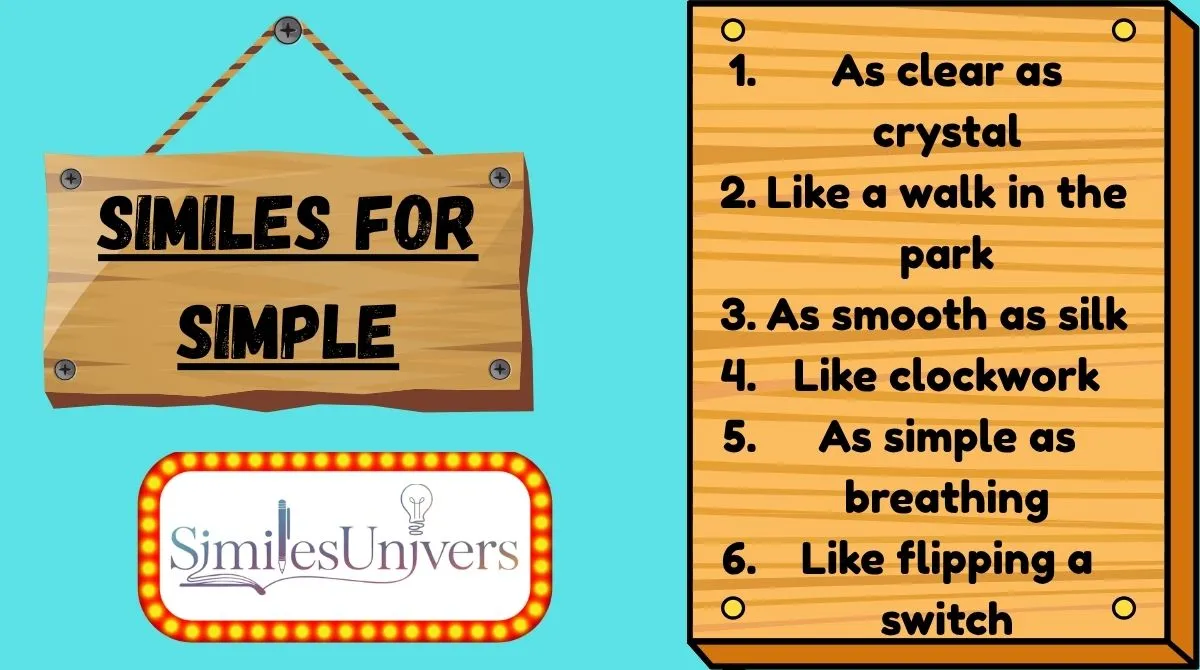
Quick List – Most Popular Similes for “Simple”
- As easy as pie
- Like shooting fish in a barrel
- As plain as day
- Like ABC
- As clear as crystal
- Like a walk in the park
- As smooth as silk
- Like clockwork
- As simple as breathing
- Like flipping a switch
Complete List of Similes for “Simple” (Grouped by Meaning)
Funny & Lighthearted
As easy as pie
Meaning: Very easy
Explanation: Refers to how making or eating pie is simple and enjoyable.
Examples:
- Solving this math problem is as easy as pie.
- Learning to ride a scooter is as easy as pie for kids.
Tone: Funny
Like flipping a pancake
Meaning: Quick and effortless
Explanation: Pancake flipping requires minimal skill once you know how.
Examples:
- Changing the TV channel is like flipping a pancake.
- Installing the app was like flipping a pancake—done in seconds.
Tone: Funny
Like finding socks in a drawer
Meaning: Very straightforward
Explanation: Imagery of searching for socks, a familiar and simple task.
Examples:
- Picking a lunch menu was like finding socks in a drawer.
- Teaching him the rules was like finding socks in a drawer.
Tone: Funny
Emotional & Deep
As plain as day
Meaning: Obvious and simple
Explanation: Something so clear it requires no effort to understand.
Examples:
- Her love for him was as plain as day.
- The solution to the problem was as plain as day.
Tone: Serious
Like water flowing
Meaning: Natural and effortless
Explanation: Suggests smoothness and simplicity in motion or action.
Examples:
- Her writing flowed like water, simple and clear.
- He adapted to the new school like water flowing.
Tone: Poetic
As soft as a whisper
Meaning: Gentle and easy
Explanation: Whispering is quiet, subtle, and simple to understand emotionally.
Examples:
- The lullaby was as soft as a whisper.
- Her instructions were as soft as a whisper.
Tone: Poetic
Dramatic & Intense
Like flipping a switch
Meaning: Instant and simple
Explanation: Turning on a switch requires no extra effort and happens immediately.
Examples:
- His mood changed like flipping a switch.
- Learning to use the software was like flipping a switch.
Tone: Serious
As easy as catching fireflies
Meaning: Effortless and playful
Explanation: Captures simplicity in an enjoyable, slightly magical task.
Examples:
- Convincing her to join was as easy as catching fireflies.
- Fixing the minor bug was as easy as catching fireflies.
Tone: Dramatic
Slow & Monotonous
Like waiting for paint to dry
Meaning: Tediously simple
Explanation: Emphasizes dull, slow simplicity.
Examples:
- The lecture dragged on like waiting for paint to dry.
- Reading the instruction manual was like waiting for paint to dry.
Tone: Casual
As dull as a blank page
Meaning: Extremely simple or uninspired
Explanation: A blank page lacks complexity, making it plain.
Examples:
- His presentation was as dull as a blank page.
- The town felt as dull as a blank page.
Tone: Casual
Creative & Unique
Like a single raindrop in a puddle
Meaning: Small, simple, yet meaningful
Explanation: Highlights simplicity within a larger context.
Examples:
- Her gesture was like a single raindrop in a puddle.
- His contribution was like a single raindrop in a puddle.
Tone: Poetic
As light as a hummingbird’s wing
Meaning: Gentle, easy, and delicate
Explanation: Compares simplicity to the effortless motion of a tiny wing.
Examples:
- Her touch was as light as a hummingbird’s wing.
- The task felt as light as a hummingbird’s wing.
Tone: Poetic
Poetic & Literary
Like a single thread in a tapestry
Meaning: Simple yet integral
Explanation: Small actions contribute meaningfully to a larger picture.
Examples:
- His small kindness was like a single thread in a tapestry.
- Every lesson she taught was like a single thread in a tapestry.
Tone: Poetic
As clear as crystal water
Meaning: Very simple and transparent
Explanation: Crystal water is pure and easy to understand visually.
Examples:
- Her intentions were as clear as crystal water.
- The explanation was as clear as crystal water.
Tone: Poetic
Like a child’s first step
Meaning: Simple and foundational
Explanation: First steps are natural, small, yet powerful in meaning.
Examples:
- Starting the project was like a child’s first step.
- Her smile grew like a child’s first step—innocent and simple.
Tone: Poetic
Fresh and Unique Similes You Won’t Hear Every Day
- Like a bookmark in a library – Simple but essential; keeps things organized.
- As quiet as a shadow at noon – Subtle simplicity with almost invisible presence.
- Like a single note in a symphony – Small, unassuming, yet part of something larger.
- As effortless as morning dew – Gentle and natural simplicity.
- Like a pebble in a stream – Minor but perfectly placed, easily handled.
How to Use These Similes in Writing
Essays: Make abstract ideas more relatable and memorable.
- Instead of: “The task was simple.”
- Use: “The task was like flipping a switch—done in an instant.”
Stories: Bring scenes and emotions to life.
- Instead of: “She was happy.”
- Use: “Her smile was like sunshine after rain.”
How to Create Your Own Similes (Mini Writing Guide)
Step-by-Step Method:
- Identify the idea or object you want to describe.
- Think of something familiar that shares its qualities.
- Use connecting words: like or as.
- Ensure clarity and relatability.
- Refine for rhythm and tone.
Practical Tips:
- Avoid clichés
- Match tone to context
- Keep it short
- Use sensory imagery
- Experiment with unusual comparisons
Transformation Examples:
- The idea is simple → The idea is like a single sunbeam through a window.
- He is calm → He is like still water in a hidden pond.
- The solution is clear → The solution is as clear as a mountain spring.
Common Mistakes When Using Similes
- Overuse: Too many similes can overwhelm the reader.
- Clichés: Avoid overdone comparisons like “as easy as pie” unless intentionally humorous.
- Tone mismatch: Funny similes in serious writing can feel awkward.
Practice Exercise
Fill in the blanks with an appropriate simile:
- The homework was ________ (very easy).
- Her touch was ________ (gentle).
- The town was ________ (boring).
- His anger changed ________ (quickly).
- The gesture was ________ (small but meaningful).
- Learning to ride a bike was ________.
- Her instructions were ________ (clear).
- The lecture dragged on ________.
- Fixing the minor bug was ________.
- The first step was ________ (foundational).
- The note in the symphony was ________ (simple yet essential).
- His smile was ________ (bright and cheerful).
Answers:
- As easy as pie
- As soft as a whisper
- As dull as a blank page
- Like flipping a switch
- Like a single raindrop in a puddle
- Like flipping a pancake
- As clear as crystal
- Like waiting for paint to dry
- As easy as catching fireflies
- Like a child’s first step
- Like a single note in a symphony
- Like sunshine on a rainy day
FAQs
What makes a simile effective?
A simile is effective when it is clear, relatable, and enhances the reader’s understanding or imagery.
Can I use similes in academic writing?
Yes, but use them sparingly and ensure they maintain a professional tone.
How do I avoid cliché similes?
Focus on fresh imagery and unexpected comparisons rather than common phrases.
Are similes the same as metaphors?
No. Similes use like or as, while metaphors state the comparison directly.
Can similes improve storytelling?
Absolutely. They make characters, emotions, and actions more vivid and relatable.
How many similes should I use in a story?
Use them strategically—enough to enrich the narrative but not overwhelm the reader.
Final Thoughts
Similes transform simple writing into memorable, vivid experiences. From classic favorites to unique creations, they bring clarity, humor, emotion, and artistry to your words.
Use this guide to expand your writing toolkit, craft your own comparisons, and turn everyday ideas into something readers will never forget.

Daniel Harper
I am simplifies complex literary concepts into clear, practical lessons for students and learners worldwide.
Through SimilesUnivers, he aims to make mastering similes engaging, structured, and academically enriching.