Weather shapes our days. It can feel soft and sweet. Or wild and scary. A calm morning can feel like peace.
A storm can feel like anger. When you describe weather in writing, plain words are not enough. Saying “it was windy” sounds flat. But saying “the wind howled like a hungry wolf” paints a picture.
Similes make your writing bright and alive. They help readers see, hear, and feel the scene.
They turn simple sentences into strong images.
In this guide, you’ll discover 25+ powerful similes for weather. You’ll find funny ones, deep ones, dramatic ones, and fresh new ones you won’t hear every day.
You’ll also learn how to create your own. Let’s make your writing sparkle like sunlight on water.
What Is a Simile? (Quick Clear Definition)
A simile is a comparison using the words “like” or “as.”
It shows how one thing is similar to another.
Example: The rain fell like tiny silver needles.
Quick List – Most Popular Similes for “Weather”
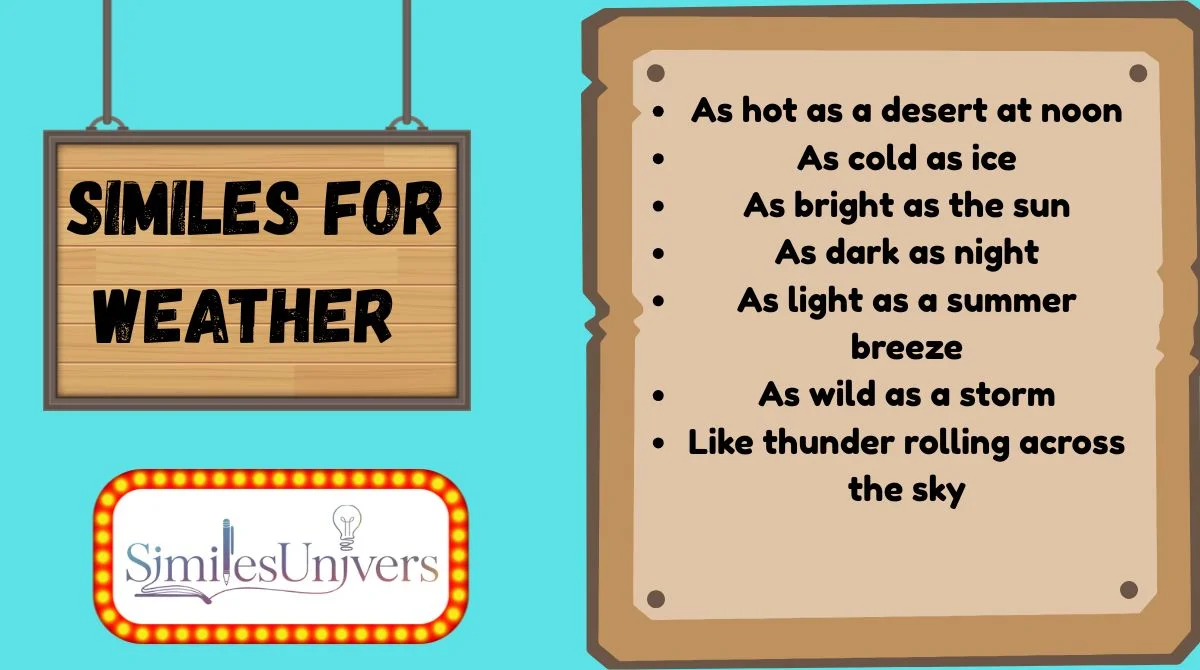
- As hot as a desert at noon
- As cold as ice
- As bright as the sun
- As dark as night
- As light as a summer breeze
- As wild as a storm
- Like thunder rolling across the sky
- Like snowflakes dancing in the air
- Like rain tapping on a drum
- As calm as a clear blue sky
Complete List of Similes for “Weather” (Grouped by Meaning)
Funny & Lighthearted
The rain fell like a leaky faucet that wouldn’t quit.
Meaning: Steady and annoying rain.
Explanation: The rain keeps dripping, just like a faucet that won’t stop.
Examples:
The rain fell like a leaky faucet that wouldn’t quit. We gave up on our picnic.
All night, the rain fell like a leaky faucet that wouldn’t quit.
Tone: Funny
The wind blew like a dog chasing its tail.
Meaning: Wild and playful wind.
Explanation: The wind moves in circles and feels silly.
Examples:
The wind blew like a dog chasing its tail in the yard.
Leaves spun as the wind blew like a dog chasing its tail.
Tone: Lighthearted
The sun shone like a spotlight at a school play.
Meaning: Bright and direct sunlight.
Explanation: The sun feels focused and strong.
Examples:
The sun shone like a spotlight at a school play.
At noon, the sun shone like a spotlight at a school play.
Tone: Casual
The snow fell like sugar from a giant spoon.
Meaning: Soft and gentle snowfall.
Explanation: Snowflakes drop lightly and sweetly.
Examples:
The snow fell like sugar from a giant spoon.
Outside the window, the snow fell like sugar from a giant spoon.
Tone: Sweet
Emotional & Deep
The sky was as gray as an old memory.
Meaning: Sad or quiet weather.
Explanation: Gray skies can feel heavy and thoughtful.
Examples:
The sky was as gray as an old memory.
That morning, the sky was as gray as an old memory.
Tone: Serious
The storm raged like bottled-up anger.
Meaning: Strong and emotional storm.
Explanation: The storm feels like emotions breaking free.
Examples:
The storm raged like bottled-up anger.
Thunder cracked as the storm raged like bottled-up anger.
Tone: Dramatic
The drizzle hung like quiet tears.
Meaning: Light and sad rain.
Explanation: Drizzle feels soft and emotional.
Examples:
The drizzle hung like quiet tears over the town.
All day, the drizzle hung like quiet tears.
Tone: Poetic
The sunset burned like fading hope.
Meaning: Emotional, deep sunset.
Explanation: The red sky feels like something ending.
Examples:
The sunset burned like fading hope.
Over the hills, the sunset burned like fading hope.
Tone: Poetic
Dramatic & Intense
The thunder roared like a lion.
Meaning: Loud thunder.
Explanation: The sound is powerful and scary.
Examples:
The thunder roared like a lion in the sky.
At midnight, thunder roared like a lion.
Tone: Dramatic
The lightning flashed like a camera in the dark.
Meaning: Sudden bright lightning.
Explanation: Lightning lights up the sky fast.
Examples:
Lightning flashed like a camera in the dark.
The sky split as lightning flashed like a camera in the dark.
Tone: Intense
The wind screamed like a train rushing past.
Meaning: Very loud wind.
Explanation: The wind makes a sharp, strong sound.
Examples:
The wind screamed like a train rushing past.
Through the trees, the wind screamed like a train rushing past.
Tone: Dramatic
The heat pressed down like a heavy blanket.
Meaning: Strong heat.
Explanation: Hot air feels thick and hard to escape.
Examples:
The heat pressed down like a heavy blanket.
All afternoon, the heat pressed down like a heavy blanket.
Tone: Serious
Slow & Monotonous
The fog moved like a sleepy cat.
Meaning: Slow and gentle fog.
Explanation: Fog creeps quietly.
Examples:
The fog moved like a sleepy cat across the field.
At dawn, the fog moved like a sleepy cat.
Tone: Calm
The clouds drifted like boats without oars.
Meaning: Slow-moving clouds.
Explanation: Clouds float slowly with no clear path.
Examples:
The clouds drifted like boats without oars.
High above, the clouds drifted like boats without oars.
Tone: Neutral
The rain fell like a ticking clock.
Meaning: Steady and endless rain.
Explanation: The rhythm feels constant.
Examples:
The rain fell like a ticking clock.
On the roof, the rain fell like a ticking clock.
Tone: Serious
Creative & Unique
The frost spread like silver lace on glass.
Meaning: Thin frost patterns.
Explanation: Frost forms delicate shapes.
Examples:
The frost spread like silver lace on glass.
By morning, frost spread like silver lace on glass.
Tone: Poetic
The wind curled like smoke from a secret.
Meaning: Mysterious wind.
Explanation: The wind twists softly.
Examples:
The wind curled like smoke from a secret.
Through the alley, the wind curled like smoke from a secret.
Tone: Literary
The sky cracked like old paint.
Meaning: Dry, hot weather.
Explanation: The sky feels split and dry.
Examples:
The sky cracked like old paint in the heat.
In summer, the sky cracked like old paint.
Tone: Serious
The hail fell like spilled marbles.
Meaning: Fast and bouncing hail.
Explanation: Hail hits hard and rolls.
Examples:
Hail fell like spilled marbles on the street.
Suddenly, hail fell like spilled marbles.
Tone: Vivid
Poetic & Literary
The morning light poured like warm honey.
Meaning: Soft sunrise.
Explanation: Light feels thick and golden.
Examples:
Morning light poured like warm honey over the hills.
Through the window, light poured like warm honey.
Tone: Poetic
The night sky stretched like velvet.
Meaning: Smooth dark sky.
Explanation: The sky feels soft and rich.
Examples:
The night sky stretched like velvet above us.
Clear and deep, the sky stretched like velvet.
Tone: Literary
The breeze whispered like a secret.
Meaning: Gentle wind.
Explanation: The wind makes soft sounds.
Examples:
The breeze whispered like a secret in the trees.
At dusk, the breeze whispered like a secret.
Tone: Calm
The rainbow arched like a painted bridge.
Meaning: Bright rainbow.
Explanation: The rainbow curves beautifully.
Examples:
A rainbow arched like a painted bridge.
After the rain, a rainbow arched like a painted bridge.
Tone: Hopeful
Fresh and Unique Similes You Won’t Hear Every Day
Here are 5 creative ones:
- The sunset melted like copper in a fire.
- The wind twisted like a key in a rusty lock.
- The rain shimmered like static on an old TV.
- The clouds stacked like folded blankets in the sky.
- The frost crept like a quiet rumor through the grass.
Each one uses strong images. They connect weather to everyday objects in surprising ways.
How to Use These Similes in Writing
In Essays:
Use similes to make descriptive paragraphs stronger. Example: Instead of “It was hot,” write “The heat pressed down like a heavy blanket.”
In Stories:
Similes build mood. A storm can show anger. A soft breeze can show peace. They help readers feel the scene.
How to Create Your Own Similes (Mini Writing Guide)
Step-by-Step Method
- Pick the weather type.
- Think about how it feels.
- Choose an object with the same feeling.
- Connect them using “like” or “as.”
5 Practical Tips
- Use senses (sound, touch, sight).
- Avoid common clichés.
- Keep it simple.
- Match the tone of your story.
- Read it out loud.
3 Transformations
Plain: It was windy.
Better: The wind blew hard.
Best: The wind screamed like a train rushing past.
Plain: It was cold.
Better: The air was freezing.
Best: The air was as sharp as broken glass.
Plain: It rained heavily.
Better: Rain poured down.
Best: The rain poured like buckets from the sky.
Common Mistakes When Using Similes
Overuse: Too many similes can tire readers.
Clichés: Avoid “as cold as ice” if possible.
Tone Mismatch: Funny similes don’t fit sad scenes.
Practice Exercise
Fill in the blanks:
- The thunder roared like a _______.
- The fog moved like a _______.
- The heat pressed down like a _______.
- The frost spread like _______.
- The rain fell like _______.
- The sky was as gray as _______.
- The breeze whispered like _______.
- The hail fell like _______.
- The sunset burned like _______.
- The wind screamed like _______.
- The snow fell like _______.
- The clouds drifted like _______.
Answers
- lion
- sleepy cat
- heavy blanket
- silver lace
- ticking clock
- an old memory
- a secret
- spilled marbles
- fading hope
- a train rushing past
- sugar from a giant spoon
- boats without oars
FAQS
What are similes for bad weather?
Examples include: “The storm raged like bottled-up anger” and “The wind screamed like a train rushing past.”
What is a simile for sunny weather?
“The morning light poured like warm honey.”
What is a simile for cold weather?
“The air was as sharp as broken glass.”
Why use similes for weather?
They make writing vivid and emotional.
Can similes be funny?
Yes. “The rain fell like a leaky faucet.”
How many similes should I use in one paragraph?
One or two is usually enough.
Final Thoughts
Weather is more than heat or rain. It carries emotion. It builds mood. The right simile can turn plain writing into powerful storytelling. Use these 25+ similes for weather to make your words shine like sunlight after a storm.

Daniel Harper
I am simplifies complex literary concepts into clear, practical lessons for students and learners worldwide.
Through SimilesUnivers, he aims to make mastering similes engaging, structured, and academically enriching.