Some moments feel too big, too strange, or too intense for plain words. That’s where similes come in. They paint pictures.
They turn “crazy” into something you can see, feel, and remember. Instead of saying someone is wild, you can say they’re “like a firecracker in a quiet room.” Instantly, the scene comes alive.
Similes make writing fun, clear, and powerful. They help readers connect fast. They also make your ideas stick.
This topic is exciting because “crazy” can mean many things—funny, emotional, loud, confusing, or even magical. In this guide, you’ll find over 33 creative similes, grouped by meaning, with simple explanations and real examples. You’ll also learn how to use and create your own similes with ease.
Similes for Crazy People and Wild Personalities
Crazy like a firecracker in a quiet room
Meaning: Extremely energetic, surprising, or unpredictable.
Explanation: A firecracker suddenly creates noise and excitement, making it a fun comparison for a wild personality.
Examples:
- He was crazy like a firecracker in a quiet room, always surprising everyone.
- She entered the party crazy like a firecracker, bringing instant energy.
Tone: Funny
Crazy like a squirrel in a thunderstorm
Meaning: Nervous, restless, and unable to stay calm.
Explanation: The image suggests frantic movement and nervous energy.
Examples:
- He was running around crazy like a squirrel in a thunderstorm.
- She became crazy like a squirrel in a thunderstorm before the big event.
Tone: Funny
Crazy like a rocket with no brakes
Meaning: Extremely energetic and difficult to control.
Explanation: A rocket moving without brakes suggests unstoppable energy and wild behavior.
Examples:
- That child is crazy like a rocket with no brakes.
- He danced crazy like a rocket with no brakes all night.
Tone: Playful
Crazy like a storm-chasing drummer
Meaning: Loud, energetic, and unpredictable.
Explanation: It combines the wild movement of a storm with the powerful energy of a drummer.
Examples:
- His personality was crazy like a storm-chasing drummer.
- She talked crazy like a storm-chasing drummer during the celebration.
Tone: Creative
Crazy like a kite caught in a whirlwind
Meaning: Free-spirited but difficult to control.
Explanation: A kite caught in strong wind moves unpredictably in every direction.
Examples:
- His personality was crazy like a kite caught in a whirlwind.
- She lived crazy like a kite in a whirlwind, always chasing new adventures.
Tone: Poetic
What Is a Simile? (Quick Clear Definition)
A simile compares two different things using “like” or “as.”
It helps describe something in a vivid way.
Example: He ran like the wind.
Quick List – Most Popular Similes for “Crazy”
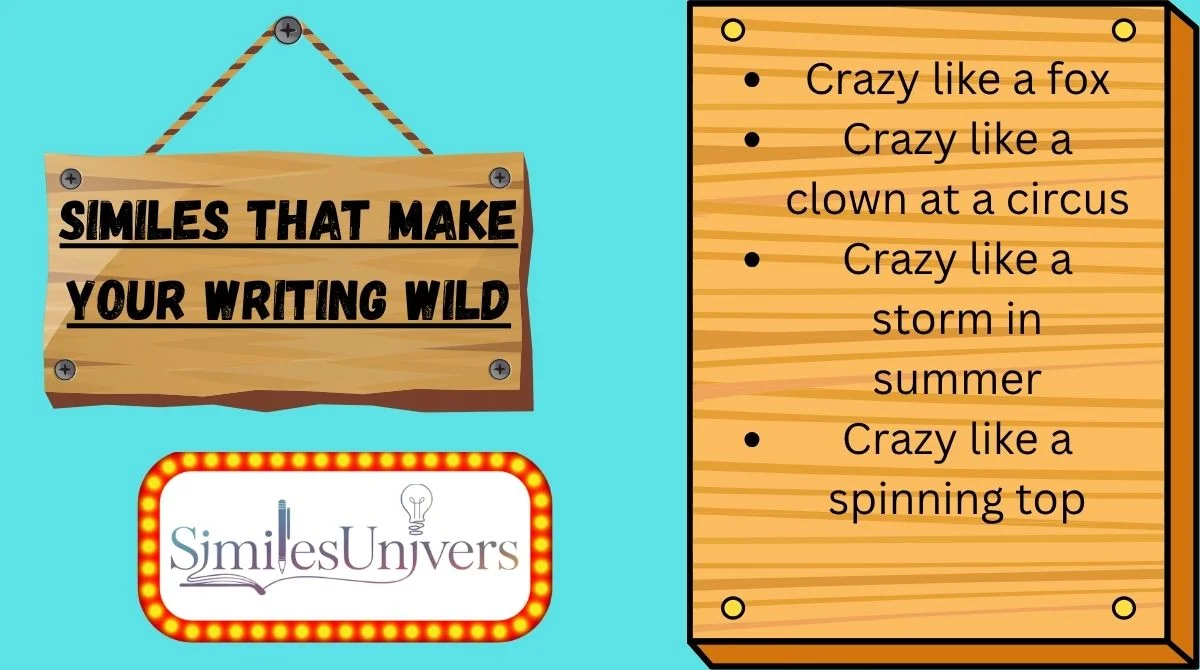
- Crazy like a fox
- Crazy like a clown at a circus
- Crazy like a storm in summer
- Crazy like a spinning top
- Crazy like fireworks in the sky
- Crazy like a monkey on sugar
- Crazy like a broken clock
- Crazy like a roller coaster
- Crazy like a buzzing beehive
- Crazy like a tornado in a field
Complete List of Similes for “Crazy” (Grouped by Meaning)
Funny & Lighthearted
Crazy like a monkey on sugar
Meaning: Very energetic and silly
Explanation: Like a monkey full of sugar, someone acts wild and playful.
Examples:
- The kids were crazy like monkeys on sugar at the party.
- He ran around crazy like a monkey on sugar.
Tone: Funny
Crazy like a clown at a circus
Meaning: Silly and over-the-top
Explanation: Clowns act strange to make people laugh.
Examples:
- She danced crazy like a clown at a circus.
- He joked around crazy like a circus clown.
Tone: Funny
Crazy like a chicken without a head
Meaning: Running around in panic
Explanation: It shows fast, confused movement.
Examples:
- He ran crazy like a chicken without a head.
- The team moved crazy like headless chickens.
Tone: Casual
Crazy like a bouncing ball
Meaning: Always moving and restless
Explanation: A ball never stays still when bouncing.
Examples:
- The puppy was crazy like a bouncing ball.
- She jumped around crazy like a ball.
Tone: Casual
Crazy like popcorn in a hot pan
Meaning: Jumping and popping everywhere
Explanation: Popcorn pops fast and wildly.
Examples:
- The kids were crazy like popcorn in a pan.
- His thoughts jumped crazy like popcorn.
Tone: Funny
Emotional & Deep
Crazy like a heart in love
Meaning: Acting wild because of love
Explanation: Love can make people behave differently.
Examples:
- She felt crazy like a heart in love.
- He acted crazy like a lovestruck heart.
Tone: Poetic
Crazy like waves in a storm
Meaning: Full of strong emotions
Explanation: Storm waves are powerful and restless.
Examples:
- Her mind felt crazy like storm waves.
- He was crazy like waves crashing in a storm.
Tone: Serious
Crazy like a mind lost in dreams
Meaning: Detached from reality
Explanation: Dreams can feel confusing and unreal.
Examples:
- He seemed crazy like a mind in dreams.
- She spoke crazy like she was dreaming.
Tone: Poetic
Crazy like a heart breaking apart
Meaning: Emotional pain causing chaos
Explanation: Heartbreak brings confusion and hurt.
Examples:
- He felt crazy like a breaking heart.
- She cried crazy like her heart was breaking.
Tone: Serious
Crazy like thoughts in the dark
Meaning: Confused and fearful thinking
Explanation: Darkness can make thoughts feel scary.
Examples:
- His mind raced crazy like thoughts in the dark.
- She felt crazy like fear in darkness.
Tone: Serious
Dramatic & Intense
Crazy like a raging storm
Meaning: Very wild and powerful
Explanation: Storms are loud and uncontrollable.
Examples:
- He shouted crazy like a raging storm.
- The crowd went crazy like a storm.
Tone: Dramatic
Crazy like a wildfire
Meaning: Spreading fast and uncontrollable
Explanation: Fire moves quickly and wildly.
Examples:
- Rumors spread crazy like wildfire.
- He grew angry crazy like fire.
Tone: Serious
Crazy like a tornado in a field
Meaning: Total chaos
Explanation: Tornadoes destroy everything in their path.
Examples:
- The room looked crazy like a tornado hit it.
- Kids ran crazy like a tornado in a field.
Tone: Dramatic
Crazy like thunder in the sky
Meaning: Loud and shocking
Explanation: Thunder surprises and startles.
Examples:
- His laugh was crazy like thunder.
- She screamed crazy like thunder.
Tone: Dramatic
Crazy like a volcano ready to erupt
Meaning: About to explode emotionally
Explanation: Volcanoes build pressure before bursting.
Examples:
- He stood crazy like a volcano.
- She felt crazy like she would explode.
Tone: Serious
Creative & Unique
Crazy like a clock that forgot time
Meaning: Out of order
Explanation: A broken sense of time feels strange.
Examples:
- His schedule was crazy like a lost clock.
- She spoke crazy like time didn’t matter.
Tone: Creative
Crazy like colors in a shattered rainbow
Meaning: Beautiful but chaotic
Explanation: Broken colors mix in wild ways.
Examples:
- Her art was crazy like a shattered rainbow.
- His ideas were crazy and bright.
Tone: Poetic
Crazy like a song with no rhythm
Meaning: Unpredictable
Explanation: Music without rhythm feels odd.
Examples:
- His speech was crazy like a broken song.
- She danced crazy like no rhythm.
Tone: Creative
Crazy like a puzzle with missing pieces
Meaning: Confusing
Explanation: Missing parts make things unclear.
Examples:
- The story felt crazy like a broken puzzle.
- His thoughts were crazy and unclear.
Tone: Casual
Crazy like shadows in flickering light
Meaning: Shifting and strange
Explanation: Shadows move oddly in light.
Examples:
- The scene looked crazy like moving shadows.
- She felt crazy in the dim light.
Tone: Poetic
Poetic & Literary
Crazy like stars spinning in the night
Meaning: Magical chaos
Explanation: Stars feel endless and wild.
Examples:
- Her dreams were crazy like spinning stars.
- He thought crazy like the night sky.
Tone: Poetic
Crazy like the wind whispering secrets
Meaning: Mysterious and strange
Explanation: Wind feels alive and unpredictable.
Examples:
- She spoke crazy like whispering wind.
- His ideas felt wild and soft.
Tone: Poetic
Crazy like a river breaking its banks
Meaning: Overflowing and unstoppable
Explanation: Rivers flood when too full.
Examples:
- His anger was crazy like a river flood.
- She cried crazy like a river.
Tone: Serious
Crazy like lightning in a dark sky
Meaning: Sudden and shocking
Explanation: Lightning appears quickly and brightly.
Examples:
- His idea came crazy like lightning.
- She acted fast and wild.
Tone: Dramatic
Crazy like echoes in empty halls
Meaning: Repeating and haunting
Explanation: Echoes feel eerie and endless.
Examples:
- His voice sounded crazy like echoes.
- The place felt strange and empty.
Tone: Poetic
Fresh and Unique Similes You Won’t Hear Every Day
- Crazy like a compass spinning without north
(Shows being lost and directionless) - Crazy like ink spilled in water
(Ideas spreading in all directions) - Crazy like a kite cut loose in the wind
(Free but uncontrolled) - Crazy like a mirror cracked into stories
(Many broken reflections at once) - Crazy like footsteps chasing their own echo
(Endless, looping confusion)
How to Use These Similes in Writing
In essays:
Use similes to explain feelings or ideas clearly. Example: “The market moved crazy like a roller coaster.”
In stories:
Use them to show action and emotion. Example: “She ran crazy like a storm chasing her.”
Keep them short and natural.
How to Create Your Own Similes (Mini Writing Guide)
Step-by-step:
- Pick what you want to describe
- Think of a strong image
- Connect with “like” or “as”
- Keep it simple
- Test if it feels clear
5 Tips:
- Use real-life images
- Avoid long comparisons
- Match tone with mood
- Be original
- Read it out loud
Transformation Examples:
- “He is crazy” → “He is crazy like a spinning top”
- “She is confused” → “She is like a lost traveler”
- “It was loud” → “It was loud like thunder”
Common Mistakes When Using Similes
Overuse: Too many similes can confuse readers
Clichés: Avoid overused lines like “crazy like a fox”
Tone mismatch: Don’t use funny similes in serious scenes
Similes for Crazy Situations and Uncontrollable Moments
Crazy like a train without brakes
Meaning: Moving quickly toward chaos with little control.
Explanation: A train without brakes creates a strong image of unstoppable action.
Examples:
- The party became crazy like a train without brakes.
- The argument grew crazy like a train without brakes.
Tone: Dramatic
Crazy like fireworks in a dry forest
Meaning: Suddenly wild, dangerous, and difficult to control.
Explanation: Fireworks suggest excitement, while a dry forest suggests rapidly spreading chaos.
Examples:
- The celebration became crazy like fireworks in a dry forest.
- The situation turned crazy like fireworks in a dry forest.
Tone: Intense
Crazy like cards flying in the wind
Meaning: Confused, scattered, and unpredictable.
Explanation: Cards blowing in different directions create an image of complete disorder.
Examples:
- The plans became crazy like cards flying in the wind.
- The meeting felt crazy like cards scattered in the wind.
Tone: Creative
Crazy like a kitchen during a food fight
Meaning: Extremely chaotic and noisy.
Explanation: A food fight creates a funny picture of people and objects moving everywhere.
Examples:
- The classroom became crazy like a kitchen during a food fight.
- The party was crazy like a kitchen during a food fight.
Tone: Funny
Crazy like a river breaking through a dam
Meaning: Suddenly uncontrollable and overwhelming.
Explanation: A broken dam releases powerful water that rushes forward without restraint.
Examples:
- The crowd became crazy like a river breaking through a dam.
- Emotions exploded crazy like a river breaking through a dam.
Tone: Dramatic
Practice Exercise
Fill in the blanks:
- He ran crazy like a ______
- Her thoughts were crazy like ______
- The room looked crazy like ______
- She laughed crazy like ______
- The storm felt crazy like ______
- He moved crazy like ______
- Her ideas spread like ______
- The crowd went crazy like ______
- His voice sounded like ______
- She felt crazy like ______
- The kids acted like ______
- His mind was like ______
Answers:
- tornado
- waves
- a tornado
- a clown
- thunder
- a bouncing ball
- wildfire
- a storm
- echoes
- a heart in love
- monkeys on sugar
- a puzzle
FAQs
What is a simile for crazy behavior?
A simile like “crazy like a monkey on sugar” shows playful, wild behavior.
What is a serious simile for crazy?
“Crazy like a raging storm” shows intense and powerful emotion.
Can similes be funny?
Yes, many similes are funny and make writing enjoyable.
Are similes good for essays?
Yes, they make ideas clearer and more engaging.
How many similes should I use?
Use a few strong ones, not too many.
Can I create my own similes?
Yes, original similes make your writing unique.
Final Thoughts
Similes turn simple words into vivid images. They help your writing stand out and connect with readers. Whether you want to sound funny, deep, or dramatic, the right simile can bring your ideas to life.
Try using these similes today—and don’t be afraid to create your own.

Daniel Harper
I am simplifies complex literary concepts into clear, practical lessons for students and learners worldwide.
Through SimilesUnivers, he aims to make mastering similes engaging, structured, and academically enriching.