Dancing is more than movement; it’s expression, emotion, and storytelling all rolled into one. But how do you capture that fluidity in words? Similes are your secret weapon.
By comparing a dancer’s motion to familiar images, you can make readers feel the rhythm, the joy, and even the exhaustion of movement.
In this guide, we’ve collected over 33 similes for dancing, from classic comparisons to fresh, unexpected ones, so you can elevate your writing with vivid, memorable imagery.
Whether you’re writing poetry, stories, or essays, these similes will help your readers almost see the dance as they read. Get ready to make your words move like never before.
What Is a Simile?
A simile is a figure of speech that compares two different things using “like” or “as” to make your description more vivid.
Example:
“Her feet moved like butterflies across the floor.”
This makes the dance delicate and light in the reader’s mind.
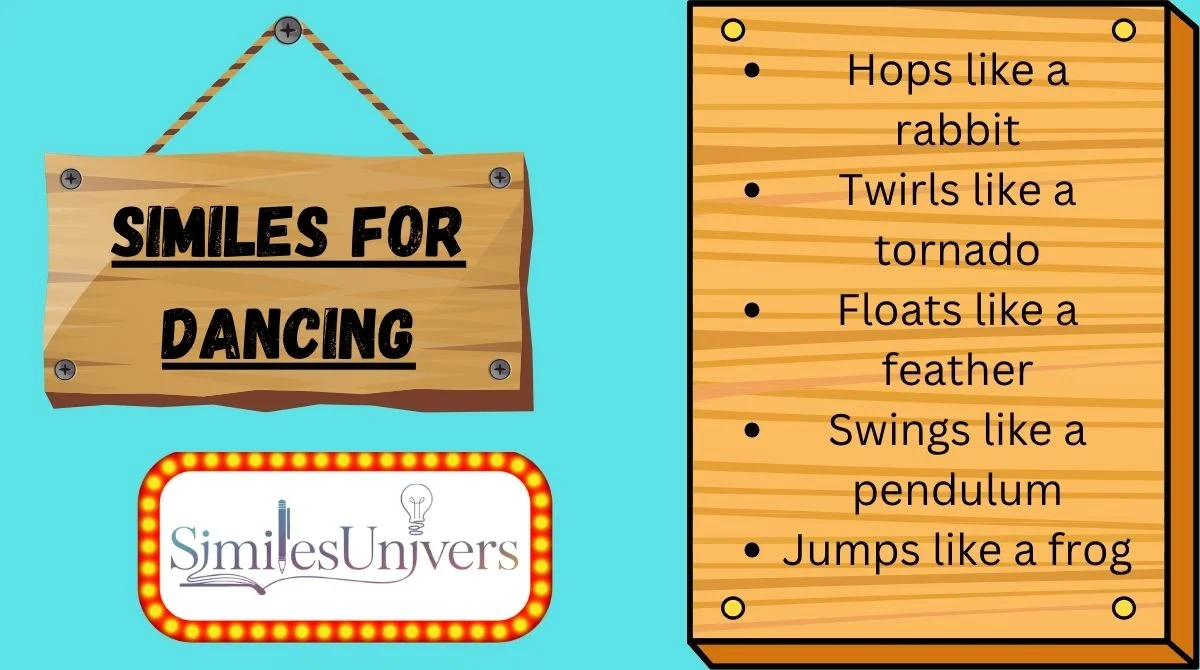
Quick List – Most Popular Similes for Dancing
- Moves like a leaf in the wind
- Spins like a top
- Glides like ice on a frozen pond
- Hops like a rabbit
- Twirls like a tornado
- Floats like a feather
- Swings like a pendulum
- Jumps like a frog
- Leaps like a gazelle
- Sways like tall grass in a breeze
Complete List of Similes for Dancing (Grouped by Meaning)
Funny & Lighthearted
Twirls like a spaghetti noodle
- Meaning: Floppy, playful movement
- Explanation: Suggests loose, silly motion that’s entertaining
- Examples:
- “The toddler twirled like a spaghetti noodle, knocking over her toy blocks.”
- “He danced at the party, twirling like a spaghetti noodle, making everyone laugh.”
- Tone: Funny
Bounces like a pogo stick
- Meaning: Energetic and springy
- Explanation: Captures rapid, lively movement
- Examples:
- “She bounced like a pogo stick across the stage.”
- “The puppy’s playful hops made him bounce like a pogo stick.”
- Tone: Funny
Jigs like a happy kangaroo
- Meaning: Excitable hopping
- Explanation: Shows cheerful, lively energy
- Examples:
- “After hearing the good news, she jiggled like a happy kangaroo.”
- “He jigs like a happy kangaroo every time his favorite song plays.”
- Tone: Funny
Wiggles like jelly
- Meaning: Soft, wobbly movement
- Explanation: Adds comic or playful imagery
- Examples:
- “The little boy wiggled like jelly when he tried to dance.”
- “Her hips wiggled like jelly to the beat.”
- Tone: Funny
Spins like a whirling cookie
- Meaning: Quick and lighthearted
- Explanation: Implies energetic and amusing motion
- Examples:
- “He spun like a whirling cookie at the school dance.”
- “She spins like a whirling cookie whenever she’s excited.”
- Tone: Funny
Emotional & Deep
Moves like a river flowing
- Meaning: Smooth and natural
- Explanation: Suggests grace and effortless motion
- Examples:
- “Her arms moved like a river flowing, soothing everyone in the room.”
- “He danced like a river flowing, every gesture connected and calm.”
- Tone: Poetic
Sways like willow branches
- Meaning: Gentle and melancholic
- Explanation: Evokes quiet, reflective motion
- Examples:
- “She swayed like willow branches in the evening breeze.”
- “His movements swayed like willow branches, soft and mesmerizing.”
- Tone: Poetic
Glides like mist over a lake
- Meaning: Ethereal and soft
- Explanation: Suggests floating with ease and subtlety
- Examples:
- “She glided like mist over a lake, leaving everyone in awe.”
- “The dancer moved like mist over a lake, almost disappearing into the stage.”
- Tone: Poetic
Floats like a dream
- Meaning: Surreal and light
- Explanation: Gives a magical, dreamy feel to motion
- Examples:
- “He floated like a dream across the ballroom floor.”
- “She danced like a dream, weightless and serene.”
- Tone: Poetic
Dances like a heartbeat
- Meaning: Natural and rhythmic
- Explanation: Evokes intimate, emotional connection
- Examples:
- “Her movements danced like a heartbeat, steady and vital.”
- “He danced like a heartbeat, every step synchronized with his soul.”
- Tone: Serious
Dramatic & Intense
Spins like a cyclone
- Meaning: Powerful, forceful movement
- Explanation: Conveys energy and drama
- Examples:
- “She spun like a cyclone, captivating everyone’s gaze.”
- “He moves like a cyclone, leaving trails of excitement.”
- Tone: Dramatic
Jumps like flames in the wind
- Meaning: Wild and unpredictable
- Explanation: Suggests sudden bursts of energy
- Examples:
- “His feet leapt like flames in the wind, fiery and untamed.”
- “She jumped like flames in the wind, igniting the stage with intensity.”
- Tone: Dramatic
Moves like a stormy sea
- Meaning: Turbulent and passionate
- Explanation: Conveys emotional and physical intensity
- Examples:
- “He moves like a stormy sea, waves crashing with every step.”
- “She danced like a stormy sea, wild and unstoppable.”
- Tone: Dramatic
Twists like a tornado
- Meaning: Spiraling, intense
- Explanation: Suggests dizzying, overwhelming energy
- Examples:
- “She twists like a tornado, drawing eyes from all corners of the room.”
- “He twirls like a tornado, unstoppable and fierce.”
- Tone: Dramatic
Leaps like a jaguar
- Meaning: Strong and precise
- Explanation: Conveys agility and explosive power
- Examples:
- “He leaps like a jaguar, sleek and deadly in his movements.”
- “Her jumps were like a jaguar, precise and full of energy.”
- Tone: Dramatic
Slow & Monotonous
Shuffles like wet sand
- Meaning: Heavy, sluggish movement
- Explanation: Evokes effort and resistance
- Examples:
- “His feet shuffled like wet sand across the floor.”
- “She shuffled like wet sand, tired and dragging.”
- Tone: Serious
Moves like a lazy cat
- Meaning: Slow, relaxed
- Explanation: Suggests casual or deliberate motion
- Examples:
- “She moves like a lazy cat, stretching each step.”
- “He danced like a lazy cat, unhurried and smooth.”
- Tone: Casual
Drags like melting wax
- Meaning: Slow and heavy
- Explanation: Evokes a sense of melting or sagging movement
- Examples:
- “His steps dragged like melting wax across the stage.”
- “She danced like melting wax, slow and pliable.”
- Tone: Serious
Creative & Unique
Moves like sunlight through stained glass
- Meaning: Colorful and fragmented
- Explanation: Suggests beauty and variety in motion
- Examples:
- “She moved like sunlight through stained glass, casting patterns on the floor.”
- “His dancing was like sunlight through stained glass, bright and captivating.”
- Tone: Poetic
Spins like autumn leaves
- Meaning: Gentle and swirling
- Explanation: Evokes natural, whimsical motion
- Examples:
- “He spun like autumn leaves, carried by the invisible wind.”
- “She twirled like autumn leaves, drifting with the rhythm.”
- Tone: Poetic
Jumps like a spark from a fire
- Meaning: Quick, energetic, fleeting
- Explanation: Suggests sudden and lively motion
- Examples:
- “He jumped like a spark from a fire, lighting up the dance floor.”
- “She leaps like a spark from a fire, fleeting and exciting.”
- Tone: Creative
Poetic & Literary
Moves like shadows at dusk
- Meaning: Subtle and mysterious
- Explanation: Suggests elegance and quiet intensity
- Examples:
- “Her dance moved like shadows at dusk, delicate and fleeting.”
- “He glides like shadows at dusk, almost unseen but mesmerizing.”
- Tone: Poetic
Flows like ink in water
- Meaning: Smooth and spreading
- Explanation: Evokes artful, flowing motion
- Examples:
- “She flows like ink in water, spreading beauty with each step.”
- “He dances like ink in water, graceful and unstoppable.”
- Tone: Poetic
Moves like a poem in motion
- Meaning: Harmonious, expressive
- Explanation: Suggests carefully crafted beauty in movement
- Examples:
- “She moves like a poem in motion, every gesture telling a story.”
- “He dances like a poem in motion, elegant and full of meaning.”
- Tone: Poetic
Fresh and Unique Similes You Won’t Hear Every Day
- Dances like constellations shifting – Each movement is precise but part of a larger cosmic pattern.
- Spins like a teacup in a gentle storm – Lighthearted but unpredictable motion.
- Glides like silk pulled through water – Smooth, tactile elegance.
- Moves like an echo in a canyon – Every step resonates and lingers.
- Leaps like a thought in a quiet mind – Sudden, light, and surprising.
How to Use These Similes in Writing
- Essays: Use similes to make descriptions vivid, e.g., “The dancer moved like sunlight through stained glass, brightening the room.”
- Stories: Bring characters to life by linking their emotions with movement, e.g., “She spun like autumn leaves, lost in her joy.”
How to Create Your Own Similes (Mini Writing Guide)
Step-by-step method:
- Identify the movement or feeling.
- Think of a visual or sensory comparison.
- Use “like” or “as” to connect them.
5 practical tips:
- Keep comparisons simple.
- Use familiar images for clarity.
- Avoid clichés.
- Match tone with context.
- Experiment with unusual objects for originality.
Transformation examples:
- “He moves gracefully” → “He moves like liquid moonlight.”
- “She jumps high” → “She jumps like sparks from a fire.”
- “He dances slowly” → “He dances like a shadow at dusk.”
Common Mistakes When Using Similes
- Overuse: Too many similes can confuse readers.
- Clichés: Avoid overused comparisons like “as light as a feather.”
- Tone mismatch: Funny similes in serious scenes can feel jarring.
Practice Exercise
Fill in the blanks with a suitable simile from the list:
- She twirled __________ across the ballroom.
- He bounced __________ when he heard the news.
- The dancer floated __________ across the stage.
- Her arms moved __________ with every beat.
- He spun __________ in excitement.
- She jumped __________ over the puddles.
- His steps dragged __________ on the carpet.
- She moves __________ in her dreams.
- He twirls __________ in the moonlight.
- Her dance flowed __________ like a stream.
- He leaps __________ with each rhythm.
- She jigged __________ at the festival.
Answers:
- like a leaf in the wind
- like a pogo stick
- like a dream
- like a river flowing
- like a tornado
- like a frog
- like melting wax
- like constellations shifting
- like autumn leaves
- like ink in water
- like a jaguar
- like a happy kangaroo
FAQs
What is a simile for dancing?
A simile for dancing is a comparison that describes movement using “like” or “as” to create vivid imagery.
How many similes for dancing are there?
There are countless options, but this guide provides 33+ high-quality examples, grouped by tone and style.
Can similes improve writing?
Yes! Similes make writing more visual, emotional, and engaging.
Are similes different from metaphors?
Yes. Similes use “like” or “as,” while metaphors state the comparison directly.
Can I create my own similes?
Absolutely. Observe motion, think visually, and compare using “like” or “as.”
What mistakes should I avoid with similes?
Avoid overuse, clichés, and tone mismatches that confuse the reader.
Final Thoughts
Similes bring movement to life. From playful spins to deep emotional sways, the right comparison can make your readers feel the dance instead of just reading about it. With over 33 creative similes and techniques to craft your own, you’re now equipped to make your writing dance on the page. Experiment, have fun, and let every word move with rhythm and grace.

Daniel Harper
I am simplifies complex literary concepts into clear, practical lessons for students and learners worldwide.
Through SimilesUnivers, he aims to make mastering similes engaging, structured, and academically enriching.