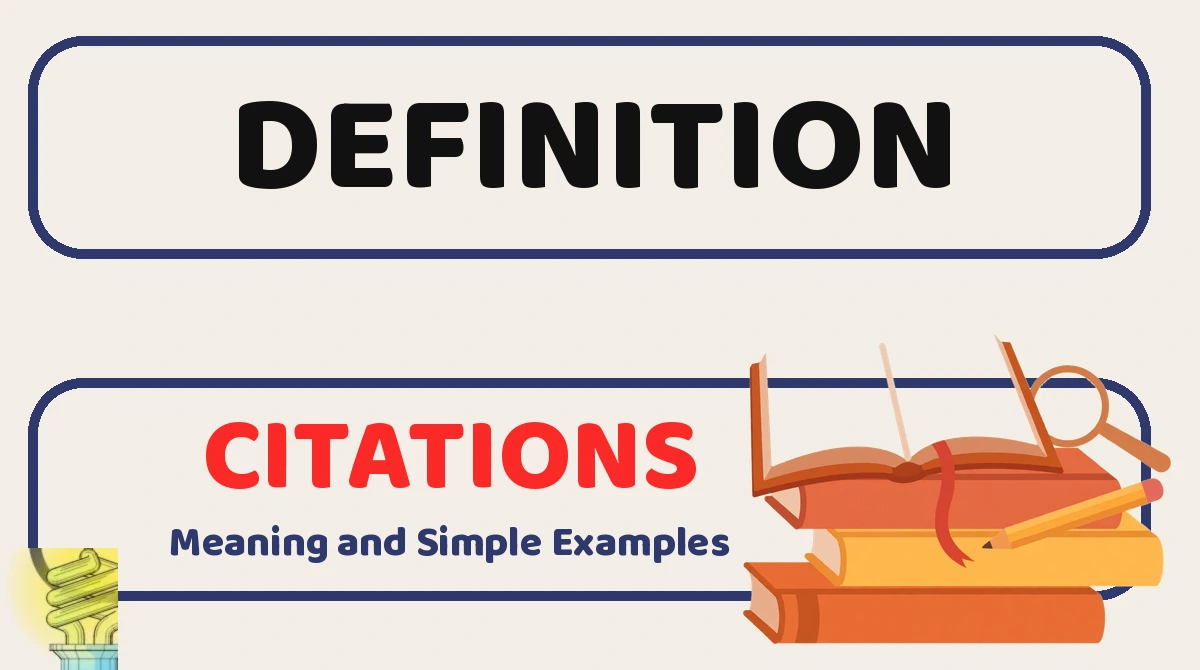
Have you ever read a school essay and seen small notes that tell where the facts came from? Those notes are citations. A citation is a clear note that points to the source of an idea, a quote, or a fact. The citations definition covers two main uses of the word: in study and writing, it means giving credit to books, sites, and authors; in law, it means an official order to appear in court, often for a traffic offence. This article explains both meanings in simple words, with styles, clear examples, and the reasons citations matter so much today.
What Is the Citations Definition?
The citations definition is this: a citation is a formal reference that names the source of information, words, or ideas, so a reader can find and check that source.
In writing, a citation is a kind of pointer. It may be a short note in brackets after a sentence, a number that leads to a list at the end, or a footnote at the foot of the page. Whatever its shape, it always answers the same two questions: whose work is this, and where can I find it?
The word comes from a Latin root meaning “to call” or “to summon.” That root fits both uses of the word well: a citation in an essay calls up the source for the reader to see, and a legal citation summons a person to court.
Citations in School and Study Writing
In school, college, and all serious writing, a citation is used whenever you lean on someone else’s work. You cite when you quote exact words, when you restate another writer’s idea in your own words, and when you use facts, figures, or findings that you did not produce yourself.
For example, a student writing about climate may quote a line from a famous scientist, restate a report’s findings on sea levels, and give the date of a record storm. All three need citations, each one naming the book, report, or site the point came from.
Citations are not decoration. They are the trail that lets a teacher, an examiner, or any reader walk back from your sentence to the source and check that you used it fairly and read it rightly. A paper with good citations can be trusted in a way that a paper without them cannot.
The Main Citation Styles: MLA, APA, and Chicago
Writers follow set styles — agreed patterns for how citations look. The three best-known styles differ in small ways:
| Style | Full Name | Used Mostly In | In-Text Shape |
|---|---|---|---|
| MLA | Modern Language Association | English, languages, humanities | (Smith 45) — author and page |
| APA | American Psychological Association | Psychology, education, social sciences | (Smith, 2020) — author and year |
| Chicago | Chicago Manual of Style | History, publishing, many books | Footnotes, or author and year |
Each style also fixes the shape of the end list — called Works Cited in MLA, References in APA, and a Bibliography in Chicago style.
The styles differ only in details: where the year sits, which words are capitalised, how the title is shown. The job is the same in all three — name the source so clearly that any reader can find it again.
What a Citation Includes
However it is styled, a full citation needs the same core facts about the source:
- Author — who wrote or made the work
- Title — the name of the book, article, chapter, or page
- Publisher or site — who issued it, or the journal or website that carries it
- Date — the year (sometimes the full date) it was published
- Page numbers — for a part of a longer work, such as a chapter or article
- Web address and access date — for online sources, which can change or vanish
For example, a book citation in MLA style looks like this: Smith, John. The Study of Rivers. River Press, 2020. An article adds the journal name, the volume, and the pages. Leave out a piece, and the trail goes cold — the reader cannot find the source, and the citation has failed at its one job.
In-Text Citations and Reference Lists
Academic citations work as a pair of parts. The in-text citation is the short pointer inside your writing, placed right where you use the source. It is brief on purpose — just enough to name the source without breaking the reader’s flow.
The reference list sits at the end of the paper and gives the full details of every source cited, in alphabetical order by author. The short pointer and the full entry are linked: read the pointer, find the entry, and you hold the whole address of the source.
Think of it like a map and a key. The in-text note is the mark on the map; the list at the end is the key that tells you exactly what the mark stands for. Both parts are needed. A pointer with no list entry is a dead end, and a list entry that is never pointed to is dead weight.
Why Citations Matter: Credit, Proof, and Honesty
Citations do three jobs at once, and all three matter.
First, credit. Writers and researchers did the work; naming them is simple fairness. A citation says: this idea is theirs, and I honour that.
Second, proof. A claim backed by a named, checkable source is stronger than a bare claim. Citations let your reader test you — and a writer who invites testing is a writer who can be believed.
Third, honesty. Using another’s words or ideas without credit is plagiarism, a serious offence in schools and in publishing, which can fail a course or end a career. Citations are how honest writers draw the line between what they found and what they think.
For example, a science report that cites its studies can be repeated and checked by other scientists. That chain of checking, link by link, is how knowledge grows to be reliable.
Citations in Law: Court Orders and Tickets
The word citation has a second life in law. A legal citation of this kind is an official written order that tells a person to appear in court at a set time.
The most common example is a traffic citation — the ticket a police officer gives a driver for speeding, running a red light, or parking wrongly. The ticket names the offence, the law it breaks, and the date by which the driver must pay a fine or come to court to answer.
Citations are also used for minor offences outside traffic: littering, fishing without a licence, or letting a dog run loose, where the matter is too small for an arrest but too real to ignore. In these cases the citation stands in place of arrest: sign it, promise to appear or pay, and go on your way.
Legal Citations: How Cases and Laws Are Named
Law has a third use of the word, close to the writing sense. Lawyers and judges cite cases and laws as sources for their arguments, and each case has a standard citation that works like an address.
A case citation gives the volume number, the name of the law report (often shortened), and the page number where the case begins, often with the year and the court. Statutes — written laws — are cited by their title and section, so any lawyer can turn to the exact words of the law.
This is the same idea as the essay citation, dressed for court: name the source so exactly that anyone can find it and check what it says. Court rules even fix the style, much like MLA or APA, so that every citation in every brief points the same way.
Common Citation Mistakes to Avoid
Most citation trouble comes from a few common slips. All are easy to fix once you know them:
- Forgetting to cite a restated idea — changing the words does not make the idea yours
- Citing a source you never read — copying citations from other papers spreads errors
- Missing details — no year, no pages, no publisher, so the source cannot be found
- Mixed styles — half MLA, half APA, so the paper looks careless
- Quote marks missing — exact words without quote marks read as your own words
- Dead web links — no access date and no site name to search by
For example, a student who restates a whole paragraph from a website in fresh words, with no citation, has still plagiarised — the ideas and the order are borrowed, even if every word was changed. The fix costs one line: a proper citation.
How to Write a Citation Step by Step
Writing a sound citation is a simple habit, done best at the moment you use the source, not at the end of the work:
- Note the source at once — as you read, write down author, title, date, and pages or web address
- Mark quotes exactly — copy quoted words letter for letter, with the page number
- Choose one style — the one your teacher, journal, or court requires — and use it throughout
- Place the pointer — put the in-text citation right after the borrowed words or idea
- Build the list as you go — add each full entry to the end list the same day
- Check at the end — every pointer has a list entry, and every entry is pointed to
Many writers use free citation tools or the reference features built into word processors to shape entries in MLA, APA, or Chicago style. The tools save time, but the writer must still check them — a tool cannot know if you typed the author’s name wrong.
People Also Ask About Citations Definition
What is the citations definition in simple words?
In simple words, a citation is a note that names the source of words, ideas, or facts you have used, so readers can find and check it. In writing it gives credit to authors; in law it can also mean an official order to appear in court.
Why do students have to use citations?
Citations give credit to the writers whose work they used, let teachers check the sources, and keep the work honest. Without citations, borrowed ideas look like the student’s own, which is plagiarism — a serious offence that can fail a course.
What is the difference between MLA and APA citations?
Both name sources, but the details differ. MLA, used in English and humanities, stresses the author and page: (Smith 45). APA, used in psychology and social sciences, stresses the author and year: (Smith, 2020). Each style also shapes the end list in its own way.
What is a traffic citation?
A traffic citation is the official ticket a police officer gives for a road offence such as speeding. It names the offence and the law, and orders the driver to pay a fine or appear in court by a set date. It is sometimes simply called a ticket.
What happens if you do not cite a source?
If you use another writer’s words or ideas without a citation, it counts as plagiarism, even if you changed the words. In school it can mean a failed paper or course; in work and publishing it can mean lost trust, a lost job, or legal trouble.
What is the difference between a citation and a bibliography?
A citation is a single note naming one source. A bibliography is the whole list of sources at the end of a work — every book, article, and site you used or read. Each entry in the bibliography is, in effect, one full citation.
How do lawyers use citations?
Lawyers cite past cases and statutes to support their arguments. Each case has a standard citation — volume, law report, and page — that acts as an exact address, so judges and other lawyers can find the case and check what it decided.
Conclusion
The citations definition joins two worlds with one idea: a citation names its source exactly, whether it is crediting an author in an essay or summoning a driver to court.
In study, citations keep writing honest, provable, and fair. In law, they keep orders clear and cases findable. Learn to cite well, and your work can be checked, trusted, and built upon by others.

Daniel Harper
I am simplifies complex literary concepts into clear, practical lessons for students and learners worldwide.
Through SimilesUnivers, he aims to make mastering similes engaging, structured, and academically enriching.