Words can paint pictures. A strong simile turns a plain sentence into something bright and alive. Instead of saying “She was brave,” you can say, “She was brave like a lion.” Now we see her courage.
Similes help writers show feelings, speed, fear, beauty, and more. They make ideas easy to imagine. From classic novels to modern stories, similes add color and emotion.
In this guide, you’ll find more than 21 powerful similes examples in literature. You’ll learn what they mean, how to use them, and even how to create your own.
Whether you’re a student, teacher, or writer, this guide will help your writing glow.
Similes for Famous Characters in Literature
- As brave as a lion — Describes a character who faces danger without fear.
- As clever as a fox — Describes a smart and resourceful character.
- As gentle as a dove — Shows a kind, peaceful, and caring personality.
- As stubborn as a mule — Describes a character who refuses to change their mind.
- As wise as an old owl — Suggests deep knowledge and good judgment.
- Like a shadow in the dark — Describes a mysterious character who stays hidden.
- As strong as an oak tree — Shows physical or emotional strength.
- Like a candle in the darkness — Represents a character who brings hope during difficult times.
- As restless as a caged bird — Describes someone who desperately wants freedom.
- Like a storm on the horizon — Suggests a character whose arrival brings tension or trouble.
What Is a Simile? (Quick Clear Definition)
A simile is a comparison between two different things using the words “like” or “as.”
It helps readers imagine something clearly.
Example: Her smile was as bright as the sun.
Quick List – Most Popular Similes for “Similes in Literature”
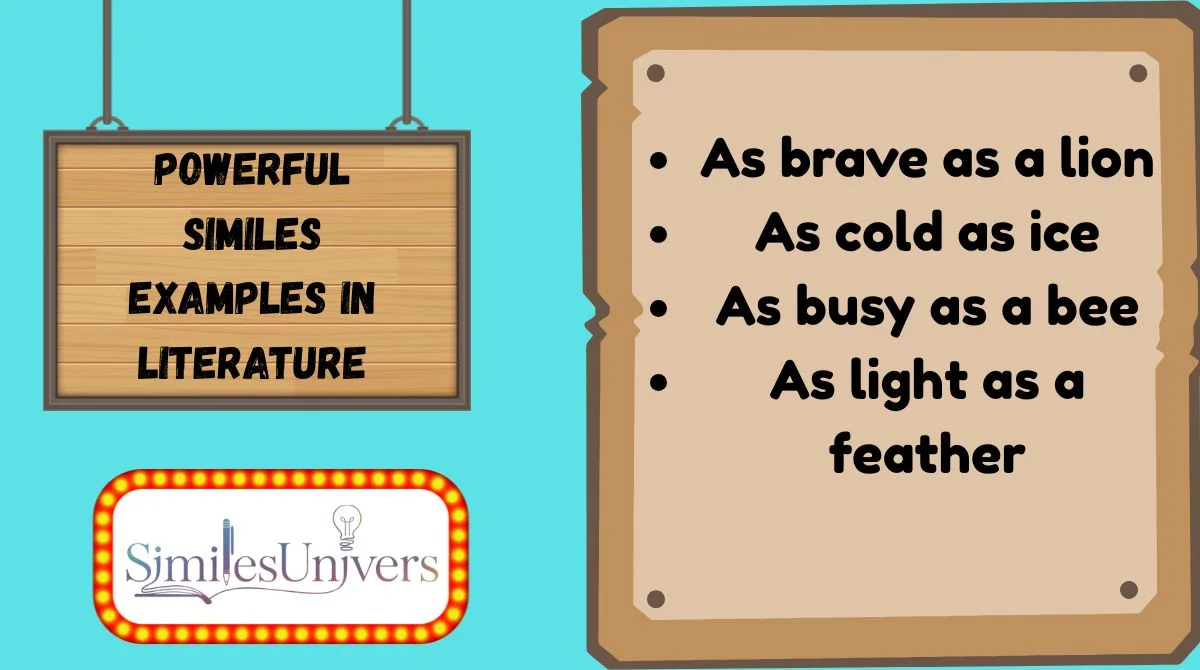
- As brave as a lion
- As cold as ice
- As busy as a bee
- As light as a feather
- Like a fish out of water
- As quiet as a mouse
- Like a bolt of lightning
- As slow as a turtle
- Like a shadow in the night
- As strong as an ox
Complete List of Similes for “Similes Examples in Literature” (Grouped by Meaning)
Funny & Lighthearted Similes
As clumsy as a newborn giraffe
Meaning: Very awkward.
Explanation: A baby giraffe wobbles when it walks.
Examples:
- He felt as clumsy as a newborn giraffe on the dance floor.
- I was as clumsy as a newborn giraffe in high heels.
Tone: Funny
Like popcorn in a hot pan
Meaning: Full of energy.
Explanation: Popcorn jumps quickly when heated.
Examples:
- The kids were bouncing like popcorn in a hot pan.
- Her ideas popped like popcorn in a hot pan.
Tone: Casual
As chatty as a radio host
Meaning: Talks a lot.
Explanation: Radio hosts speak nonstop.
Examples:
- She was as chatty as a radio host at lunch.
- My cousin is as chatty as a radio host at family dinners.
Tone: Funny
Emotional & Deep Similes
Like rain on a broken roof
Meaning: Painful and constant sadness.
Explanation: Rain leaking through a roof feels never-ending.
Examples:
- His grief fell like rain on a broken roof.
- The memories hit her like rain on a broken roof.
Tone: Serious
As fragile as thin glass
Meaning: Easily hurt.
Explanation: Thin glass can break with one touch.
Examples:
- Her heart felt as fragile as thin glass.
- Trust is as fragile as thin glass.
Tone: Serious
Like a candle in the wind
Meaning: Weak but hopeful.
Explanation: A candle flickers but still shines.
Examples:
- His hope burned like a candle in the wind.
- She stood like a candle in the wind, still brave.
Tone: Poetic
Dramatic & Intense Similes
Like thunder cracking the sky
Meaning: Sudden and powerful.
Explanation: Thunder is loud and shocking.
Examples:
- His shout was like thunder cracking the sky.
- The news hit like thunder cracking the sky.
Tone: Dramatic
As fierce as a wildfire
Meaning: Wild and unstoppable.
Explanation: Wildfires spread fast and destroy everything.
Examples:
- Her anger was as fierce as a wildfire.
- The competition burned as fierce as a wildfire.
Tone: Intense
Like a blade through silk
Meaning: Smooth and sharp at the same time.
Explanation: A blade cuts silk easily and cleanly.
Examples:
- His words sliced like a blade through silk.
- The skater moved like a blade through silk.
Tone: Serious
Slow & Monotonous Similes
As slow as winter sunrise
Meaning: Very slow.
Explanation: Winter mornings brighten slowly.
Examples:
- The meeting moved as slow as winter sunrise.
- Time felt as slow as winter sunrise.
Tone: Casual
Like paint drying on a wall
Meaning: Extremely boring.
Explanation: Watching paint dry is dull.
Examples:
- The lecture was like paint drying on a wall.
- Waiting there felt like paint drying on a wall.
Tone: Funny
As steady as dripping water
Meaning: Slow but constant.
Explanation: Water drips again and again.
Examples:
- His footsteps were as steady as dripping water.
- The clock ticked as steady as dripping water.
Tone: Neutral
Creative & Unique Similes (Less Common)
Like a map with missing roads
Meaning: Confused and unsure.
Explanation: A map without roads cannot guide you.
Examples:
- I felt like a map with missing roads.
- Her plan was like a map with missing roads.
Tone: Creative
As bright as glass catching morning light
Meaning: Shining and clear.
Explanation: Sunlight reflects sharply off glass.
Examples:
- Her eyes were as bright as glass catching morning light.
- His idea was as bright as glass catching morning light.
Tone: Poetic
Like footsteps fading in snow
Meaning: Slowly disappearing.
Explanation: Snow covers prints quietly.
Examples:
- The sound faded like footsteps in snow.
- His memory slipped away like footsteps in snow.
Tone: Poetic
As restless as a tide before a storm
Meaning: Nervous and uneasy.
Explanation: The sea moves wildly before storms.
Examples:
- She felt as restless as a tide before a storm.
- The crowd grew as restless as a tide before a storm.
Tone: Dramatic
Poetic & Literary Similes
Like stars scattered across velvet
Meaning: Beautiful and sparkling.
Explanation: Stars shine against dark sky.
Examples:
- The city lights spread like stars across velvet.
- Her necklace glittered like stars across velvet.
Tone: Poetic
As silent as falling snow
Meaning: Completely quiet.
Explanation: Snow falls without sound.
Examples:
- The room was as silent as falling snow.
- He moved as silent as falling snow.
Tone: Calm
Like a whisper in a cathedral
Meaning: Soft yet powerful.
Explanation: A whisper echoes in a large space.
Examples:
- Her voice carried like a whisper in a cathedral.
- The truth spread like a whisper in a cathedral.
Tone: Literary
As endless as the horizon
Meaning: Never-ending.
Explanation: The horizon seems to go on forever.
Examples:
- His dreams were as endless as the horizon.
- The desert stretched as endless as the horizon.
Tone: Poetic
Fresh and Unique Similes You Won’t Hear Every Day
- Like a clock ticking underwater – Suggests muted urgency.
- As fragile as frost on window glass – Beautiful but short-lived.
- Like a library after midnight – Quiet but full of hidden stories.
- As sharp as winter air at dawn – Clear and biting.
- Like a bridge made of paper – Weak support that won’t last.
These similes work because they create strong mental pictures. They mix everyday objects with emotion.
How to Use These Similes in Writing
In Essays
- Use similes to explain ideas clearly.
- Add them in introductions for strong hooks.
- Use them to compare themes or emotions.
Example:
“Hope in the novel burns like a candle in the wind.”
In Stories
- Show emotions instead of telling them.
- Make characters feel real.
- Add drama to scenes.
Example:
“She stood as fierce as a wildfire, ready to fight.”
How to Create Your Own Similes (Mini Writing Guide)
Step-by-Step Method
- Pick a feeling or action.
- Think of an object that shows it clearly.
- Connect them using “like” or “as.”
- Check if the image is easy to picture.
- Make it short and clear.
5 Practical Tips
- Use nature for strong images.
- Avoid tired clichés.
- Match tone to mood.
- Keep it simple.
- Read it out loud.
3 Transformation Examples
Plain: She was nervous.
Simile: She was as nervous as a leaf in strong wind.
Plain: The room was quiet.
Simile: The room was as silent as falling snow.
Plain: He ran fast.
Simile: He ran like lightning across the field.
Common Mistakes When Using Similes
Overuse
Too many similes can confuse readers.
Clichés
“As busy as a bee” is common. Try fresh ideas.
Tone Mismatch
Don’t use funny similes in serious scenes.
Similes for Literary Themes and Emotions
- Love like a blooming rose — Represents beauty, growth, and affection.
- Grief like rain on an empty street — Creates an image of quiet and lasting sadness.
- Hope like a candle in the darkness — Shows a small but powerful source of comfort.
- Fear like ice in the veins — Describes sudden and intense fear.
- Anger like a raging fire — Shows powerful emotion that can quickly spread.
- Loneliness like a deserted road — Suggests emptiness and isolation.
- Freedom like a bird released from a cage — Represents relief and independence.
- Memories like footprints in the sand — Suggests experiences that remain but may slowly disappear.
- Time like a river — Shows how time keeps moving forward.
- Dreams like stars beyond reach — Represents hopes that seem distant but inspiring.
Practice Exercise
Fill in the blanks:
- He was as brave as a _______.
- Her smile shone like _______.
- The night was as silent as _______.
- His anger spread like _______.
- She felt like a _______ with missing roads.
- The baby slept as peaceful as _______.
- Time moved as slow as _______.
- Her voice echoed like _______.
- Hope flickered like _______.
- The city lights sparkled like _______.
- The test felt like _______ drying on a wall.
- His dream stretched as endless as _______.
Answers
- lion
- the sun
- falling snow
- a wildfire
- map
- falling snow
- winter sunrise
- thunder cracking the sky
- a candle in the wind
- stars across velvet
- paint
- the horizon
FAQs
What are similes in literature?
Similes are comparisons using “like” or “as” to create vivid images in writing.
Why do authors use similes?
They make ideas clearer and more emotional.
What is the difference between a simile and a metaphor?
A simile uses “like” or “as.” A metaphor does not.
Are similes good for essays?
Yes. They help explain ideas clearly.
Can similes be funny?
Yes. Many similes are playful and light.
How many similes should I use in one paragraph?
Usually one or two. Too many can distract readers.
Final Thoughts
Similes make writing brighter, deeper, and more powerful. They help readers see what you mean. Whether you use classic comparisons or fresh creative ones, the key is clarity and emotion.
Now you have 21+ powerful similes examples in literature, plus tools to create your own. Use them wisely, and your writing will shine like stars across velvet.
Daniel Harper
I am simplifies complex literary concepts into clear, practical lessons for students and learners worldwide.
Through SimilesUnivers, he aims to make mastering similes engaging, structured, and academically enriching.