Do you struggle to describe someone who’s mean or unkind without sounding repetitive?
Words alone often fall flat, but a well-crafted simile can bring your writing to life. Similes help readers see, feel, and experience the traits of a character instead of just reading about them.
Using vivid comparisons transforms your descriptions from plain text into memorable images.
Whether you’re writing stories, essays, or even social media posts, knowing the right similes can make your writing sharper and more expressive.
In this guide, you’ll discover over 29 high-quality similes for “mean,” including classic favorites, fresh creative options, and tips for creating your own. By the end, you’ll have a toolkit to convey meanness with humor, drama, or poetic flair.
What Is a Simile? (Quick Clear Definition)
A simile is a figure of speech that compares two different things using the words “like” or “as.” It makes descriptions more vivid and relatable.
Example: He was as mean as a swarm of bees.
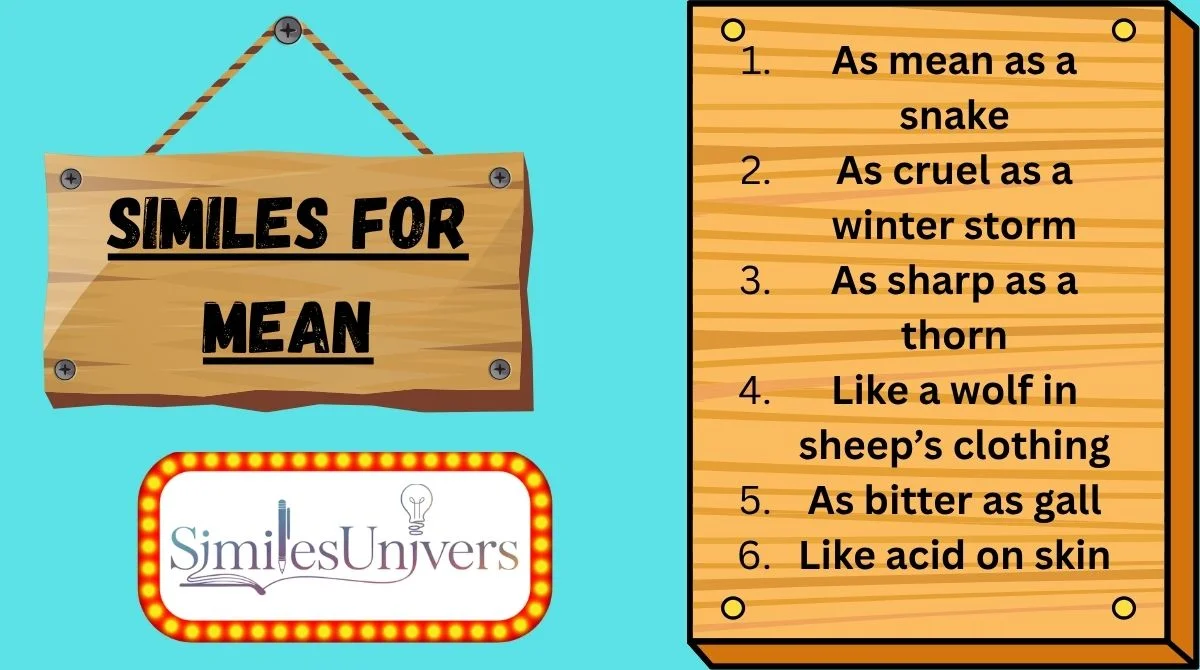
Quick List – Most Popular Similes for “Mean”
- As mean as a snake
- As cruel as a winter storm
- As sharp as a thorn
- Like a wolf in sheep’s clothing
- As bitter as gall
- Like acid on skin
- As cold as ice
- As harsh as a whip
- Like fire in the eyes
- As cutting as a knife
Complete List of Similes for “Mean” (Grouped by Meaning)
Funny & Lighthearted
As mean as a grumpy cat
Meaning: Someone small but irritable.
Explanation: Highlights a petty yet amusing kind of meanness.
Examples:
- My little brother is as mean as a grumpy cat when he doesn’t get his toy.
- She was as mean as a grumpy cat when someone touched her dessert.
Tone: Funny
As stingy as a tightwad squirrel
Meaning: Unwilling to share.
Explanation: Evokes an image of hoarding, common in squirrels, humorously linked to human meanness.
Examples:
- Grandpa is as stingy as a tightwad squirrel with his allowance.
- He’s as stingy as a tightwad squirrel during lunch break.
Tone: Funny
Like a lemon that never sweetens
Meaning: Always sour or critical.
Explanation: A twist on taste imagery to describe someone perpetually mean.
Examples:
- Her comments were like a lemon that never sweetens.
- Dealing with him is like a lemon that never sweetens—you can’t escape the sourness.
Tone: Funny
Emotional & Deep
As mean as a shattered heart
Meaning: Emotional cruelty.
Explanation: Captures pain caused intentionally or unknowingly.
Examples:
- His words were as mean as a shattered heart to anyone who trusted him.
- She gave advice as mean as a shattered heart, cutting deep with sorrow.
Tone: Serious
Like a shadow that bites
Meaning: Quietly harmful, subtly cruel.
Explanation: Suggests lurking meanness that attacks without warning.
Examples:
- Her criticism was like a shadow that bites, subtle yet painful.
- He lurked in meetings like a shadow that bites, making colleagues uneasy.
Tone: Serious
As bitter as black coffee
Meaning: Sharp, harsh personality.
Explanation: Conveys acerbic and uncompromising meanness.
Examples:
- She’s as bitter as black coffee when someone disagrees with her.
- His tone was as bitter as black coffee, impossible to soften.
Tone: Serious
Dramatic & Intense
As mean as a razor’s edge
Meaning: Dangerous, cutting remarks or actions.
Explanation: Suggests someone whose meanness can hurt instantly.
Examples:
- He delivered his message as mean as a razor’s edge.
- Her rejection was as mean as a razor’s edge, leaving him stunned.
Tone: Dramatic
Like fire in the veins
Meaning: Aggressive or violent meanness.
Explanation: Implies intense anger or malice.
Examples:
- He attacked the plan like fire in the veins.
- Her glare was like fire in the veins, threatening anyone nearby.
Tone: Dramatic
As cruel as winter frost
Meaning: Cold, unforgiving behavior.
Explanation: Winter frost is harsh and unyielding, similar to cruel people.
Examples:
- His rejection was as cruel as winter frost.
- The teacher’s comments were as cruel as winter frost.
Tone: Dramatic
Slow & Monotonous
Like a dripping faucet
Meaning: Persistently annoying or mean in a minor way.
Explanation: Slow, repetitive meanness that wears others down.
Examples:
- Her teasing was like a dripping faucet, constant and irritating.
- He reminded me of deadlines like a dripping faucet—never letting up.
Tone: Casual
As dull as a concrete wall
Meaning: Emotionless or harshly indifferent.
Explanation: Describes someone mean through apathy rather than aggression.
Examples:
- He stared as dull as a concrete wall while she cried.
- Her rejection was as dull as a concrete wall, offering no warmth.
Tone: Serious
Creative & Unique
As mean as a cactus in a sandbox
Meaning: Unexpectedly sharp or hurtful in an unusual setting.
Explanation: Combines playfulness with sharp imagery for originality.
Examples:
- His remarks were as mean as a cactus in a sandbox.
- She’s as mean as a cactus in a sandbox when provoked.
Tone: Creative
Like a storm cloud with teeth
Meaning: Danger hidden in appearance.
Explanation: Personifies meanness with imagery of a menacing cloud.
Examples:
- He approached like a storm cloud with teeth, ready to scold.
- Her anger came like a storm cloud with teeth, unexpected but terrifying.
Tone: Creative
As sneaky as spilled ink
Meaning: Subtle mischief or harmful intent.
Explanation: Suggests mean actions that spread quietly and damage unexpectedly.
Examples:
- He was as sneaky as spilled ink, ruining plans without notice.
- Her gossip spread as sneaky as spilled ink.
Tone: Creative
Poetic & Literary
As mean as winter shadows
Meaning: Dark, lingering harshness.
Explanation: Evokes literary imagery of coldness and darkness.
Examples:
- Her presence was as mean as winter shadows, chilling the room.
- He lingered as mean as winter shadows over their hopes.
Tone: Poetic
Like thorned roses
Meaning: Beauty hiding cruelty.
Explanation: Suggests someone charming yet hurtful.
Examples:
- She smiled like thorned roses, beautiful but sharp.
- His compliments were like thorned roses, hiding intent behind charm.
Tone: Poetic
As cutting as winter wind
Meaning: Sharp, penetrating meanness.
Explanation: Uses natural harshness as metaphor for verbal cruelty.
Examples:
- His criticism was as cutting as winter wind.
- She left as cutting as winter wind, leaving everyone shivering.
Tone: Poetic
Fresh and Unique Similes You Won’t Hear Every Day
- Like a chessboard with missing pieces – Suggests someone strategic in cruelty, but incomplete in empathy.
- As mean as spilled starlight – Innocent yet destructive in appearance.
- Like shadows chewing at sunlight – Stealthy and draining negativity.
- As sharp as a glass harp – Beautiful in form but painfully harsh.
- Like a frozen ink pen – Unable to create warmth, only leaving cold marks.
Imagery Explanation: These similes combine familiar concepts with unexpected twists to spark imagination while describing meanness vividly.
How to Use These Similes in Writing
- Essays: Use similes to strengthen descriptive writing and make arguments more relatable.
- Stories: Bring characters to life with precise, visual comparisons. Place similes in dialogue, narration, or internal thoughts.
How to Create Your Own Similes (Mini Writing Guide)
Step-by-Step Method:
- Identify the trait you want to describe.
- Brainstorm images from nature, objects, or animals.
- Compare using “like” or “as.”
- Ensure it’s vivid and understandable.
- Check tone consistency.
5 Practical Tips:
- Keep it short and punchy.
- Avoid clichés unless purposefully humorous.
- Match simile to audience age and context.
- Mix humor and seriousness for variety.
- Read aloud to test flow.
3 Transformation Examples:
- He is mean → He’s like a frostbite on a sunny day.
- She’s cruel → She’s as cruel as a locked gate in a storm.
- His sarcasm → His sarcasm is like barbed wire around a hug.
Common Mistakes When Using Similes
- Overuse: Too many similes can overwhelm writing.
- Clichés: Phrases like “as cold as ice” may feel tired if overused.
- Tone mismatch: Humorous similes in serious scenes can confuse readers.
Practice Exercise
Fill in the blanks with an appropriate simile:
- He was __________, refusing to help anyone.
- Her words were __________, leaving everyone in shock.
- The teacher glared __________ at the misbehaving student.
- His attitude was __________, never sharing his toys.
- She laughed __________ when she teased him.
- The boss was __________, punishing mistakes harshly.
- His stare was __________, making her uncomfortable.
- The comment was __________, cutting deep.
- Her tone was __________, showing no warmth.
- He spread rumors __________.
- She acted __________ when no one was looking.
- His rejection was __________, leaving a mark.
Answers:
- As mean as a snake
- As cutting as a knife
- Like fire in the eyes
- As stingy as a tightwad squirrel
- As mean as a grumpy cat
- As cruel as winter frost
- As sharp as a thorn
- As bitter as gall
- As cold as ice
- Like spilled ink
- Like a shadow that bites
- As mean as winter shadows
FAQs
What are similes for mean people?
Similes for mean people compare cruelty, harshness, or coldness to familiar objects, animals, or situations.
How can similes improve my writing?
Similes make descriptions vivid, relatable, and memorable, helping readers visualize traits or emotions.
Can I create my own similes?
Yes! Identify the trait, choose a visual comparison, and link with “like” or “as.” Ensure it fits the tone.
Are some similes better for humor?
Yes, similes using animals or quirky imagery often create a funny tone.
Should I avoid clichés?
It’s better to use fresh similes, but classic ones can work if used sparingly.
How many similes are ideal in a story?
Use enough to enrich descriptions but not so many that they distract; 2–4 per page is usually effective.
Final Thoughts
Similes are powerful tools for writers to make abstract traits like meanness vivid and memorable. With this guide of 29+ similes for “mean,” including fresh and creative options, you can describe characters in funny, dramatic, or poetic ways.
Experiment with these comparisons, and don’t hesitate to craft your own. Your writing will become sharper, more engaging, and more relatable to your readers.

Daniel Harper
I am simplifies complex literary concepts into clear, practical lessons for students and learners worldwide.
Through SimilesUnivers, he aims to make mastering similes engaging, structured, and academically enriching.