Similes are the secret spice that turns plain writing into a vivid feast for the imagination. From poetry to everyday prose, similes help readers see, feel, and experience your words in new ways.
They make emotions tangible, scenes memorable, and ideas easier to grasp. Imagine describing a sunset simply as “orange and red” versus saying it “glowed like molten gold spilling into the horizon.” One phrase is flat, the other sings.
This guide is your ultimate resource for over 35 high-quality similes in poetry, designed to inspire writers of every level. By the end, you’ll not only have dozens of ready-to-use similes, but you’ll also learn how to craft your own, making your writing truly unforgettable.
What Is a Simile? (Quick Clear Definition)
A simile is a figure of speech that compares two different things using words like “like” or “as”. It helps make abstract ideas concrete or paints vivid pictures in the reader’s mind.
Example: Her smile was bright like the morning sun.
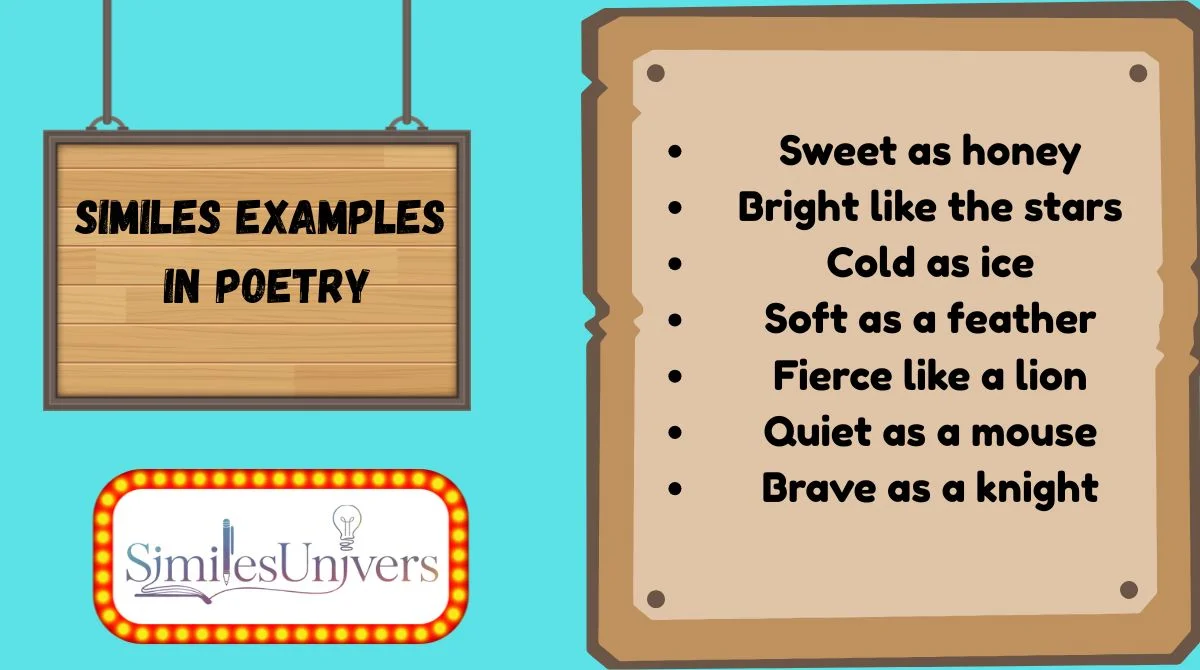
Quick List – Most Popular Similes for Poetry
- Sweet as honey
- Bright like the stars
- Cold as ice
- Soft as a feather
- Fierce like a lion
- Quiet as a mouse
- Brave as a knight
- Smooth like silk
- Light as a cloud
- Sharp like a knife
Complete List of Similes for Poetry (Grouped by Meaning)
Funny & Lighthearted
H3: Busy as a squirrel in autumn
Meaning: Extremely busy
Explanation: Compares someone’s energetic activity to a squirrel gathering nuts.
Examples:
- He was busy as a squirrel in autumn, juggling homework and chores.
- The office was busy as a squirrel in autumn during the end-of-month rush.
Tone: Funny
H3: Sneaky like a cat at midnight
Meaning: Very secretive
Explanation: Highlights stealth and careful movement, playful yet descriptive.
Examples:
- She crept into the kitchen, sneaky like a cat at midnight.
- His plan was sneaky like a cat at midnight, leaving no trace.
Tone: Funny
Emotional & Deep
H3: Heavy as a broken heart
Meaning: Emotionally burdensome
Explanation: Conveys emotional weight and sorrow.
Examples:
- His thoughts were heavy as a broken heart after the loss.
- The silence in the room felt heavy as a broken heart.
Tone: Serious
H3: Fragile like morning dew
Meaning: Vulnerable and delicate
Explanation: Evokes delicate emotions or fragile situations.
Examples:
- Her trust was fragile like morning dew, disappearing with a single harsh word.
- The moment was fragile like morning dew, beautiful yet fleeting.
Tone: Poetic
Dramatic & Intense
H3: Fierce like a wildfire
Meaning: Powerful and uncontrollable
Explanation: Portrays intense energy or emotion that spreads rapidly.
Examples:
- Her anger was fierce like a wildfire, consuming everything in its path.
- The battle raged fierce like a wildfire across the plains.
Tone: Serious
H3: Silent as the grave
Meaning: Complete silence or ominous stillness
Explanation: Suggests extreme quietness with dramatic undertones.
Examples:
- The library was silent as the grave during the exam.
- The forest stood silent as the grave after the storm passed.
Tone: Serious
Slow & Monotonous
H3: Slow as molasses in January
Meaning: Very slow
Explanation: Evokes the sluggish, dragging pace of time or movement.
Examples:
- The lecture moved slow as molasses in January.
- Traffic crawled slow as molasses in January.
Tone: Casual
H3: Dull as a rainy afternoon
Meaning: Boring and unexciting
Explanation: Suggests monotony and lack of energy.
Examples:
- His day felt dull as a rainy afternoon.
- The meeting was dull as a rainy afternoon, with no surprises.
Tone: Casual
Creative & Unique
H3: Bright like neon jellyfish
Meaning: Intensely colorful or striking
Explanation: Creates vivid, unusual imagery.
Examples:
- Her dress was bright like neon jellyfish, glowing in the dark.
- The city lights flickered bright like neon jellyfish in the harbor.
Tone: Poetic
H3: Twisting like a ribbon in the wind
Meaning: Graceful, flowing movement
Explanation: Evokes dynamic, smooth motion.
Examples:
- The dancer spun, twisting like a ribbon in the wind.
- Smoke rose twisting like a ribbon in the wind.
Tone: Poetic
Poetic & Literary
H3: Silent like shadows at twilight
Meaning: Quiet and mysterious
Explanation: Conjures subtle, poetic imagery of the fading light and hush of evening.
Examples:
- He moved silent like shadows at twilight.
- The forest whispered silent like shadows at twilight.
Tone: Poetic
H3: Gentle as moonlight on glass
Meaning: Soft, calm, and delicate
Explanation: Suggests tenderness and serenity.
Examples:
- Her touch was gentle as moonlight on glass.
- The breeze felt gentle as moonlight on glass.
Tone: Poetic
Fresh and Unique Similes You Won’t Hear Every Day
- H3: Floating like a thought in a dream
Imagery: Evokes ethereal, weightless feeling. - H3: Crisp like winter stars
Imagery: Suggests cold clarity and sparkling beauty. - H3: Tumbling like a melody lost in wind
Imagery: Conveys fleeting, delicate motion. - H3: Fierce like coffee at dawn
Imagery: Evokes sudden, awakening energy. - H3: Wrinkled like old parchment
Imagery: Suggests age, wisdom, and texture.
How to Use These Similes in Writing
- Essays: Similes can clarify complex ideas or add flavor to arguments. Example: “Her dedication shone bright like the morning sun.”
- Stories: Use similes to create atmosphere, develop characters, or enhance emotion. Example: “The villain lurked, silent as the grave, in the shadows of the alley.”
How to Create Your Own Similes (Mini Writing Guide)
Step-by-Step Method:
- Identify what you want to describe.
- Choose a vivid object or experience for comparison.
- Decide whether to use “like” or “as”.
- Ensure the comparison enhances your imagery.
- Revise for clarity and originality.
5 Practical Tips:
- Avoid clichés
- Match tone to context
- Keep it concise
- Make it relatable
- Use sensory details
3 Transformation Examples:
- Boring: The room was dark → Enhanced: The room was dark like a cave in winter.
- Weak: She was fast → Enhanced: She ran like lightning across the field.
- Plain: He was tired → Enhanced: He was tired as a candle burning at both ends.
Common Mistakes When Using Similes
- Overuse: Too many similes can distract.
- Clichés: Avoid tired comparisons like “busy as a bee.”
- Tone mismatch: Ensure your simile fits the mood of your writing.
Practice Exercise
Fill in the blanks with suitable similes:
- He ran ___ the wind.
- Her smile was ___ sunshine.
- The room was ___ a tomb.
- The night was ___ velvet.
- His hands were ___ ice.
- She floated ___ a cloud.
- The city was ___ a jungle.
- His voice was ___ honey.
- The storm hit ___ a freight train.
- The baby slept ___ a log.
- The candle flickered ___ a ghost.
- Time passed ___ molasses.
Answers:
- like
- like
- silent as
- soft as
- cold as
- like
- like
- smooth as
- like
- like
- like
- slow as
FAQs
H3: What is a simile in poetry?
A simile is a figure of speech comparing two things using “like” or “as”.
H3: How do similes enhance poetry?
They create vivid imagery, evoke emotions, and make abstract ideas tangible.
H3: Can similes be humorous?
Yes! Funny similes add playful imagery and lighten the tone.
H3: How do I avoid overusing similes?
Use them sparingly and ensure each adds meaningful imagery.
H3: What is the difference between a simile and a metaphor?
A simile uses “like” or “as”, while a metaphor makes a direct comparison without these words.
H3: Can I invent my own similes?
Absolutely! Original similes make your writing unique and memorable.
Final Thoughts
Similes are more than literary devices—they’re keys to imagination. With over 35 examples, grouped by tone, plus fresh ideas and writing strategies, this guide equips you to craft poetry and prose that resonates. Experiment, be bold, and watch your words come alive with the power of similes.

Daniel Harper
I am simplifies complex literary concepts into clear, practical lessons for students and learners worldwide.
Through SimilesUnivers, he aims to make mastering similes engaging, structured, and academically enriching.