Anxiety is something almost everyone feels. It can be soft and quiet. Or loud and overwhelming.
Sometimes it feels like a tiny buzz. Other times, like a storm inside your chest.
But how do you describe that feeling in a way that truly connects with readers?
That’s where similes come in. A strong simile turns a simple sentence into something alive. It helps readers see and feel the emotion.
Instead of saying “She was anxious,” you can say, “She was as tense as a wire about to snap.” Now the feeling is real.
In this guide, you’ll discover 20+ powerful similes for anxious. Some are classic. Many are fresh and creative. You’ll also learn how to use them in stories, essays, and everyday writing.
Let’s bring anxiety to life with words.
Similes for Anxious Thoughts and Overthinking
Like a hamster running on a wheel
Meaning: Thoughts keep moving without reaching a solution.
Explanation: A hamster on a wheel keeps running in the same place, much like an anxious mind repeating the same worries.
Examples:
- Her thoughts were like a hamster running on a wheel all night.
- My mind felt like a hamster on a wheel, going over every possible mistake.
Tone: Casual
Like a radio stuck between stations
Meaning: Thoughts feel confused, noisy, and difficult to control.
Explanation: A radio between stations produces constant static, similar to a mind filled with scattered worries.
Examples:
- His mind was like a radio stuck between stations before the meeting.
- My thoughts sounded like a radio between stations, jumping from one fear to another.
Tone: Creative
As tangled as a ball of thread
Meaning: Confused and difficult to sort out.
Explanation: Tangled thread has no clear beginning or end, just like complicated anxious thoughts.
Examples:
- Her thoughts were as tangled as a ball of thread.
- My worries became as tangled as thread after hours of overthinking.
Tone: Poetic
Like a door that will not stop creaking
Meaning: A small worry keeps demanding attention.
Explanation: A repeated creaking sound can become impossible to ignore, just like a persistent anxious thought.
Examples:
- That question stayed in his mind like a door that would not stop creaking.
- My doubt kept returning like a creaky door in an empty house.
Tone: Reflective
As busy as bees trapped in a jar
Meaning: Mentally active and unable to settle down.
Explanation: Trapped bees move constantly, creating an image of thoughts that refuse to become quiet.
Examples:
- Her mind was as busy as bees trapped in a jar.
- My thoughts buzzed like bees trapped in a jar before the decision.
Tone: Visual
What Is a Simile? (Quick Clear Definition)
A simile compares two different things using the words “like” or “as.”
It helps explain a feeling or idea by linking it to something familiar.
Example:
She was as nervous as a cat in a room full of rocking chairs.
Quick List – Most Popular Similes for “Anxious”
- As nervous as a cat on a hot tin roof
- As jumpy as a rabbit in a thunderstorm
- Like a ticking time bomb
- As tense as a stretched rubber band
- Like a deer in headlights
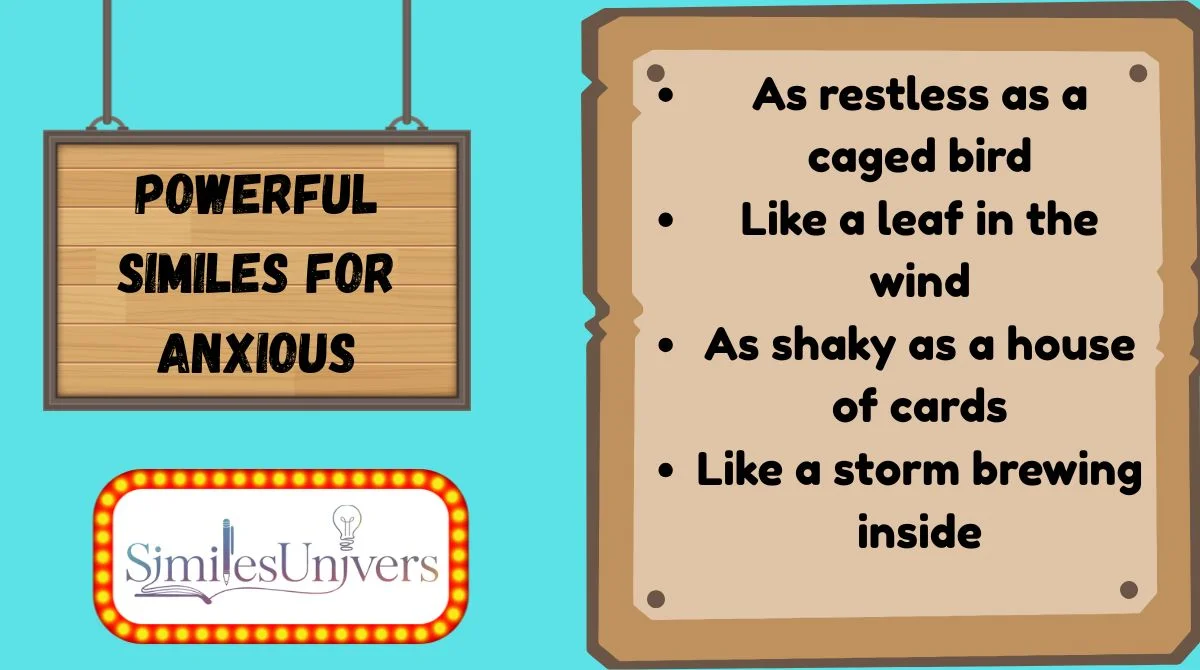
- As restless as a caged bird
- Like a leaf in the wind
- As shaky as a house of cards
- Like a storm brewing inside
- As uneasy as a mouse near a trap
Complete List of Similes for “Anxious” (Grouped by Meaning)
Funny & Lighthearted
As nervous as a cat on a hot tin roof
Meaning: Very jumpy and uncomfortable.
Explanation: A cat on a hot roof would keep moving quickly to avoid the heat.
Examples:
- He was as nervous as a cat on a hot tin roof before his speech.
- I felt like a cat on a hot tin roof waiting for the test results.
Tone: Funny
As jumpy as a squirrel on espresso
Meaning: Extremely restless.
Explanation: Squirrels already move fast. Add coffee, and it’s chaos.
Examples:
- She was as jumpy as a squirrel on espresso before her audition.
- I get squirrel-on-espresso energy before big games.
Tone: Funny
Like popcorn in a microwave
Meaning: Bursting with nervous energy.
Explanation: Popcorn pops rapidly and unpredictably.
Examples:
- His thoughts were like popcorn in a microwave before the interview.
- I felt like popcorn about to explode during the exam.
Tone: Casual
As fidgety as a kid before recess
Meaning: Full of restless anticipation.
Explanation: Children can barely sit still when waiting to play.
Examples:
- She was as fidgety as a kid before recess.
- I felt like that before my name was called.
Tone: Light
Emotional & Deep
Like a storm cloud hanging low
Meaning: Heavy and uneasy.
Explanation: Storm clouds create tension before rain.
Examples:
- Anxiety hung over him like a storm cloud.
- The news sat in my chest like a low storm cloud.
Tone: Serious
As tight as a knotted rope
Meaning: Physically tense.
Explanation: A rope pulled tight holds pressure.
Examples:
- Her shoulders were as tight as a knotted rope.
- I felt as tight as rope pulled from both ends.
Tone: Serious
Like glass about to crack
Meaning: On the edge of breaking.
Explanation: Glass under pressure can shatter suddenly.
Examples:
- He felt like glass about to crack.
- I was like fragile glass before the announcement.
Tone: Dramatic
As uneasy as the air before lightning
Meaning: Waiting for something bad.
Explanation: The air feels still and tense before a strike.
Examples:
- The room felt uneasy as the air before lightning.
- I was as uneasy as that silent sky.
Tone: Poetic
Dramatic & Intense
Like a ticking time bomb
Meaning: About to explode with worry.
Explanation: A bomb builds tension before going off.
Examples:
- He felt like a ticking time bomb.
- I was ready to explode with nerves.
Tone: Dramatic
As tense as a wire about to snap
Meaning: Extremely strained.
Explanation: A tight wire can break at any second.
Examples:
- She stood as tense as a wire about to snap.
- I felt stretched thin and ready to break.
Tone: Serious
Like a drum beating too fast
Meaning: Racing heart.
Explanation: Fast drumbeats mirror anxiety.
Examples:
- My heart was like a drum beating too fast.
- He felt that rapid drum inside his chest.
Tone: Dramatic
As shaky as a bridge in a storm
Meaning: Physically trembling.
Explanation: Strong winds make bridges sway.
Examples:
- She was as shaky as a bridge in a storm.
- My hands felt that unsteady.
Tone: Intense
Slow & Monotonous Anxiety
Like a clock that ticks too loudly
Meaning: Constant low worry.
Explanation: The ticking becomes impossible to ignore.
Examples:
- Anxiety ticked like a loud clock.
- It was always there in the background.
Tone: Subtle
As restless as a spinning wheel
Meaning: Never calm.
Explanation: A spinning wheel keeps moving without stopping.
Examples:
- He felt as restless as a spinning wheel.
- My thoughts would not slow down.
Tone: Neutral
Creative & Unique (Less Common)
Like a balloon stretched too full
Meaning: About to burst.
Explanation: Too much pressure leads to popping.
Examples:
- She felt like a balloon stretched too full.
- I was ready to burst with nerves.
Tone: Visual
As fragile as thin ice in spring
Meaning: Easily broken.
Explanation: Spring ice looks strong but cracks fast.
Examples:
- His calm felt as fragile as thin ice in spring.
- I could break at any second.
Tone: Poetic
Like a phone on 1% battery
Meaning: Drained and worried.
Explanation: You expect shutdown any moment.
Examples:
- I felt like a phone on 1% battery.
- She walked around waiting to shut down.
Tone: Modern
As unsettled as sand under waves
Meaning: Never stable.
Explanation: Waves constantly shift the sand.
Examples:
- His thoughts were as unsettled as sand under waves.
- I could not find solid ground.
Tone: Poetic
Like a compass spinning without north
Meaning: Lost and unsure.
Explanation: Without direction, you feel confused.
Examples:
- She felt like a compass spinning without north.
- I did not know where to turn.
Tone: Reflective
Poetic & Literary
As quiet as a forest before winter
Meaning: Silent but tense.
Explanation: Nature pauses before harsh change.
Examples:
- The room was as quiet as a forest before winter.
- My heart held that same silence.
Tone: Poetic
Like a candle flickering in wind
Meaning: Weak and uncertain.
Explanation: The flame could go out anytime.
Examples:
- He felt like a candle flickering in wind.
- I was unsure if I would stay steady.
Tone: Poetic
Fresh and Unique Similes You Won’t Hear Every Day
- Like a browser with too many tabs open
Imagery: Mental overload. Too many thoughts at once. - As tight as shoes one size too small
Imagery: Physical discomfort you cannot ignore. - Like a whisper stuck in your throat
Imagery: Words and fears you cannot release. - As crowded as a hallway before a fire drill
Imagery: Panic building in limited space. - Like ink spreading through water
Imagery: Anxiety slowly taking over everything.
How to Use These Similes in Writing
In Essays
Use similes to make emotional points stronger.
Example:
“Students often feel as tense as a wire about to snap during exam season.”
In Stories
Show feelings instead of naming them.
Instead of: She was anxious.
Write: She stood as shaky as a bridge in a storm.
How to Create Your Own Similes (Mini Writing Guide)
Step-by-Step Method
- Name the emotion (anxiety).
- Think about how it feels (tight, shaky, restless).
- Find objects that act that way.
- Connect them using “like” or “as.”
- Read it aloud to test the flow.
5 Practical Tips
- Use clear images.
- Avoid overused clichés.
- Match the tone to your story.
- Keep it short.
- Make sure it makes sense.
Transformation Examples
Plain: He felt anxious.
Better: He felt like a ticking clock in a silent room.
Plain: She was nervous.
Better: She was as fragile as thin ice in spring.
Plain: I was worried.
Better: I was like a balloon stretched too full.
Common Mistakes When Using Similes
Overuse
Too many similes can tire readers.
Clichés
Avoid ones readers see everywhere unless you refresh them.
Tone mismatch
Do not use funny similes in sad scenes.
Similes for Anxious People in Stressful Situations
As nervous as a student before a difficult exam
Meaning: Extremely worried about an important outcome.
Explanation: A difficult exam can create strong pressure and uncertainty.
Examples:
- He was as nervous as a student before a difficult exam.
- She looked as nervous as a student waiting for the test to begin.
Tone: Familiar
Like a rabbit caught in a sudden downpour
Meaning: Overwhelmed and unsure what to do.
Explanation: A rabbit surprised by heavy rain may freeze or search quickly for shelter.
Examples:
- He looked like a rabbit caught in a sudden downpour when the question was asked.
- I felt like a rabbit caught in a downpour when everyone turned toward me.
Tone: Poetic
As tense as a rope pulled too tight
Meaning: Extremely stressed and close to losing composure.
Explanation: A rope stretched too far is under constant pressure and may snap.
Examples:
- She was as tense as a rope pulled too tight before the announcement.
- His whole body felt as tense as a rope stretched between two poles.
Tone: Dramatic
Like a passenger waiting for a sudden stop
Meaning: Alert, uneasy, and expecting something unpleasant.
Explanation: Waiting for an unexpected stop creates a feeling of uncertainty and tension.
Examples:
- He sat like a passenger waiting for a sudden stop.
- She felt like a passenger bracing for a sudden stop.
Tone: Serious
As shaky as a candle in a strong breeze
Meaning: Nervous and struggling to remain calm.
Explanation: A candle flame flickers and becomes unstable when exposed to strong wind.
Examples:
- Her hands were as shaky as a candle in a strong breeze.
- He stood as shaky as a candle fighting the wind during the interview.
Tone: Poetic
Practice Exercise
Fill in the blanks:
- She was as tense as a _______.
- My heart felt like a _______.
- He stood like a _______ about to snap.
- I felt as fragile as _______.
- Her thoughts were like _______ in a microwave.
- He was as restless as a _______.
- I felt like a _______ on 1% battery.
- She shook like a _______ in a storm.
- Anxiety hung like a _______.
- He felt like a _______ spinning without north.
- I was as jumpy as a _______.
- My calm was as thin as _______ in spring.
Answers
- wire about to snap
- drum beating too fast
- wire
- thin ice
- popcorn
- spinning wheel
- phone
- bridge
- storm cloud
- compass
- squirrel on espresso
- ice
FAQs
What is the best simile for anxious?
“As tense as a wire about to snap” is strong and vivid.
Are similes good for essays?
Yes. They make emotions clear and relatable.
What is a simple simile for kids?
“As nervous as a cat on a hot tin roof.”
Can similes replace adjectives?
Yes. They show emotion instead of just naming it.
How many similes should I use in a paragraph?
Usually one or two is enough.
What’s the difference between a simile and a metaphor?
A simile uses “like” or “as.” A metaphor does not.
Final Thoughts
Anxiety is hard to describe. But the right simile makes it clear and powerful. It turns invisible feelings into images readers can see.
Use these 20+ similes for anxious to make your writing vivid. Try the creative ones. Make your own. And remember—great writing helps people feel what you feel.

Daniel Harper
I am simplifies complex literary concepts into clear, practical lessons for students and learners worldwide.
Through SimilesUnivers, he aims to make mastering similes engaging, structured, and academically enriching.