Writing is more than putting words on a page—it’s about painting pictures with language. One of the simplest yet most powerful tools for vivid writing is a simile.
A well-crafted simile turns abstract ideas into images readers can instantly grasp. But what about writing that involves something “bad”? Whether it’s a bad day, a bad meal, or a bad decision, similes can make your description striking, memorable, and even entertaining.
In this guide, you’ll discover over 35 carefully chosen similes for “bad,” including classic favorites and unique new expressions.
You’ll learn how to use them in essays, stories, and everyday writing. By the end, you’ll have a full toolkit to make your “bad” situations jump off the page—without sounding boring or repetitive.
What Is a Simile?
A simile is a figure of speech that compares two different things using “like” or “as” to make an idea more vivid.
Example: The soup was as bad as last week’s leftovers.
Similes help readers picture your message clearly, making your writing more engaging and lively.
Quick List – Most Popular Similes for “Bad”
- As bad as a stormy night
- Like a rotten apple
- As useless as a broken pencil
- Like a flat tire
- As foul as spoiled milk
- Like a sinking ship
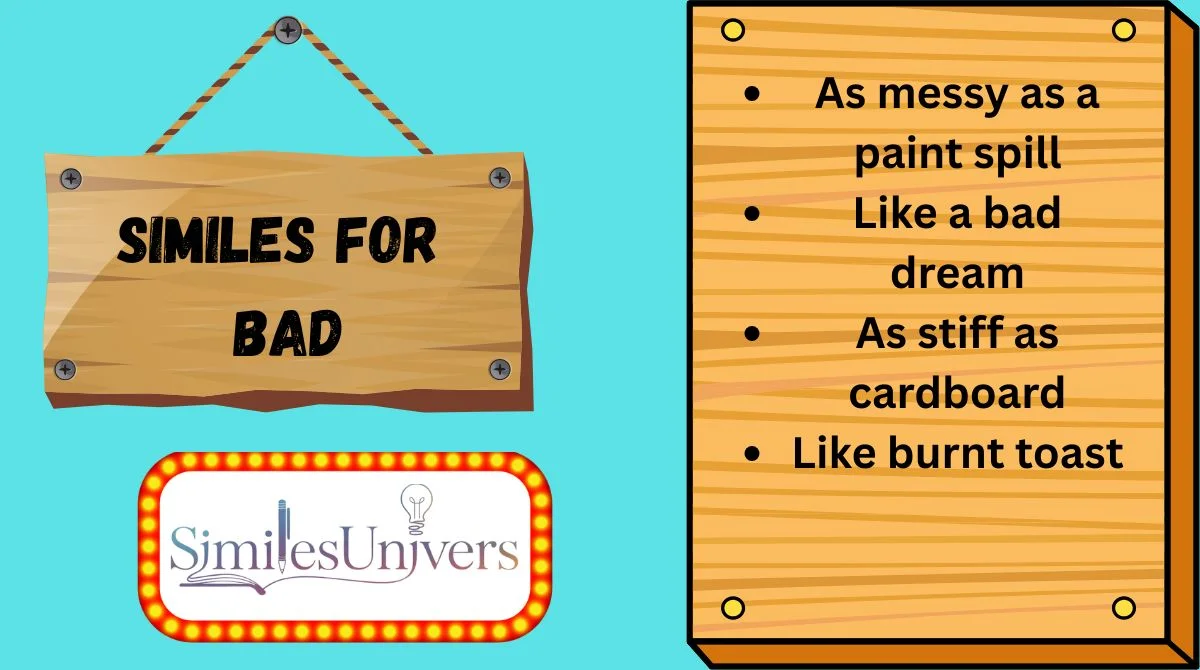
- As messy as a paint spill
- Like a bad dream
- As stiff as cardboard
- Like burnt toast
Complete List of Similes for “Bad” (Grouped by Meaning)
Funny & Lighthearted
Like a cat in a bathtub
- Meaning: Uncomfortable, awkward
- Explanation: Compares awkward situations to a cat’s famous dislike for water.
- Examples:
- His attempt at dancing was like a cat in a bathtub—completely unnatural.
- Meeting my old rival at the party felt like a cat in a bathtub.
- Tone: Funny
As crooked as a politician’s promise
- Meaning: Dishonest or unreliable
- Explanation: Highlights deceit in a humorous way.
- Examples:
- That deal was as crooked as a politician’s promise.
- The instructions were as crooked as a politician’s promise—confusing and misleading.
- Tone: Funny
Like socks in the dryer
- Meaning: Missing, mismatched, or chaotic
- Explanation: Evokes humor from everyday frustration.
- Examples:
- My plan fell apart like socks in the dryer.
- His explanation was like socks in the dryer—nothing matched.
- Tone: Funny
As off as a rubber chicken
- Meaning: Silly or ineffective
- Explanation: Uses absurdity to stress poor performance.
- Examples:
- His joke was as off as a rubber chicken.
- The new software is as off as a rubber chicken—doesn’t work at all.
- Tone: Funny
Like expired yogurt
- Meaning: Unpleasant or unwelcome
- Explanation: Makes the audience imagine something immediately unappealing.
- Examples:
- That idea was like expired yogurt—nobody wanted it.
- The smell of his cooking was like expired yogurt.
- Tone: Funny
Emotional & Deep
Like a wilted flower
- Meaning: Hopeless, weak, or disappointing
- Explanation: Suggests loss of vitality or potential.
- Examples:
- His confidence was like a wilted flower after the rejection.
- The project felt like a wilted flower—lifeless and sad.
- Tone: Serious
As hollow as a drum
- Meaning: Empty, meaningless
- Explanation: Signifies something lacking depth or substance.
- Examples:
- His apology was as hollow as a drum.
- The speech was as hollow as a drum—full of words, no meaning.
- Tone: Serious
Like shadows at noon
- Meaning: Weak or ineffective
- Explanation: Shadows disappear in bright light, symbolizing insignificance.
- Examples:
- His warnings were like shadows at noon—barely noticeable.
- The promises faded like shadows at noon.
- Tone: Poetic
Dramatic & Intense
Like a wildfire in winter
- Meaning: Unexpected disaster
- Explanation: Shows a situation going badly in an improbable, destructive way.
- Examples:
- Their argument spread like a wildfire in winter.
- The plan failed like a wildfire in winter.
- Tone: Dramatic
As rotten as a carcass
- Meaning: Terribly bad, morally or physically
- Explanation: Evokes strong disgust and intensity.
- Examples:
- The old contract was as rotten as a carcass.
- That betrayal was as rotten as a carcass.
- Tone: Intense
Like glass in the rain
- Meaning: Fragile and chaotic
- Explanation: Highlights danger and poor outcomes.
- Examples:
- His argument shattered like glass in the rain.
- The fragile plan fell apart like glass in the rain.
- Tone: Dramatic
Slow & Monotonous
As dull as dishwater
- Meaning: Boring, tedious
- Explanation: Conveys extreme monotony.
- Examples:
- The lecture was as dull as dishwater.
- That movie dragged on as dull as dishwater.
- Tone: Casual
Like a snail in molasses
- Meaning: Very slow, frustrating
- Explanation: Creates imagery of extreme sluggishness.
- Examples:
- The traffic moved like a snail in molasses.
- His response came like a snail in molasses.
- Tone: Casual
As flat as a pancake
- Meaning: Lifeless, boring
- Explanation: Evokes flatness and lack of excitement.
- Examples:
- The party was as flat as a pancake.
- Her storytelling was as flat as a pancake.
- Tone: Casual
Creative & Unique
Like burnt marshmallows
- Meaning: Disappointing after expectation
- Explanation: Evokes ruined delight.
- Examples:
- Their surprise was like burnt marshmallows—sweet idea, bad execution.
- The cake tasted like burnt marshmallows.
- Tone: Creative
As twisted as a pretzel
- Meaning: Confusing or convoluted
- Explanation: Visual metaphor for complexity gone wrong.
- Examples:
- The plot was as twisted as a pretzel.
- His explanation was as twisted as a pretzel.
- Tone: Creative
Like spilled ink
- Meaning: Ruined, messy
- Explanation: Evokes permanent mistakes or chaos.
- Examples:
- Their plan ended like spilled ink.
- The document was ruined like spilled ink.
- Tone: Creative
Poetic & Literary
Like a candle in a storm
- Meaning: Weak, vulnerable
- Explanation: Suggests fragility under pressure.
- Examples:
- Her courage flickered like a candle in a storm.
- The small company’s profits were like a candle in a storm.
- Tone: Poetic
As bitter as wormwood
- Meaning: Painful or unpleasant
- Explanation: Evokes strong bitterness both emotionally and physically.
- Examples:
- His criticism was as bitter as wormwood.
- Life felt as bitter as wormwood that year.
- Tone: Poetic
Like ash in the wind
- Meaning: Lost, destroyed
- Explanation: Suggests impermanence and ruin.
- Examples:
- The dreams scattered like ash in the wind.
- Their hopes vanished like ash in the wind.
- Tone: Poetic
Fresh and Unique Similes You Won’t Hear Every Day
- Like a coffee left in the rain – ruined expectations; soggy and bitter
- As mismatched as a pirate’s socks – chaotic, comical mess
- Like a kite in a hurricane – doomed and out of control
- As sour as winter lemons – extremely unpleasant, shocking
- Like a book with missing pages – incomplete, unsatisfying
How to Use These Similes in Writing
Essays: Enhance descriptive sections to illustrate negative experiences vividly.
Stories: Bring characters’ failures or struggles to life, making them relatable and memorable.
How to Create Your Own Similes (Mini Writing Guide)
- Identify the feeling or quality.
- Think of objects, animals, or experiences that share that quality.
- Use “like” or “as” to connect them.
- Test readability and clarity.
- Adjust tone for audience and purpose.
Practical Tips:
- Avoid clichés
- Match simile tone to context
- Keep it short
- Use sensory details
- Make it relatable
Transformation Examples:
- “The plan was bad” → “The plan was like a sandcastle at high tide.”
- “The soup tasted bad” → “The soup tasted as off as forgotten cheese.”
- “The party was terrible” → “The party was like a balloon with a slow leak.”
Common Mistakes When Using Similes
- Overuse: Too many similes can overwhelm.
- Clichés: Avoid tired phrases like “as bad as it gets.”
- Tone mismatch: Ensure the simile fits the context.
Practice Exercise
Fill in the blanks with a suitable simile for “bad”:
- His mood was ________ after the test.
- The cake turned out ________.
- The movie was ________.
- Her day felt ________.
- The argument ended ________.
- His explanation was ________.
- The traffic moved ________.
- Their team played ________.
- The performance was ________.
- The gift was ________.
- The coffee tasted ________.
- The speech was ________.
Answers:
- like a wilted flower
- like burnt marshmallows
- as dull as dishwater
- like a cat in a bathtub
- like a sinking ship
- as twisted as a pretzel
- like a snail in molasses
- as bad as a stormy night
- like glass in the rain
- like expired yogurt
- as sour as winter lemons
- as hollow as a drum
FAQs
What is the easiest way to use similes?
Pick a quality and compare it to something familiar using “like” or “as.”
Can similes improve storytelling?
Yes! They make abstract feelings and actions vivid and relatable.
How do I avoid clichés in similes?
Try fresh comparisons from everyday life or your imagination.
How many similes are too many in writing?
Use them sparingly—1–2 per paragraph is usually enough.
Are funny similes acceptable in serious writing?
Sometimes. Ensure humor doesn’t clash with the tone of your piece.
Can I create my own similes for “bad”?
Absolutely! Original similes often make your writing stand out.
Final Thoughts
Similes are powerful tools to make writing vivid, memorable, and engaging. With over 35 unique expressions for “bad,” from funny and casual to poetic and dramatic, you now have the tools to elevate your storytelling, essays, or everyday writing. Remember to balance originality with readability, and let your imagination guide your comparisons.

Daniel Harper
I am simplifies complex literary concepts into clear, practical lessons for students and learners worldwide.
Through SimilesUnivers, he aims to make mastering similes engaging, structured, and academically enriching.