Autumn is a season of transformation, where leaves shimmer like molten gold and crisp air carries the scent of change. Writers love capturing this magical time, but ordinary words often fall flat.
That’s where similes come in—they turn simple descriptions into vivid experiences, letting readers see, feel, and even smell your scene. Whether you’re crafting a story, an essay, or just dabbling in poetry, the right autumn simile makes your writing unforgettable.
In this guide, you’ll discover over 35 high-quality similes for autumn, from the most popular and familiar to fresh, unique phrases you won’t hear anywhere else. By the end, you’ll have a toolbox of imagery that brings the season to life and elevates your writing with emotional and poetic depth.
What Is a Simile?
A simile is a figure of speech that compares two different things using “like” or “as.” It helps readers picture ideas clearly. For example:
- “The leaves fell like golden confetti.”
This simple comparison makes the image vivid and memorable.
Quick List – Most Popular Similes for Autumn
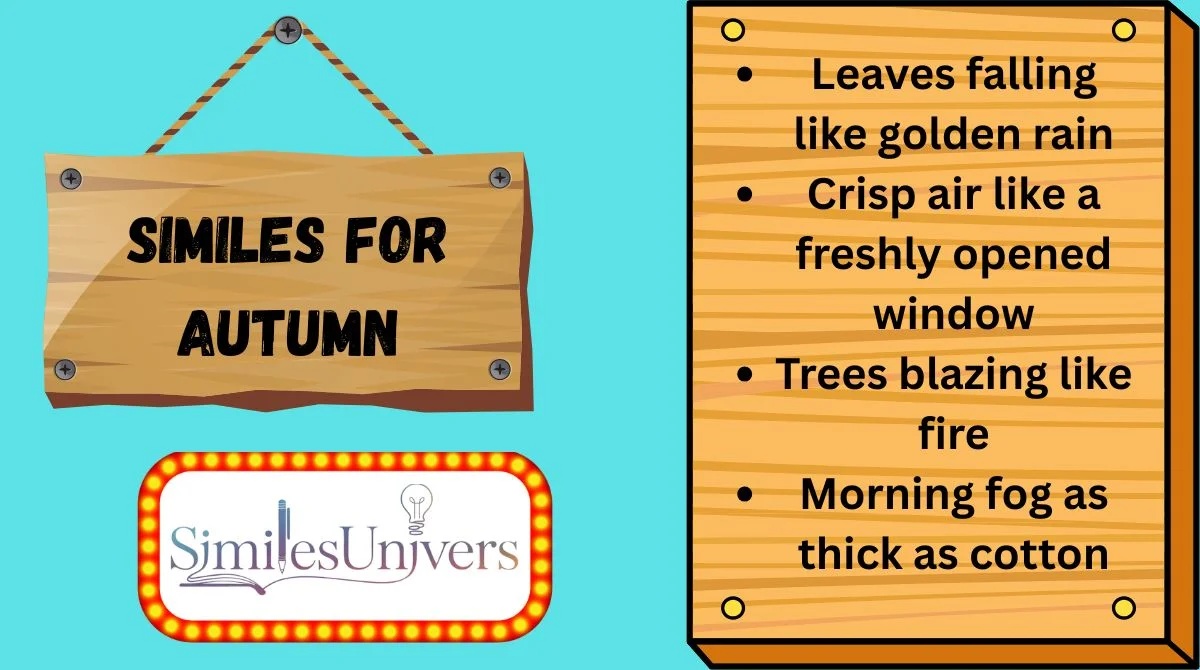
- Leaves falling like golden rain
- Crisp air like a freshly opened window
- Trees blazing like fire
- Morning fog as thick as cotton
- Autumn winds like playful ghosts
- Pumpkins glowing like lanterns
- Sunset like melted amber
- Harvest fields as rich as treasure chests
- Rain pattering like soft drums
- Shadows stretching like long fingers
Complete List of Similes for Autumn (Grouped by Meaning)
Funny & Lighthearted
Leaves crunching like potato chips
Meaning: The sound of dry leaves underfoot
Explanation: Highlights the playful, snackable crunch of stepping on autumn leaves.
Examples:
- “She danced down the street, leaves crunching like potato chips beneath her boots.”
- “His dog leaped into the pile, leaves crunching like potato chips with every jump.”
Tone: Funny
Pumpkins smiling like mischievous children
Meaning: A playful view of pumpkin faces
Explanation: Imagines pumpkins with a cheeky, lively personality.
Examples:
- “Jack-o’-lanterns lined the porch, smiling like mischievous children.”
- “The pumpkin patch seemed alive, each one grinning like mischievous children.”
Tone: Funny
Apples dangling like candy
Meaning: Highlights their bright, tempting appearance
Explanation: Makes the fruit look irresistible and playful.
Examples:
- “Orchard trees hung heavy, apples dangling like candy.”
- “He reached up, thinking the apples dangled like candy just for him.”
Tone: Lighthearted
Wind swirling like a playful puppy
Meaning: Shows autumn wind as energetic
Explanation: Personifies the wind as lively and mischievous.
Examples:
- “The wind swirled like a playful puppy around the corners of the house.”
- “Leaves danced through the air, twirling like a playful puppy chasing its tail.”
Tone: Funny
Fog creeping like a sleepy cat
Meaning: Slow, soft fog movement
Explanation: Soft, cozy imagery makes fog feel gentle and alive.
Examples:
- “The morning fog crept over the fields like a sleepy cat.”
- “Through the quiet streets, fog curled like a sleepy cat in the alley.”
Tone: Funny
Emotional & Deep
Leaves falling like forgotten memories
Meaning: Evokes melancholy
Explanation: Compares drifting leaves to fading thoughts or lost moments.
Examples:
- “She watched the leaves fall like forgotten memories, each one slipping away quietly.”
- “Autumn afternoons felt like leaves falling, carrying forgotten memories with them.”
Tone: Serious
Sunset bleeding like a wounded heart
Meaning: Captures emotional intensity
Explanation: The colors of the sky mirror sorrow or passion.
Examples:
- “The sunset bled like a wounded heart over the horizon.”
- “He paused, watching the sunset, bleeding like a wounded heart into the trees.”
Tone: Serious
Rain weeping like the sky is lonely
Meaning: Makes rain emotional
Explanation: Personifies rain as an expression of sadness.
Examples:
- “The rain tapped on the window, weeping like the sky is lonely.”
- “Puddles formed as rain wept like the sky is lonely.”
Tone: Serious
Autumn winds sighing like lost lovers
Meaning: Romantic, nostalgic imagery
Explanation: Makes the wind’s sound feel intimate and sorrowful.
Examples:
- “The autumn wind sighed like lost lovers across the empty park.”
- “Leaves trembled in the breeze, as if autumn winds were sighing like lost lovers.”
Tone: Poetic
Trees bending like old men
Meaning: Symbolizes age and endurance
Explanation: Trees reflect wisdom or weariness through their posture.
Examples:
- “The trees bent like old men, their branches heavy with time.”
- “Shadows stretched as the ancient oaks bent like old men in the fading light.”
Tone: Serious
Dramatic & Intense
Leaves swirling like a fiery storm
Meaning: Shows energetic chaos
Explanation: Imagery of movement and intensity mirrors action or conflict.
Examples:
- “The leaves swirled like a fiery storm across the empty street.”
- “He ran through the park, leaves twisting like a fiery storm around him.”
Tone: Dramatic
The sky darkened like a closing curtain
Meaning: Dramatic foreboding
Explanation: Signals the end of the day or impending weather.
Examples:
- “Thunder rolled as the sky darkened like a closing curtain.”
- “She watched the horizon, the sky darkening like a closing curtain over the land.”
Tone: Dramatic
Harvest moons glowing like molten silver
Meaning: Captures luminous intensity
Explanation: Moonlight looks radiant, almost unreal.
Examples:
- “The harvest moon glowed like molten silver in the crisp sky.”
- “He paused to admire the night, the harvest moon glowing like molten silver above.”
Tone: Dramatic
Fog twisting like haunted spirits
Meaning: Creepy, suspenseful imagery
Explanation: Fog takes on a ghostly, unsettling personality.
Examples:
- “The mist twisted like haunted spirits through the cemetery.”
- “Autumn evenings felt eerie, fog twisting like haunted spirits across the fields.”
Tone: Dramatic
Leaves cascading like flames in the wind
Meaning: Dynamic autumn energy
Explanation: Leaves mimic fire in color and movement.
Examples:
- “Golden leaves cascaded like flames in the wind along the path.”
- “She kicked through the pile, watching them cascade like flames in the wind.”
Tone: Dramatic
Slow & Monotonous
Rain falling like a ticking clock
Meaning: Shows repetitive, steady rain
Explanation: Conveys time passing slowly and predictably.
Examples:
- “The rain fell like a ticking clock, marking the long afternoon.”
- “Inside, she listened as the rain tapped like a ticking clock outside.”
Tone: Serious
Leaves drifting like sleepy boats
Meaning: Slow, calm movement
Explanation: Leaves appear serene and peaceful.
Examples:
- “Leaves drifted like sleepy boats along the gentle stream.”
- “Autumn mornings were quiet, leaves floating like sleepy boats on puddles.”
Tone: Poetic
Wind moaning like an old violin
Meaning: Slow, mournful sound
Explanation: Personifies wind with musical sorrow.
Examples:
- “The wind moaned like an old violin through the abandoned streets.”
- “Shadows shifted as the wind moaned like an old violin across the fields.”
Tone: Poetic
Creative & Unique
Fog hugging the hills like a shy child
Meaning: Gentle, protective imagery
Explanation: Makes fog feel intimate and endearing.
Examples:
- “Morning fog hugged the hills like a shy child seeking comfort.”
- “The valley lay quiet, fog embracing each slope like a shy child.”
Tone: Poetic
Leaves dancing like paper ballerinas
Meaning: Playful visual of movement
Explanation: Highlights grace and delicate motion.
Examples:
- “Autumn leaves twirled like paper ballerinas in the wind.”
- “The alley sparkled as leaves danced like paper ballerinas.”
Tone: Poetic
Apples rolling like tiny planets
Meaning: Imagines apple movement as cosmic
Explanation: Fun and imaginative visual.
Examples:
- “Orchard apples tumbled down the hill like tiny planets in orbit.”
- “The basket spilled, apples rolling like tiny planets across the floor.”
Tone: Creative
Poetic & Literary
Trees whispering like ancient poets
Meaning: Trees as wise, expressive beings
Explanation: Creates a reflective, literary tone.
Examples:
- “The forest was quiet, trees whispering like ancient poets in the wind.”
- “Autumn afternoons felt eternal, trees speaking like ancient poets.”
Tone: Poetic
Twilight melting like candle wax
Meaning: Smooth transition from day to night
Explanation: Evokes softness and impermanence.
Examples:
- “Twilight melted like candle wax behind the hills.”
- “He watched, mesmerized, as the evening melted like candle wax across the sky.”
Tone: Poetic
Frost sparkling like diamond dust
Meaning: Crisp, magical imagery
Explanation: Highlights winter’s early touch on autumn mornings.
Examples:
- “Frost sparkled like diamond dust on the grass.”
- “Windows shimmered, frost sparkling like diamond dust in the morning light.”
Tone: Poetic
Fresh and Unique Similes You Won’t Hear Every Day
- Leaves falling like whispered secrets—captures intimacy and quietness.
- Pumpkins glowing like shy suns—shows warmth without blinding intensity.
- Autumn wind curling like smoke rings—gives graceful, playful motion.
- Shadows stretching like old ink stains—creates a literary, moody feel.
- Raindrops bouncing like silver beads—bright and tactile imagery.
How to Use These Similes in Writing
- Essays: Add vivid imagery to descriptive essays to engage readers’ senses.
- Stories: Use similes for character reactions, mood setting, or scene details.
How to Create Your Own Similes (Mini Writing Guide)
Step-by-Step Method:
- Identify the object or feeling you want to describe.
- Find something with a similar quality or effect.
- Connect them using “like” or “as.”
5 Practical Tips:
- Keep it simple and clear
- Avoid clichés
- Match the tone to your writing
- Use sensory details
- Experiment with unusual comparisons
3 Transformation Examples:
- Ordinary: “The leaf fell.” → Simile: “The leaf fell like a golden tear from the sky.”
- Ordinary: “The wind blew.” → Simile: “The wind blew like a restless painter sweeping the trees.”
- Ordinary: “It was cold.” → Simile: “It was cold as a forgotten letter in an attic.”
Common Mistakes When Using Similes
- Overuse: Too many similes can overwhelm readers.
- Clichés: Phrases like “as busy as a bee” feel stale.
- Tone mismatch: Funny similes in serious contexts can feel jarring.
Practice Exercise
Fill in the blanks with an appropriate autumn simile:
- The leaves fell __________.
- The wind howled __________.
- Pumpkins glowed __________.
- The fog crept __________.
- Shadows stretched __________.
- Rain tapped __________.
- Twilight melted __________.
- Frost sparkled __________.
- Leaves danced __________.
- Apples rolled __________.
- Trees whispered __________.
- Autumn sun shone __________.
Answers (examples):
- like golden confetti
- like playful ghosts
- like shy suns
- like a sleepy cat
- like long fingers
- like soft drums
- like candle wax
- like diamond dust
- like paper ballerinas
- like tiny planets
- like ancient poets
- like molten amber
FAQs
What are the best similes for autumn leaves?
- “Leaves falling like golden rain” and “Leaves drifting like sleepy boats” are vivid and versatile.
How do similes enhance autumn writing?
- They create imagery, evoke emotion, and make descriptions memorable.
Can I make my own autumn similes?
- Yes! Compare the season’s sights, sounds, or feelings to something familiar, using “like” or “as.”
What’s the difference between a simile and a metaphor?
- A simile uses “like” or “as” for comparison; a metaphor states it directly.
Are funny similes suitable for poetry?
- Absolutely, but match them to tone; humor can add charm to autumn poems.
How many similes are ideal in one paragraph?
- 1–2 per paragraph keeps imagery strong without overwhelming the reader.
Final Thoughts
Autumn is a season full of color, emotion, and movement, perfect for writers who love imagery. Using similes transforms ordinary descriptions into vivid, memorable scenes. From playful to poetic, dramatic to gentle, the similes in this guide give your writing a toolbox of sensory magic. Experiment, create your own, and let autumn speak through your words.

Daniel Harper
I am simplifies complex literary concepts into clear, practical lessons for students and learners worldwide.
Through SimilesUnivers, he aims to make mastering similes engaging, structured, and academically enriching.