Colors are everywhere. They shape what we see, feel, and imagine. But plain color words can feel dull if you use them again and again. That’s where similes come in. They turn simple colors into vivid pictures your reader can feel.
Think about it—saying “the sky was blue” is fine. But saying “the sky was blue like a calm ocean” creates a whole mood. It paints a scene in the reader’s mind.
In this guide, you’ll find powerful, creative, and easy-to-use similes for colors. You’ll learn how to use them in stories, essays, and daily writing.
Whether you want to sound poetic, funny, or dramatic, this article gives you the tools to do it right.
Let’s make your writing shine with color.
Similes for Bright and Vibrant Colors
Bright as a summer sunrise
Meaning: Extremely bright, warm, and lively.
Explanation: A summer sunrise creates a strong, glowing burst of color.
Examples:
- Her yellow dress was bright as a summer sunrise.
- The flowers looked bright as a summer sunrise.
Tone: Poetic
Red like a blazing sunset
Meaning: Bold, glowing red.
Explanation: A blazing sunset creates rich, powerful red shades.
Examples:
- The clouds turned red like a blazing sunset.
- Her scarf was red like a blazing sunset.
Tone: Dramatic
Blue like a tropical lagoon
Meaning: Bright, fresh blue.
Explanation: Tropical lagoons are known for clear, vivid blue water.
Examples:
- The water was blue like a tropical lagoon.
- Her eyes sparkled blue like a tropical lagoon.
Tone: Vivid
Green like fresh spring leaves
Meaning: Bright, lively green.
Explanation: New spring leaves have a fresh and energetic green color.
Examples:
- The garden was green like fresh spring leaves.
- His shirt was green like fresh spring leaves.
Tone: Fresh
Yellow like a golden lantern
Meaning: Warm, glowing yellow.
Explanation: A golden lantern gives off a cheerful, noticeable glow.
Examples:
- The windows shone yellow like a golden lantern.
- Her dress was yellow like a golden lantern.
Tone: Warm
What Is a Simile? (Quick Clear Definition)
A simile is a comparison using “like” or “as.”
It helps describe something by comparing it to something familiar.
Example:
Her dress was red like a rose.
Quick List – Most Popular Similes for “Colors”
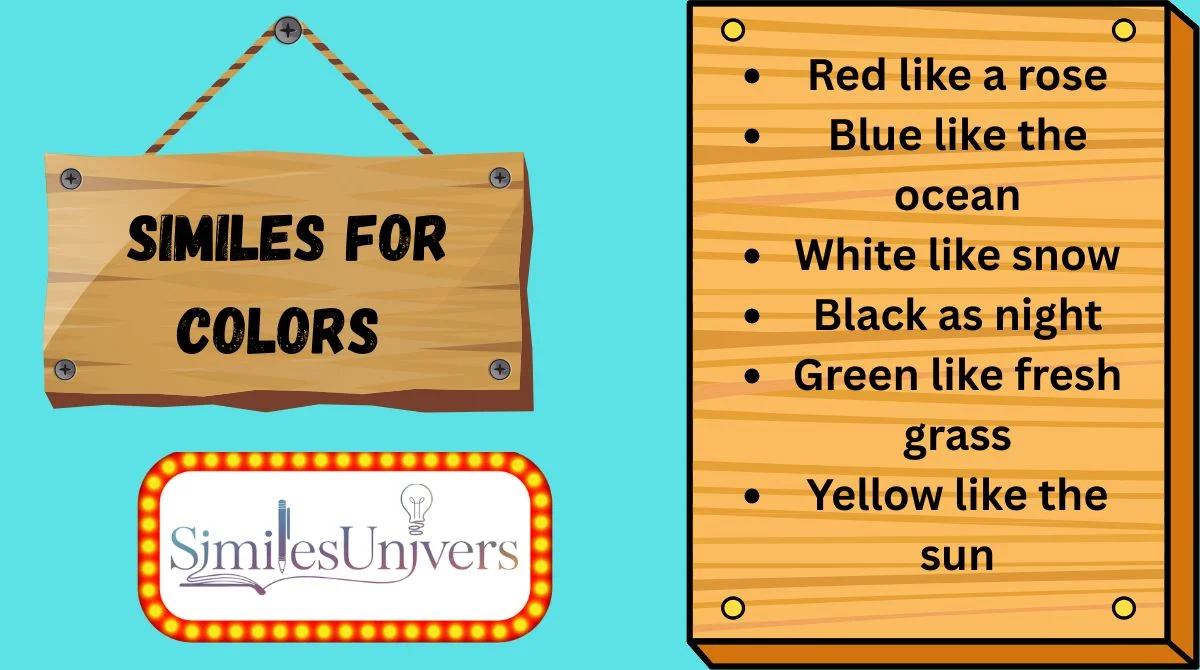
- Red like a rose
- Blue like the ocean
- White like snow
- Black as night
- Green like fresh grass
- Yellow like the sun
- Pink like cotton candy
- Orange like a sunset
- Purple like a royal robe
- Brown like chocolate
Complete List of Similes for “Colors” (Grouped by Meaning)
Funny & Lighthearted
Bright as a clown’s wig
Meaning: Very colorful and eye-catching
Explanation: Clown wigs are bold and playful, full of bright colors.
Examples:
- Her outfit was bright as a clown’s wig at the party.
- The room looked bright as a clown’s wig after decoration.
Tone: Funny
Yellow like melted butter
Meaning: Soft, warm yellow
Explanation: Melted butter has a smooth, gentle yellow tone.
Examples:
- The sunlight was yellow like melted butter.
- Her dress glowed yellow like melted butter.
Tone: Casual
Pink like bubblegum
Meaning: Bright, playful pink
Explanation: Bubblegum pink feels fun and youthful.
Examples:
- The walls were pink like bubblegum.
- Her shoes popped pink like bubblegum.
Tone: Fun
Green like a cartoon frog
Meaning: Bright, unrealistic green
Explanation: Cartoon frogs often have exaggerated green shades.
Examples:
- His shirt was green like a cartoon frog.
- The paint looked green like a cartoon frog.
Tone: Funny
Blue like a kid’s crayon drawing
Meaning: Bold and simple blue
Explanation: Kids use bright, pure blue in drawings.
Examples:
- The sky was blue like a kid’s crayon drawing.
- The lake shimmered blue like a crayon sketch.
Tone: Lighthearted
Emotional & Deep
Red like a burning heart
Meaning: Strong passion or love
Explanation: Red is often tied to deep emotion and heat.
Examples:
- Her cheeks turned red like a burning heart.
- The sky glowed red like a burning heart at dusk.
Tone: Emotional
Blue like a lonely sea
Meaning: Sad or calm blue
Explanation: The sea can feel vast and lonely.
Examples:
- His eyes were blue like a lonely sea.
- The evening felt blue like a lonely sea.
Tone: Serious
Gray like a rainy memory
Meaning: Dull or sad gray
Explanation: Rain often connects with quiet sadness.
Examples:
- The sky was gray like a rainy memory.
- Her mood felt gray like a rainy memory.
Tone: Poetic
Black like hidden sorrow
Meaning: Deep, heavy darkness
Explanation: Black often symbolizes deep emotion.
Examples:
- The night felt black like hidden sorrow.
- His thoughts were black like hidden sorrow.
Tone: Serious
White like silent peace
Meaning: Calm and pure white
Explanation: White can suggest stillness and calm.
Examples:
- The snow lay white like silent peace.
- Her dress looked white like silent peace.
Tone: Poetic
Dramatic & Intense
Red like spilled fire
Meaning: Very intense red
Explanation: Fire suggests heat and danger.
Examples:
- The sky burned red like spilled fire.
- The paint looked red like spilled fire.
Tone: Dramatic
Black as a bottomless pit
Meaning: Extremely dark
Explanation: A pit suggests endless darkness.
Examples:
- The cave was black as a bottomless pit.
- The night turned black as a pit.
Tone: Intense
Purple like a storm bruise
Meaning: Dark, heavy purple
Explanation: Bruises often have deep purple tones.
Examples:
- The clouds were purple like a storm bruise.
- His arm looked purple like a storm bruise.
Tone: Serious
Orange like a blazing flame
Meaning: Bright and hot orange
Explanation: Flames glow with strong orange light.
Examples:
- The sky turned orange like a blazing flame.
- The fire burned orange like a flame.
Tone: Dramatic
Green like toxic smoke
Meaning: Unnatural, eerie green
Explanation: Toxic smoke feels dangerous and strange.
Examples:
- The fog was green like toxic smoke.
- The light flickered green like toxic smoke.
Tone: Intense
Slow & Monotonous
Gray like old dust
Meaning: Dull and lifeless
Explanation: Dust suggests stillness and boredom.
Examples:
- The room looked gray like old dust.
- His day felt gray like old dust.
Tone: Casual
Beige like dry sand
Meaning: Plain and boring
Explanation: Sand has a simple, dull tone.
Examples:
- The walls were beige like dry sand.
- The field stretched beige like dry sand.
Tone: Neutral
Brown like worn leather
Meaning: Aged brown
Explanation: Leather darkens with time.
Examples:
- The bag was brown like worn leather.
- The chair looked brown like worn leather.
Tone: Casual
White like blank paper
Meaning: Empty or plain
Explanation: Blank paper has no detail.
Examples:
- The wall stood white like blank paper.
- His mind felt white like blank paper.
Tone: Neutral
Creative & Unique
Blue like frozen glass
Meaning: Cold, clear blue
Explanation: Ice has a sharp, glass-like look.
Examples:
- The lake was blue like frozen glass.
- Her eyes shone blue like frozen glass.
Tone: Creative
Red like crushed berries
Meaning: Rich, juicy red
Explanation: Berries release deep red juice.
Examples:
- The stain spread red like crushed berries.
- Her lips looked red like crushed berries.
Tone: Vivid
Green like a hidden jungle
Meaning: Deep, rich green
Explanation: Jungles are full of layered greens.
Examples:
- The forest was green like a hidden jungle.
- The fabric shimmered green like jungle leaves.
Tone: Descriptive
Yellow like a glowing lantern
Meaning: Warm, soft yellow
Explanation: Lantern light feels cozy and warm.
Examples:
- The room glowed yellow like a lantern.
- The light shone yellow like a lantern.
Tone: Warm
Purple like twilight shadows
Meaning: Soft, fading purple
Explanation: Twilight mixes light and dark tones.
Examples:
- The sky turned purple like twilight shadows.
- The hills faded purple like twilight shadows.
Tone: Poetic
Poetic & Literary
White like drifting clouds
Meaning: Soft and airy white
Explanation: Clouds feel light and free.
Examples:
- The dress flowed white like drifting clouds.
- The sky opened white like clouds.
Tone: Poetic
Black like a moonless sky
Meaning: Pure darkness
Explanation: No moon means complete dark.
Examples:
- The night was black like a moonless sky.
- The tunnel felt black like the sky at midnight.
Tone: Literary
Blue like endless horizons
Meaning: Wide and open blue
Explanation: Horizons suggest distance and freedom.
Examples:
- The sea stretched blue like endless horizons.
- The sky opened blue like endless horizons.
Tone: Poetic
Gold like a king’s crown
Meaning: Rich and bright gold
Explanation: Crowns symbolize wealth and shine.
Examples:
- The light glowed gold like a king’s crown.
- Her necklace shone gold like a crown.
Tone: Formal
Silver like falling stars
Meaning: Shiny and sparkling
Explanation: Stars glimmer in the dark sky.
Examples:
- The river shimmered silver like falling stars.
- Her dress sparkled silver like stars.
Tone: Poetic
Fresh and Unique Similes You Won’t Hear Every Day
- Blue like a whisper of ice – suggests quiet, cold beauty
- Red like a secret flame – hidden passion or emotion
- Green like a sleeping forest – calm, deep nature
- Yellow like a shy sunrise – soft, gentle light
- Black like folded shadows – layered darkness
These similes stand out because they mix emotion with imagery, making your writing feel fresh and original.
How to Use These Similes in Writing
In Essays:
Use similes to make descriptions clearer and more vivid.
Example: The sky was blue like a calm ocean.
In Stories:
Similes add emotion and detail.
Example: Her anger burned red like spilled fire.
How to Create Your Own Similes (Mini Writing Guide)
Step-by-step method:
- Pick a color
- Think of objects with that color
- Choose one that feels strong or emotional
- Connect using “like” or “as”
- Keep it simple
5 Practical Tips:
- Use real-life objects
- Avoid overused phrases
- Match tone with mood
- Keep it short
- Be visual
3 Transformation Examples:
- Blue → blue like a deep ocean
- Red → red like fresh paint
- Green → green like spring leaves
Common Mistakes When Using Similes
Overuse:
Too many similes can confuse readers.
Clichés:
Avoid boring ones like “red like a rose” (unless used creatively).
Tone mismatch:
Don’t use funny similes in serious writing.
Similes for Dark and Muted Colors
Black as a moonless night
Meaning: Extremely dark and almost completely black.
Explanation: A moonless night provides a familiar image of deep darkness.
Examples:
- The cave was black as a moonless night.
- His coat was black as a moonless night.
Tone: Dramatic
Gray like a cloudy afternoon
Meaning: Soft, dull, or muted gray.
Explanation: Heavy clouds often create a quiet, washed-out gray atmosphere.
Examples:
- The sky looked gray like a cloudy afternoon.
- The walls were gray like a cloudy afternoon.
Tone: Calm
Brown like aged wood
Meaning: Deep, muted brown.
Explanation: Old wood often develops a rich, weathered brown color.
Examples:
- The table was brown like aged wood.
- The door looked brown like aged wood.
Tone: Natural
Purple like a fading twilight
Meaning: Soft, dark purple with a muted appearance.
Explanation: Twilight often creates gentle purple shades as daylight disappears.
Examples:
- The sky was purple like a fading twilight.
- The curtains looked purple like a fading twilight.
Tone: Poetic
Blue like deep ocean water
Meaning: Dark, rich, and muted blue.
Explanation: Deep ocean water gives an image of a darker and more serious blue.
Examples:
- Her dress was blue like deep ocean water.
- The lake looked blue like deep ocean water.
Tone: Serious
Practice Exercise
Fill in the blanks:
- The sky was blue like ______
- Her dress was red like ______
- The night was black as ______
- The grass was green like ______
- The light was yellow like ______
- His eyes were gray like ______
- The clouds were white like ______
- The fire burned orange like ______
- The river shone silver like ______
- The crown glowed gold like ______
- The forest looked green like ______
- The sunset was pink like ______
Answers (Sample):
ocean, rose, night, grass, sun, rain, snow, flame, stars, crown, jungle, cotton candy
FAQs (Optimized for People Also Ask)
What are similes for colors?
Similes for colors compare a color to something else using “like” or “as” to make it more vivid.
Why use similes in writing?
They make descriptions clearer, more interesting, and easier to imagine.
Are similes good for essays?
Yes, when used carefully, they improve clarity and engagement.
Can similes be creative?
Yes, unique similes make your writing stand out.
What is an example of a color simile?
“The sky was blue like the ocean.”
How many similes should I use?
Use a few strong ones instead of many weak ones.
Final Thoughts
Colors bring life to writing—but similes make them unforgettable. A simple shift from “red” to “red like spilled fire” can turn plain text into a vivid scene.
Use these similes to add depth, emotion, and creativity to your words. Try mixing common ones with unique ideas to keep your writing fresh.
The more you practice, the more natural it will feel. Soon, you won’t just describe colors—you’ll paint with them.
Daniel Harper
I am simplifies complex literary concepts into clear, practical lessons for students and learners worldwide.
Through SimilesUnivers, he aims to make mastering similes engaging, structured, and academically enriching.