Autumn is a season of transformation, when leaves turn fiery shades of orange, gold, and crimson, and the air carries a crisp chill.
Writing about fall can be magical—but without the right words, even the most vivid scenes can fall flat. This is where similes come in. Similes make writing sparkle, comparing one thing to another in a way that awakens readers’ senses.
In this guide, you’ll discover over 32 creative similes for fall, including classic favorites and fresh, uncommon comparisons you won’t find anywhere else.
Whether you’re writing a poem, story, or essay, these similes will help your writing feel alive, colorful, and unforgettable. By the end, you’ll have a toolbox full of comparisons that capture the essence of autumn perfectly.
Similes for Fall Weather and Changing Seasons
- Fall weather changes like a restless mood — captures the unpredictable shifts from sunshine to rain and wind.
- The autumn breeze feels as crisp as a fresh apple — describes the cool, clean feeling of fall air.
- The sky turns gray like a blanket of smoke — creates a gloomy picture of an overcast autumn day.
- The temperature drops like a stone in water — emphasizes how quickly the air can become colder.
- The seasons change like pages turning in a book — compares autumn’s transition to the natural progress of a story.
What Is a Simile?
A simile is a figure of speech that compares two different things using “like” or “as.” It helps readers picture ideas clearly and vividly.
Example: The leaves fell like golden rain from the trees.
Quick List – Most Popular Similes for Fall
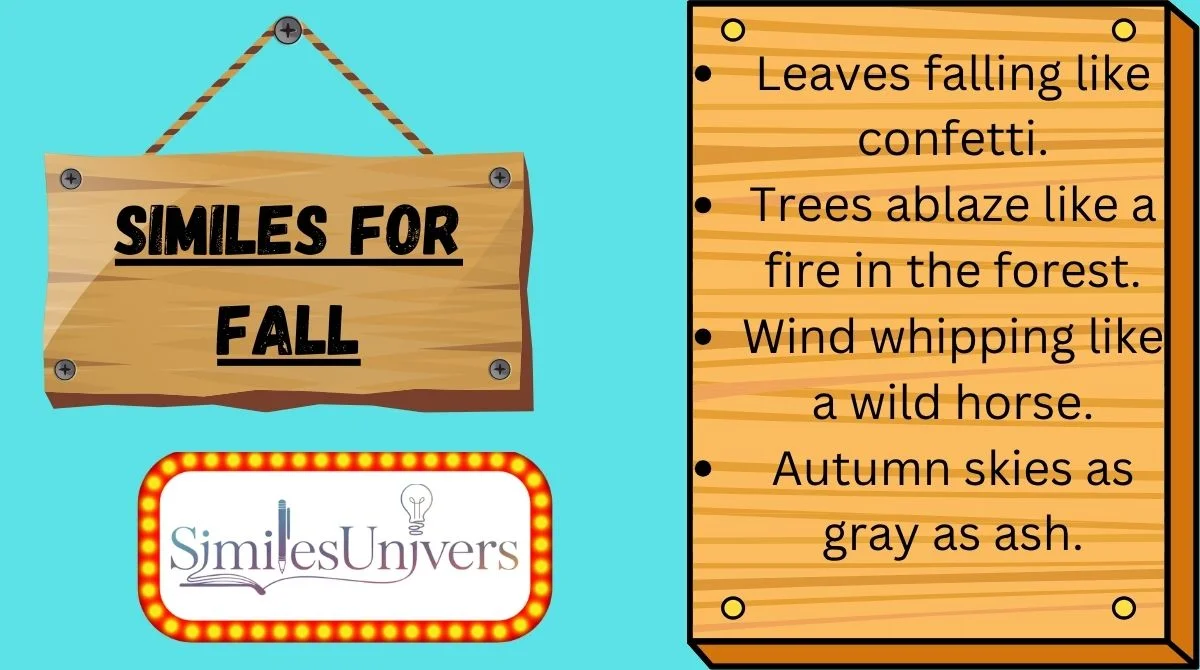
- Leaves falling like confetti.
- Trees ablaze like a fire in the forest.
- Wind whipping like a wild horse.
- Autumn skies as gray as ash.
- Pumpkins round like lanterns.
- Air crisp as a fresh apple.
- Shadows stretching like long fingers.
- Leaves crunching like dry paper.
- Sunlight soft as amber.
- Rain pattering like tiny drums.
Complete List of Similes for Fall (Grouped by Meaning)
Funny & Lighthearted
Leaves tumbling like clumsy dancers
Meaning: Leaves falling awkwardly yet playfully.
Explanation: This evokes a sense of fun as leaves spin and sway to the ground.
Examples:
- The maple leaves tumbled like clumsy dancers across the garden path.
- Wind scattered the autumn leaves like clumsy dancers on a windy stage.
Tone: Funny
Pumpkins waddle like tiny orange sumo wrestlers
Meaning: Pumpkins looking round and heavy on the vine.
Explanation: Imagery exaggerates their roundness in a humorous way.
Examples:
- The farmer’s pumpkins waddle like tiny orange sumo wrestlers in the patch.
- Children rolled the pumpkins, which wobbled like tiny sumo wrestlers.
Tone: Funny
Apples bouncing like playful balls
Meaning: Apples dropping or rolling energetically.
Explanation: Adds a lively, playful scene to an orchard description.
Examples:
- The apples fell from the tree, bouncing like playful balls.
- A gust of wind sent apples bouncing like playful balls across the grass.
Tone: Lighthearted
Emotional & Deep
Leaves drifting like forgotten memories
Meaning: Leaves slowly falling, evoking nostalgia.
Explanation: Suggests reflection and the passing of time.
Examples:
- Autumn leaves drifted like forgotten memories across the empty park.
- She watched the leaves, drifting like forgotten memories, and sighed.
Tone: Serious
Fog curling like a quiet whisper
Meaning: Mist moving gently over the land.
Explanation: Evokes a mysterious, soft atmosphere.
Examples:
- The morning fog curled like a quiet whisper around the old bridge.
- Silence filled the air, as fog curled like a quiet whisper among the trees.
Tone: Poetic
The harvest moon glowing like a guardian lantern
Meaning: The moon brightening the autumn night.
Explanation: Gives the moon a protective, comforting imagery.
Examples:
- The harvest moon glowed like a guardian lantern above the sleepy town.
- They hiked under the harvest moon, glowing like a guardian lantern in the sky.
Tone: Poetic
Dramatic & Intense
Wind howling like a pack of wolves
Meaning: Strong, unsettling wind.
Explanation: Conveys power and urgency of a stormy fall night.
Examples:
- The wind howled like a pack of wolves through the bare branches.
- Windows rattled as the wind howled like a pack of wolves.
Tone: Dramatic
Leaves snapping like brittle bones
Meaning: Dry, crisp leaves breaking underfoot.
Explanation: Intensifies the sensory feeling of crunching leaves.
Examples:
- He stepped on the autumn leaves, snapping them like brittle bones.
- The forest floor was alive with leaves snapping like brittle bones underfoot.
Tone: Intense
Rain slashing like silver knives
Meaning: Heavy rain hitting sharply.
Explanation: Adds danger and movement to a stormy scene.
Examples:
- Rain lashed the windows, slashing like silver knives.
- The storm roared as rain slashed like silver knives across the fields.
Tone: Dramatic
Slow & Monotonous
Leaves falling like lazy snowflakes
Meaning: Slow, gentle descent of leaves.
Explanation: Evokes calm, peaceful imagery.
Examples:
- Golden leaves drifted down like lazy snowflakes.
- The park was quiet, with leaves falling like lazy snowflakes.
Tone: Calm
Days shortening like a shrinking candle
Meaning: Autumn days getting shorter.
Explanation: Symbolizes the passage of time.
Examples:
- The light faded, days shortening like a shrinking candle.
- Evening came early, days shortening like a shrinking candle in the sky.
Tone: Reflective
Fog spreading like old memories
Meaning: Thick mist enveloping the landscape.
Explanation: Slow, gradual, and melancholic.
Examples:
- The river disappeared under fog spreading like old memories.
- Morning came slowly, fog spreading like old memories over the hills.
Tone: Poetic
Creative & Unique
Leaves swirling like dancers in a masquerade
Meaning: Playful, coordinated movement of falling leaves.
Explanation: Adds elegance and creativity to leaf imagery.
Examples:
- The park was alive with leaves swirling like dancers in a masquerade.
- Autumn winds carried leaves swirling like dancers in a masquerade.
Tone: Creative
Acorns rolling like tiny planets
Meaning: Acorns moving across the ground.
Explanation: Suggests motion and miniature grandeur.
Examples:
- Acorns rolled like tiny planets across the forest floor.
- The squirrels chased acorns rolling like tiny planets down the hill.
Tone: Creative
Smoke rising like dragon whispers
Meaning: Fireplace smoke curling into the air.
Explanation: Imagery evokes mystery and fantasy.
Examples:
- From the chimney, smoke rose like dragon whispers in the twilight.
- Evening fires sent smoke rising like dragon whispers above the rooftops.
Tone: Poetic
Poetic & Literary
Leaves cascading like golden rain
Meaning: Leaves falling in abundance.
Explanation: Highlights beauty and movement.
Examples:
- Autumn leaves cascaded like golden rain from the oak trees.
- The garden was alive with leaves cascading like golden rain.
Tone: Poetic
Twilight settling like a velvet curtain
Meaning: Evening darkness spreading slowly.
Explanation: Literary metaphor for calm and transition.
Examples:
- Twilight settled over the hills like a velvet curtain.
- Shadows lengthened as twilight settled like a velvet curtain.
Tone: Poetic
Branches bending like weary dancers
Meaning: Trees bending under wind or weight.
Explanation: Evokes sympathy and visual elegance.
Examples:
- The trees swayed, branches bending like weary dancers.
- Wind swept through the forest, branches bending like weary dancers.
Tone: Poetic
Fresh and Unique Similes You Won’t Hear Every Day
- Leaves clinging like stubborn old friends – evokes attachment and nostalgia.
- Morning mist drifting like secret letters – mysterious and delicate imagery.
- Pumpkins glowing like embers of sunset – emphasizes warm autumn light.
- Wind whispering like a shy poet – gentle and intimate sound.
- Shadows stretching like tired cats – playful yet calm depiction of evening.
How to Use These Similes in Writing
- Essays: Add color and emotion, e.g., “Autumn leaves fell like forgotten memories, marking the passing of time.”
- Stories: Enhance imagery and mood, e.g., “The wind howled like a pack of wolves, chasing the children through the orchard.”
How to Create Your Own Similes
Step-by-step method:
- Identify the object or feeling you want to describe.
- Think of something familiar that shares a similar quality.
- Connect them using “like” or “as.”
- Test the simile in a sentence.
- Adjust for tone and clarity.
Tips:
- Keep it simple.
- Use sensory details.
- Avoid clichés.
- Match tone to context.
- Be playful or bold with comparisons.
Examples:
- Ordinary: Leaves falling. → Creative: Leaves falling like whispered secrets from the sky.
- Ordinary: Wind blowing. → Creative: Wind blowing like invisible dancers across the fields.
- Ordinary: Pumpkin bright. → Creative: Pumpkin bright like a sunset trapped in a gourd.
Common Mistakes When Using Similes
- Overuse: Too many comparisons can confuse readers.
- Clichés: Avoid tired similes like “busy as a bee” or “red as a rose.”
- Tone mismatch: A funny simile in a serious scene can break immersion.
Similes for Fall Leaves, Colors, and Autumn Beauty
- The leaves glow like scattered pieces of gold — highlights the bright yellow and golden colors of autumn.
- Red maple leaves shine like tiny flames — creates a vivid image of fiery fall foliage.
- The forest looks like a painted masterpiece — describes the colorful beauty of trees in autumn.
- Leaves cover the ground like a colorful carpet — shows how fallen leaves transform paths and lawns.
- The autumn trees stand like jeweled towers — compares colorful trees to tall, sparkling structures.
Practice Exercise
Fill in the blanks with an appropriate simile:
- Leaves fell __________.
- Wind screamed __________.
- Pumpkin glowed __________.
- Shadows stretched __________.
- Rain pelted __________.
- Trees swayed __________.
- Fog rolled __________.
- Apples bounced __________.
- Twilight descended __________.
- Acorns tumbled __________.
- Morning mist floated __________.
- Branches creaked __________.
Answers:
- like golden rain
- like a pack of wolves
- like embers of sunset
- like tired cats
- like silver knives
- like weary dancers
- like old memories
- like playful balls
- like a velvet curtain
- like tiny planets
- like secret letters
- like bending dancers
FAQs
What is a simile?
A simile is a figure of speech comparing two things using “like” or “as.”
Why use similes in writing?
Similes make descriptions vivid, relatable, and memorable.
How do I make unique similes?
Combine unexpected comparisons with sensory details and emotions.
Can similes improve essays?
Yes, they add color, emotion, and depth to your writing.
Are similes only for poetry?
No, they work in essays, stories, and creative writing.
What’s the difference between a simile and a metaphor?
Similes use “like” or “as” to compare; metaphors state the comparison directly.
Final Thoughts
Fall is a season full of beauty, transformation, and emotion. Using similes helps you capture its essence, turning ordinary descriptions into vivid, memorable scenes.
From playful and funny to deep and poetic, the right simile can make your writing sparkle. Experiment, create, and let your words paint the colors of autumn for your readers.
Daniel Harper
I am simplifies complex literary concepts into clear, practical lessons for students and learners worldwide.
Through SimilesUnivers, he aims to make mastering similes engaging, structured, and academically enriching.