Emotions are the colors of our inner world—they can brighten our day, cloud our thoughts, or overwhelm our senses.
Yet, describing them vividly in writing can be tricky. That’s where similes come in. A well-crafted simile can instantly make your feelings tangible, helping readers connect with your story or essay on a deeper level.
From joy to frustration, fear to longing, similes turn abstract emotions into images that readers can see, hear, and feel.
In this guide, you’ll discover over 32 powerful similes for emotions, from timeless classics to fresh, unique expressions.
You’ll learn how to use them naturally in writing, how to craft your own, and how to avoid common pitfalls. By the end, your writing will evoke emotions with clarity, impact, and style.
What Is a Simile?
A simile is a figure of speech that compares two different things using “like” or “as.” It’s a simple way to make your writing more vivid and relatable.
Example:
“Her smile was like sunshine on a cloudy day.”
This tells the reader her smile is warm and bright, without just saying “she had a nice smile.”
Quick List – Most Popular Similes for Emotions
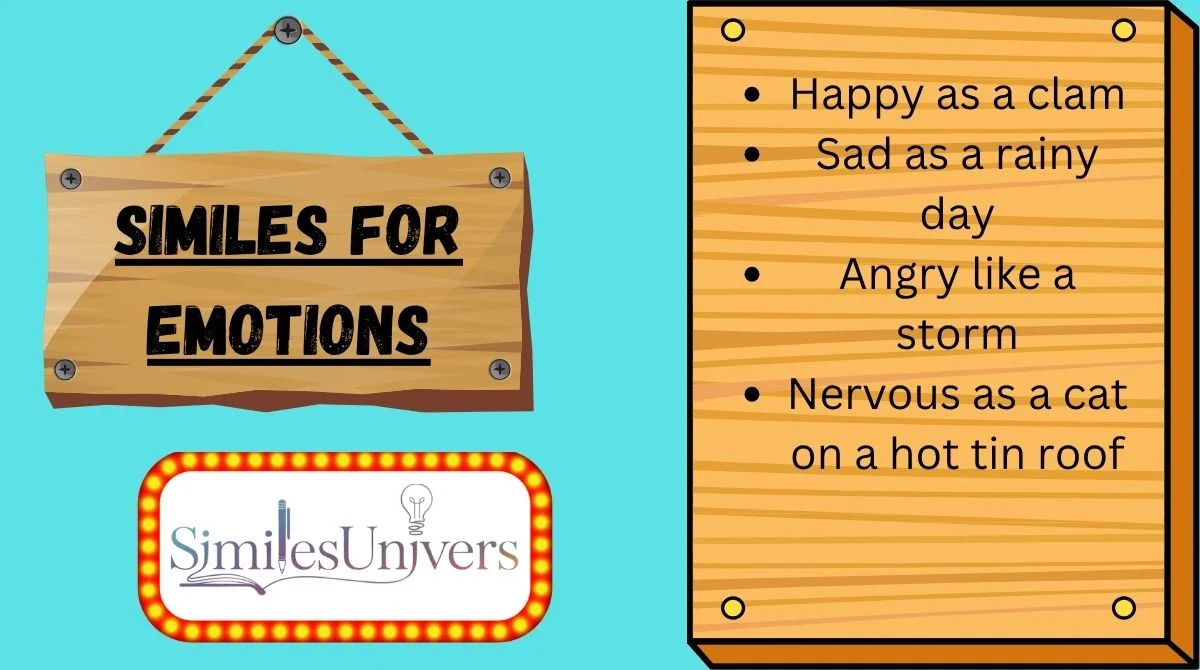
- Happy as a clam
- Sad as a rainy day
- Angry like a storm
- Nervous as a cat on a hot tin roof
- Excited like a child on Christmas morning
- Lonely as a single star in the sky
- Calm as a still lake
- Jealous like a green-eyed monster
- Frustrated as a stuck zipper
- Hopeful like a sprouting seed
Complete List of Similes for Emotions (Grouped by Meaning)
Funny & Lighthearted
Laughing like a hyena
- Meaning: Laughing uncontrollably
- Explanation: Compares wild, unrestrained laughter to the loud, raucous sound of a hyena
- Examples:
- “She was laughing like a hyena at his silly dance moves.”
- “The audience laughed like hyenas when the comedian slipped on stage.”
- Tone: Funny
Surprised as a cat in a cucumber patch
- Meaning: Shocked and startled
- Explanation: Cats often react dramatically to unexpected objects, capturing surprise
- Examples:
- “He jumped as surprised as a cat in a cucumber patch when the doorbell rang.”
- “Her eyes widened, as surprised as a cat in a cucumber patch.”
- Tone: Humorous
Cheerful as a puppy with a new toy
- Meaning: Extremely happy and playful
- Explanation: Puppies show pure joy when they get something new, a metaphor for innocence and excitement
- Examples:
- “She ran down the hallway, cheerful as a puppy with a new toy.”
- “His mood lifted, cheerful as a puppy with a new toy.”
- Tone: Lighthearted
Emotional & Deep
Heartbroken like shattered glass
- Meaning: Intense sadness
- Explanation: Evokes the sharp, irreversible pain of heartbreak
- Examples:
- “He walked away, heartbroken like shattered glass.”
- “Her journal was full of words, heartbroken like shattered glass.”
- Tone: Serious
Anxious like leaves in a storm
- Meaning: Restless, uneasy
- Explanation: Leaves flutter unpredictably, mirroring inner turmoil
- Examples:
- “She sat waiting for the call, anxious like leaves in a storm.”
- “His mind raced, anxious like leaves in a storm.”
- Tone: Serious
Hopeful like dawn breaking
- Meaning: Optimistic, looking forward
- Explanation: Dawn symbolizes new beginnings and opportunities
- Examples:
- “Despite the setback, she felt hopeful like dawn breaking.”
- “He faced the challenge, hopeful like dawn breaking.”
- Tone: Poetic
Dramatic & Intense
Angry like a volcano ready to erupt
- Meaning: Extreme anger
- Explanation: Compares boiling rage to the unstoppable force of a volcanic eruption
- Examples:
- “She glared at him, angry like a volcano ready to erupt.”
- “He slammed the door, angry like a volcano ready to erupt.”
- Tone: Dramatic
Fearful like a deer in headlights
- Meaning: Paralyzed by fear
- Explanation: Deer freeze when faced with danger, reflecting intense fear
- Examples:
- “He froze, fearful like a deer in headlights.”
- “She hesitated, fearful like a deer in headlights.”
- Tone: Serious
Confused like a chameleon in a bag of Skittles
- Meaning: Utterly bewildered
- Explanation: A chameleon cannot adapt quickly to chaotic surroundings
- Examples:
- “He scratched his head, confused like a chameleon in a bag of Skittles.”
- “The instructions left her confused like a chameleon in a bag of Skittles.”
- Tone: Creative
Slow & Monotonous
Sad as a ticking clock
- Meaning: A slow, dreary sadness
- Explanation: The relentless, monotonous ticking emphasizes dull sadness
- Examples:
- “The afternoon dragged, sad as a ticking clock.”
- “He felt sad as a ticking clock in the empty room.”
- Tone: Serious
Drained like an old battery
- Meaning: Exhausted
- Explanation: Lacks energy and vitality, like a device without power
- Examples:
- “After the long meeting, she was drained like an old battery.”
- “He worked all day, drained like an old battery.”
- Tone: Casual
Lonely as a forgotten sock
- Meaning: Feeling isolated
- Explanation: Evokes humor but emphasizes abandonment and solitude
- Examples:
- “He sat alone at the café, lonely as a forgotten sock.”
- “Her thoughts drifted, lonely as a forgotten sock.”
- Tone: Lighthearted
Creative & Unique
Nervous like a hummingbird on espresso
- Meaning: Hyperactive anxiety
- Explanation: Hummingbirds are quick and jittery, amplified by caffeine imagery
- Examples:
- “She waited for the interview, nervous like a hummingbird on espresso.”
- “His hands shook, nervous like a hummingbird on espresso.”
- Tone: Funny
Joyful like rain on parched soil
- Meaning: Relief and happiness
- Explanation: Compares sudden happiness to life-giving rain after drought
- Examples:
- “The good news made her joyful like rain on parched soil.”
- “He smiled, joyful like rain on parched soil.”
- Tone: Poetic
Embarrassed like a tomato at sunset
- Meaning: Intense embarrassment
- Explanation: A tomato’s redness mirrors a person’s blushing face
- Examples:
- “He tripped in front of everyone, embarrassed like a tomato at sunset.”
- “She stammered, embarrassed like a tomato at sunset.”
- Tone: Poetic
Poetic & Literary
Melancholy like autumn leaves
- Meaning: Gentle sadness
- Explanation: Falling leaves symbolize inevitable change and loss
- Examples:
- “He watched the rain, melancholy like autumn leaves.”
- “Her thoughts drifted, melancholy like autumn leaves.”
- Tone: Poetic
Passionate like fire in the hearth
- Meaning: Strong love or desire
- Explanation: Fire symbolizes warmth, energy, and intensity
- Examples:
- “She spoke with passion, like fire in the hearth.”
- “His eyes burned, passionate like fire in the hearth.”
- Tone: Poetic
Lonely like a lighthouse in fog
- Meaning: Isolated and watchful
- Explanation: A lighthouse stands alone, signaling for connection
- Examples:
- “He wandered through the city, lonely like a lighthouse in fog.”
- “Her room felt empty, lonely like a lighthouse in fog.”
- Tone: Poetic
Fresh and Unique Similes You Won’t Hear Every Day
- Excited like a kite in a hurricane – Over-the-top exhilaration, energy beyond control.
- Hopeful like moss on stone – Persistence of hope in unlikely places.
- Conflicted like a compass at the North Pole – Directionless uncertainty.
- Elated like bubbles escaping champagne – Light, spontaneous joy.
- Wistful like footprints in sand – Gentle longing, temporary and fleeting.
How to Use These Similes in Writing
Essays: Use similes to clarify abstract feelings. For example, describing anxiety as “leaves in a storm” makes your point vivid without over-explaining.
Stories: Characters come alive when their emotions are shown, not told. Similes like “angry as a volcano ready to erupt” paint a mental image instantly.
How to Create Your Own Similes
Step-by-Step Method:
- Identify the emotion.
- Brainstorm related imagery (nature, animals, objects).
- Choose a comparison that amplifies the feeling.
- Use “like” or “as” naturally.
- Test readability and tone.
Practical Tips:
- Avoid clichés.
- Keep it simple and clear.
- Match tone to context.
- Draw from personal experiences.
- Experiment with surprising comparisons.
Transformation Examples:
- Sad → Sad as a wilting flower
- Nervous → Nervous like a squirrel in traffic
- Happy → Happy like a child catching fireflies
Common Mistakes When Using Similes
- Overuse: Too many similes overwhelm the reader.
- Clichés: “Busy as a bee” feels tired; choose fresh comparisons.
- Tone mismatch: A playful simile in a tragic scene can break immersion.
Practice Exercise
Fill in the blanks with an appropriate simile:
- She ran down the street, ________.
- He glared at the cheater, ________.
- Waiting for the test results, she felt ________.
- His heart soared, ________.
- Alone in the forest, he felt ________.
- She whispered, ________.
- Angry at the traffic, he was ________.
- He laughed, ________.
- Excited about the trip, she was ________.
- The baby cried, ________.
- Nervous before the speech, he was ________.
- Dreaming of adventure, she felt ________.
Answers:
- cheerful as a puppy with a new toy
- angry like a volcano ready to erupt
- anxious like leaves in a storm
- joyful like rain on parched soil
- lonely as a lighthouse in fog
- shy as a deer
- frustrated as a stuck zipper
- laughing like a hyena
- excited like a child on Christmas morning
- loud as a thunderclap
- nervous like a hummingbird on espresso
- hopeful like dawn breaking
FAQs
What is a simile in writing?
A simile is a figure of speech comparing two things using “like” or “as” to make descriptions vivid.
Why use similes for emotions?
They turn abstract feelings into visual, relatable images, making writing more engaging.
Can similes be too dramatic?
Yes, over-the-top similes can distract. Balance with tone and context.
How do I avoid clichés?
Use personal experiences, fresh imagery, and less common comparisons.
Are similes the same as metaphors?
No, metaphors imply a direct comparison, while similes use “like” or “as.”
Can similes improve storytelling?
Absolutely—showing emotions through imagery makes characters and scenes more vivid.
Final Thoughts
Similes are a writer’s secret weapon for evoking emotions. From playful humor to deep sorrow, the right simile brings your readers closer to the experience. Use the classic examples, explore the unique ones, and even create your own to make your writing shine. Embrace these 32+ similes, and watch your essays, stories, and poems come alive with emotion.

Daniel Harper
I am simplifies complex literary concepts into clear, practical lessons for students and learners worldwide.
Through SimilesUnivers, he aims to make mastering similes engaging, structured, and academically enriching.