Have you ever struggled to describe something that’s tough, stubborn, or challenging? Words like “hard” or “difficult” are fine, but they can feel flat.
That’s where similes come in—they give your writing color, depth, and emotional punch. Using similes can make your essays, stories, or even everyday conversations more vivid and memorable.
Whether you’re describing a hard task, a tough decision, or something physically unyielding, this guide gives you over 31 creative and powerful similes that will elevate your writing.
By the end, you’ll have a toolkit to describe anything hard with flair and precision.
What Is a Simile? (Quick Clear Definition)
A simile is a figure of speech that compares two different things using words like “as” or “like.”
For example: “She was as brave as a lion.”
It helps readers visualize or feel what you’re describing in a relatable way.
Quick List – Most Popular Similes for Hard
- Hard as a rock
- Hard as nails
- Hard as iron
- Hard as concrete
- Hard as steel
- Hard as a diamond
- Hard as a tree trunk
- Hard as leather
- Hard as stone
- Hard as a brick
Similes for Hard Work and Difficult Tasks
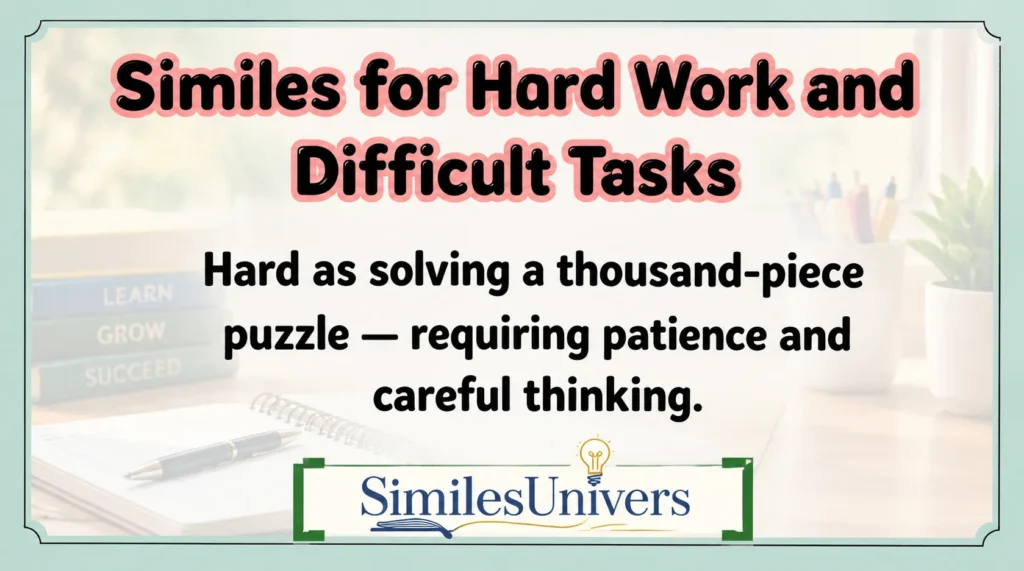
When you want to describe a task that requires great effort, patience, or determination, these similes can make your writing more vivid.
- Hard as climbing a mountain — extremely challenging and demanding.
Finishing the project was as hard as climbing a mountain. - Hard as solving a thousand-piece puzzle — requiring patience and careful thinking.
The problem was as hard as solving a thousand-piece puzzle. - Hard as pushing a boulder uphill — exhausting and seemingly never-ending.
Getting everyone to agree was as hard as pushing a boulder uphill. - Hard as breaking through a brick wall — requiring tremendous effort to make progress.
Learning the new skill felt as hard as breaking through a brick wall. - Hard as running through deep mud — slow, tiring, and difficult.
Completing the assignment was as hard as running through deep mud. - Hard as moving a mountain — requiring an enormous amount of effort.
Changing the old system was as hard as moving a mountain.
Complete List of Similes for Hard (Grouped by Meaning)
Funny & Lighthearted
Hard as a peanut shell
Meaning: Slightly tough but not intimidating
Explanation: Implies something is hard but in a minor, almost amusing way
Examples:
- The candy was hard as a peanut shell, cracking under my teeth.
- His excuses were hard as a peanut shell—easy to see through.
Tone: Funny
Hard as Grandma’s meatloaf
Meaning: Very firm and old-fashioned
Explanation: Compares hardness to overcooked comfort food
Examples:
- The floor was hard as Grandma’s meatloaf after baking all day.
- His handshake was hard as Grandma’s meatloaf—solid and unyielding.
Tone: Lighthearted
Emotional & Deep
Hard as a shattered heart
Meaning: Emotionally tough or closed off
Explanation: Describes someone emotionally hardened by experiences
Examples:
- After the betrayal, her trust was hard as a shattered heart.
- He faced life with a hard-as-a-shattered-heart resolve.
Tone: Serious
Hard as the winter frost
Meaning: Cold and unyielding emotionally
Explanation: Evokes the icy, hard nature of frost to convey emotional toughness
Examples:
- His demeanor was hard as the winter frost, unwelcoming to strangers.
- She kept her feelings hard as the winter frost, protecting herself.
Tone: Poetic
Dramatic & Intense
Hard as a volcano rock
Meaning: Extremely solid and resistant
Explanation: Lava solidifies into rock—immense strength is implied
Examples:
- The mountain’s surface was hard as a volcano rock.
- His determination was hard as a volcano rock, unbreakable.
Tone: Serious
Hard as iron chains
Meaning: Restrictive, unyielding
Explanation: Chains symbolize confinement and rigid strength
Examples:
- The rules felt hard as iron chains, impossible to break.
- Her discipline was hard as iron chains, unbending.
Tone: Dramatic
Slow & Monotonous
Hard as frozen oatmeal
Meaning: Stiff and dull
Explanation: Overcooked, cold oatmeal illustrates a bland kind of toughness
Examples:
- The porridge was hard as frozen oatmeal, impossible to chew.
- His routine felt hard as frozen oatmeal, dragging day after day.
Tone: Casual
Hard as dried clay
Meaning: Tough to mold or change
Explanation: Dried clay is rigid and resistant
Examples:
- The path ahead was hard as dried clay, difficult to traverse.
- Her mindset was hard as dried clay, resisting all advice.
Tone: Serious
Creative & Unique
Hard as a knight’s armor
Meaning: Protective and unyielding
Explanation: Symbolizes strength, resistance, and defense
Examples:
- His emotions were hard as a knight’s armor, impenetrable.
- The old door was hard as a knight’s armor, refusing entry.
Tone: Poetic
Hard as a blacksmith’s hammer
Meaning: Forceful and strong
Explanation: Hammering metal requires solid, unyielding strength
Examples:
- The workbench was hard as a blacksmith’s hammer.
- Her voice hit hard as a blacksmith’s hammer, demanding attention.
Tone: Dramatic
Hard as the desert sun
Meaning: Harsh, relentless
Explanation: Sun’s heat is unforgiving, symbolizing toughness
Examples:
- His stare was hard as the desert sun, burning through lies.
- The landscape was hard as the desert sun, unforgiving to travelers.
Tone: Poetic
Poetic & Literary
Hard as frozen tears
Meaning: Emotional and tragic toughness
Explanation: Evokes frozen sorrow, unmelting and lasting
Examples:
- Her expression was hard as frozen tears after the loss.
- The memory stayed hard as frozen tears in his heart.
Tone: Poetic
Hard as the northern ice
Meaning: Frigid, cold, and impenetrable
Explanation: Ice imagery conveys natural toughness and endurance
Examples:
- The river was hard as the northern ice, impossible to cross.
- His will was hard as the northern ice, unaffected by storms.
Tone: Serious
Fresh and Unique Similes You Won’t Hear Every Day
Hard as a philosopher’s doubt
Imagery: Intellectual rigidity, resistance to simple answers
Hard as a cat’s decision
Imagery: Unpredictable, independent toughness
Hard as the last leaf in autumn
Imagery: Clinging stubbornly despite adversity
Hard as the edge of a forgotten sword
Imagery: Sharp, long-lasting strength
Hard as the silence before a storm
Imagery: Tense, unyielding anticipation
How to Use These Similes in Writing
- Essays: Enhance descriptive passages to illustrate challenges or obstacles.
- Stories: Bring characters, settings, and conflicts to life by making “hard” tangible.
- Dialogue: Add authenticity and emotional depth to conversations.
How to Create Your Own Similes (Mini Writing Guide)
- Identify what’s hard: Physical object, emotion, or situation.
- Think visually: Pick a concrete, familiar comparison.
- Use “as” or “like”: Connect the two elements naturally.
- Add sensory detail: Smell, feel, or sound enhances imagery.
- Check tone: Match the simile to the context.
Tips:
- Avoid clichés unless intentional.
- Mix funny, poetic, and dramatic for variety.
- Use similes to clarify, not confuse.
- Be specific: “hard as iron” beats “hard as stuff.”
- Revise to maintain rhythm and flow.
Transformation Examples:
- “Hard as steel” → “Hard as the sunbaked bricks of a desert village.”
- “Hard as stone” → “Hard as the ancient statue in the empty square.”
- “Hard as nails” → “Hard as the old boot soles of a long trekker.”
Similes for a Hard and Unforgiving Person
These similes describe someone who is emotionally tough, strict, cold, stubborn, or unwilling to show kindness.
- Hard as stone — emotionally cold and difficult to influence.
His heart was as hard as stone. - Hard as iron — extremely firm, strict, or unyielding.
Her attitude was as hard as iron. - Hard as steel — strong-willed and resistant to pressure.
His resolve was as hard as steel. - Cold as winter ice — distant, unfriendly, and lacking warmth.
She was as cold as winter ice toward everyone. - Hard as an old oak tree — stubborn, strong, and difficult to bend.
His opinions were as hard as an old oak tree. - Hard as a locked door — unwilling to open up or listen.
He was as hard as a locked door when it came to forgiveness. - Hard as a fortress wall — strongly guarded and difficult to reach emotionally.
Her heart was as hard as a fortress wall.
Common Mistakes When Using Similes
- Overuse: Too many similes can overwhelm the reader.
- Clichés: Avoid tired phrases unless they fit your tone intentionally.
- Tone mismatch: Funny similes in serious scenes can distract.
Practice Exercise
Fill in the blanks with the correct simile:
- The wall was ________, refusing to budge.
- Her stare was ________, warning me to stop.
- The chocolate was ________, snapping under my bite.
- His emotions were ________, untouched by kindness.
- The homework felt ________, impossible to finish.
- The chair was ________, old but strong.
- His determination was ________, unstoppable.
- The ice on the pond was ________, dangerous to step on.
- The routine was ________, dragging every day.
- Her voice was ________, commanding attention.
- The task was ________, testing every skill I had.
- The silence was ________, tense before the storm.
Answers:
- Hard as stone
- Hard as the desert sun
- Hard as a peanut shell
- Hard as a shattered heart
- Hard as concrete
- Hard as wood
- Hard as a volcano rock
- Hard as northern ice
- Hard as frozen oatmeal
- Hard as a blacksmith’s hammer
- Hard as steel
- Hard as the silence before a storm
FAQs
Q: What’s the difference between a simile and a metaphor?
A: A simile uses “like” or “as” to compare, while a metaphor states the comparison directly.
Q: Can I use similes in academic essays?
A: Yes, if they clarify or enhance your point without sounding casual.
Q: Are similes only for literary writing?
A: No, they work in storytelling, marketing, speeches, and everyday speech.
Q: How do I avoid clichés in similes?
A: Combine unusual comparisons or add sensory details for freshness.
Q: How many similes should I use in a paragraph?
A: One or two strong similes per paragraph keeps writing vivid but readable.
Q: Can similes be funny and serious at the same time?
A: Yes, but ensure the context and tone match so the humor doesn’t undermine the message.
Final Thoughts
Similes are powerful tools to describe hardness in all its forms—physical, emotional, and situational. By using the 31+ similes above, including fresh and unique comparisons, you can make your writing more engaging, vivid, and memorable.
Practice creating your own, pay attention to tone, and watch your words transform from flat to striking.

Daniel Harper
I am simplifies complex literary concepts into clear, practical lessons for students and learners worldwide.
Through SimilesUnivers, he aims to make mastering similes engaging, structured, and academically enriching.