When you want your writing to pop, nothing beats a clever simile. A simile paints vivid images in your reader’s mind, making ideas unforgettable.
Whether you’re describing someone’s thoughts, appearance, or state of mind, the right simile can bring a sentence to life. Imagine your story, essay, or poem leaping off the page because your descriptions resonate emotionally and visually.
This guide is packed with over 31 creative similes for the head, from familiar expressions to fresh, lesser-known comparisons.
You’ll learn not only what these similes mean but also how to use them effectively in your writing. By the end, you’ll have a treasure trove of metaphors to make any narrative sharper, funnier, or more poetic.
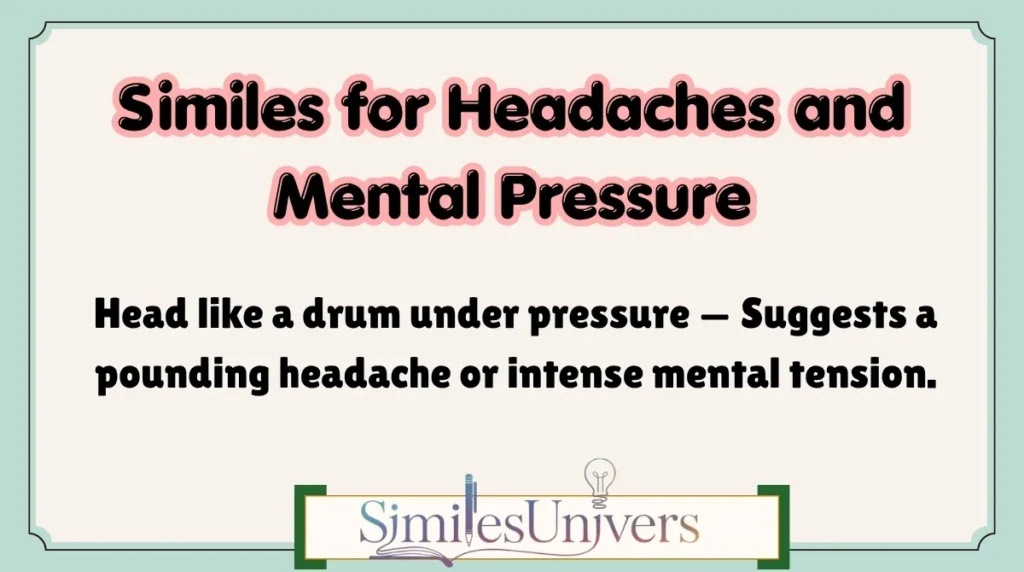
Similes for Headaches and Mental Pressure
- Head as heavy as a mountain — Describes an overwhelming feeling caused by stress, worry, or a severe headache.
- Head like a drum under pressure — Suggests a pounding headache or intense mental tension.
- Head as tight as a locked box — Describes pressure, tension, or difficulty thinking clearly.
- Head like a storm cloud — Suggests a mind filled with stress, worry, or painful thoughts.
- Head as pounding as a hammer — Describes a strong, throbbing headache.
- Head like a pressure cooker — Shows intense mental stress that feels ready to burst.
- Head as heavy as wet wool — Suggests tiredness, mental exhaustion, and sluggish thinking.
What Is a Simile?
A simile is a figure of speech that compares two different things using “like” or “as.” It helps readers visualize or feel something more clearly.
Example: Her head was like a cloud, full of swirling ideas.
Quick List – Most Popular Similes for Head
- As empty as a hollow drum
- As big as a watermelon
- As sharp as a tack
- As heavy as a stone
- As light as a feather
- As hot as a furnace
- As cold as ice
- Like a spinning top
- Like a buzzing bee
- Like a balloon ready to burst
Complete List of Similes for Head (Grouped by Meaning)
Funny & Lighthearted
Head as Big as a Pumpkin
Meaning: Exaggerating the size of someone’s head in a playful way.
Explanation: Suggests humorously large head, often to tease.
Examples:
- His head was as big as a pumpkin after that hair treatment.
- I couldn’t stop laughing—her head looked like a pumpkin on Halloween.
Tone: Funny
Head like a Duck’s Ball
Meaning: Round, soft, or bouncy head shape.
Explanation: Visualizes a round or awkwardly shaped head.
Examples:
- The toddler’s head bounced like a duck’s ball on the pillow.
- He shook his head like a duck’s ball after the silly idea.
Tone: Humorous
Head as Full as a Piñata
Meaning: Overstuffed with thoughts or ideas.
Explanation: Suggests chaos or too many ideas crammed inside.
Examples:
- Her head was as full as a piñata before the final exam.
- He entered the meeting with a head as full as a piñata of random facts.
Tone: Lighthearted
Emotional & Deep
Head like a Stormy Sky
Meaning: Troubled or overthinking.
Explanation: Implies emotional turbulence or inner conflict.
Examples:
- His head was like a stormy sky, full of doubt and fear.
- After the argument, my thoughts swirled like a stormy sky.
Tone: Serious
Head as Hollow as a Cave
Meaning: Empty or numb feelings.
Explanation: Suggests a lack of ideas or emotional emptiness.
Examples:
- After the loss, her head felt as hollow as a cave.
- I stared blankly, my mind as hollow as a cave.
Tone: Poetic
Head like a Ticking Clock
Meaning: Anxious, constantly aware of time.
Explanation: The mind is counting down, restless, or overthinking.
Examples:
- His head was like a ticking clock before the presentation.
- Thoughts in my head ticked like a clock, reminding me of deadlines.
Tone: Serious
Dramatic & Intense
Head as Heavy as Lead
Meaning: Overwhelmed, burdened.
Explanation: Suggests mental or emotional weight.
Examples:
- My head felt as heavy as lead after the shocking news.
- Carrying all those worries made her head feel as heavy as lead.
Tone: Dramatic
Head like a Volcano
Meaning: About to explode in anger or ideas.
Explanation: Implies tension building toward an emotional eruption.
Examples:
- He stormed into the room with a head like a volcano.
- My thoughts were like a volcano, ready to erupt.
Tone: Intense
Head as Sharp as a Sword
Meaning: Extremely intelligent or perceptive.
Explanation: Highlights mental clarity or wit.
Examples:
- Her head was as sharp as a sword in solving puzzles.
- With a head as sharp as a sword, he spotted every detail.
Tone: Serious
Slow & Monotonous
Head like a Stone
Meaning: Slow-thinking or unresponsive.
Explanation: Suggests difficulty processing or lethargy.
Examples:
- After the long lecture, my head felt like a stone.
- His thoughts moved like a stone rolling down a hill.
Tone: Casual
Head as Foggy as a Misty Morning
Meaning: Confused or unclear.
Explanation: Implies a lack of focus or mental haze.
Examples:
- My head was as foggy as a misty morning after staying up all night.
- She wandered through her work, head foggy as a misty morning.
Tone: Poetic
Creative & Unique
Head like a Jigsaw Puzzle
Meaning: Complex or full of scattered thoughts.
Explanation: Pieces of ideas that need assembling.
Examples:
- His head was like a jigsaw puzzle after the brainstorming session.
- Thoughts in her head were like a jigsaw puzzle with missing pieces.
Tone: Creative
Head as Bright as Neon
Meaning: Vibrant, full of ideas or energy.
Explanation: Suggests liveliness and attention-grabbing thoughts.
Examples:
- Her head shone as bright as neon during creative bursts.
- The inventor’s head was as bright as neon with wild ideas.
Tone: Poetic
Head like a Spinning Carousel
Meaning: Confused or dizzy with thoughts.
Explanation: Imagery of constant circular motion in the mind.
Examples:
- After all the changes, his head felt like a spinning carousel.
- Her thoughts went round and round, head like a spinning carousel.
Tone: Creative
Poetic & Literary
Head like a Garden of Thoughts
Meaning: Flourishing with ideas.
Explanation: Suggests growth, richness, and creativity in thinking.
Examples:
- Her head was like a garden of thoughts, blooming with creativity.
- I wandered through his head like exploring a garden of thoughts.
Tone: Poetic
Head as Light as a Cloud
Meaning: Carefree or unburdened.
Explanation: Suggests mental ease or happiness.
Examples:
- After finishing her exams, her head felt as light as a cloud.
- He walked through the park, head as light as a cloud.
Tone: Poetic
Fresh and Unique Similes You Won’t Hear Every Day
- Head like a comet trailing sparks – Fast, brilliant, fleeting thoughts.
- Head as soft as marshmallow clouds – Gentle, dreamy ideas.
- Head like a library in a hurricane – Ideas chaotic but rich.
- Head as tangled as seaweed in a storm – Confused, complex mental state.
- Head like a lantern in fog – Illuminating small ideas amidst confusion.
Imagery Explained: Each evokes clear mental images of speed, softness, chaos, or focus, making descriptions more memorable.
How to Use These Similes in Writing
Essays: Add humor or emotional depth. For example, “My head was as foggy as a misty morning” explains confusion effectively.
Stories: Build character traits or moods. “His head was like a volcano” shows simmering anger without stating it outright.
How to Create Your Own Similes
Step-by-Step Method:
- Identify the quality or emotion.
- Think of something visual or tangible that shares that quality.
- Link them using “like” or “as.”
- Test for clarity and tone.
- Refine until natural.
5 Practical Tips:
- Avoid clichés
- Match tone to scene
- Use fresh imagery
- Keep simple and clear
- Read aloud to check flow
3 Transformation Examples:
- Angry → Head like a stormy sea
- Confused → Head like a tangled fishing net
- Excited → Head like fireworks in summer
Common Mistakes When Using Similes
- Overuse: Too many similes overwhelm the reader.
- Clichés: Avoid “as busy as a bee” unless intentional.
- Tone mismatch: Funny similes in serious scenes can distract.
Similes for a Smart and Intelligent Head
- Head as sharp as a razor — Describes someone with quick and precise thinking.
- Head like a bright lantern — Suggests a mind that quickly finds ideas and solutions.
- Head as quick as lightning — Describes someone who understands or reacts very quickly.
- Head like a well-stocked library — Suggests a person with a large amount of knowledge.
- Head as clever as a fox — Highlights intelligence, quick thinking, and clever problem-solving.
- Head like a computer — Describes someone who can process information quickly and accurately.
- Head as bright as a shining star — Suggests creativity, intelligence, and original ideas.
Practice Exercise
Fill-in-the-blank:
- His head was as ______ as a stone.
- Her thoughts swirled like ______.
- My head felt as ______ as a feather.
- His ideas exploded like ______.
- Her mind was a ______ of ideas.
- My head was spinning like a ______.
- The child’s head was as ______ as a pumpkin.
- Thoughts in his head were tangled like ______.
- My head felt as hollow as a ______.
- She had a head as sharp as a ______.
- His mind raced like a ______.
- Her head shone as bright as ______.
Answers:
- heavy
- a stormy sky
- light
- fireworks
- garden
- carousel
- round
- seaweed in a storm
- cave
- sword
- comet
- neon
FAQs
What is a simile for a head?
A comparison using “like” or “as” to describe a head, e.g., “head as heavy as lead.”
Why use similes in writing?
They make ideas vivid, emotional, or humorous, helping readers visualize better.
How many similes should I use in a paragraph?
1–2 per paragraph is ideal to avoid overloading the reader.
Can similes describe emotions?
Yes! For example, “head like a stormy sky” conveys mental turmoil.
What is the difference between a simile and a metaphor?
Similes use “like” or “as” to compare; metaphors state it directly.
Are all similes original?
You can create unique similes by linking fresh imagery to familiar concepts.
Final Thoughts
Similes are powerful tools to transform ordinary writing into something vivid and memorable. By exploring these 31+ similes for the head, you now have playful, emotional, dramatic, and poetic ways to describe thoughts, moods, and personalities.
Use them wisely, mix in your own creations, and watch your writing come alive with imagery that sticks.

Daniel Harper
I am simplifies complex literary concepts into clear, practical lessons for students and learners worldwide.
Through SimilesUnivers, he aims to make mastering similes engaging, structured, and academically enriching.