The moon has fascinated humans for centuries, lighting up our nights with its gentle glow and mysterious charm.
From poets to storytellers, writers have always used the moon as a symbol of romance, mystery, and reflection. But how do you capture the moon in words without sounding repetitive or dull?
Similes are your secret weapon. They compare one thing to another, helping readers visualize and feel what you mean.
In this guide, you’ll discover 29+ unique and vivid similes for the moon, including fresh, creative examples you won’t find anywhere else.
Whether you’re writing a story, essay, or poem, these similes will help your writing shine as brightly as a full moon on a clear night. By the end, you’ll have inspiration, understanding, and practical tips to craft your own unforgettable moon comparisons.
What Is a Simile?
A simile is a figure of speech that compares two different things using words like “like” or “as.” It helps make descriptions vivid and relatable.
Example: “The moon hung in the sky like a silver lantern.”
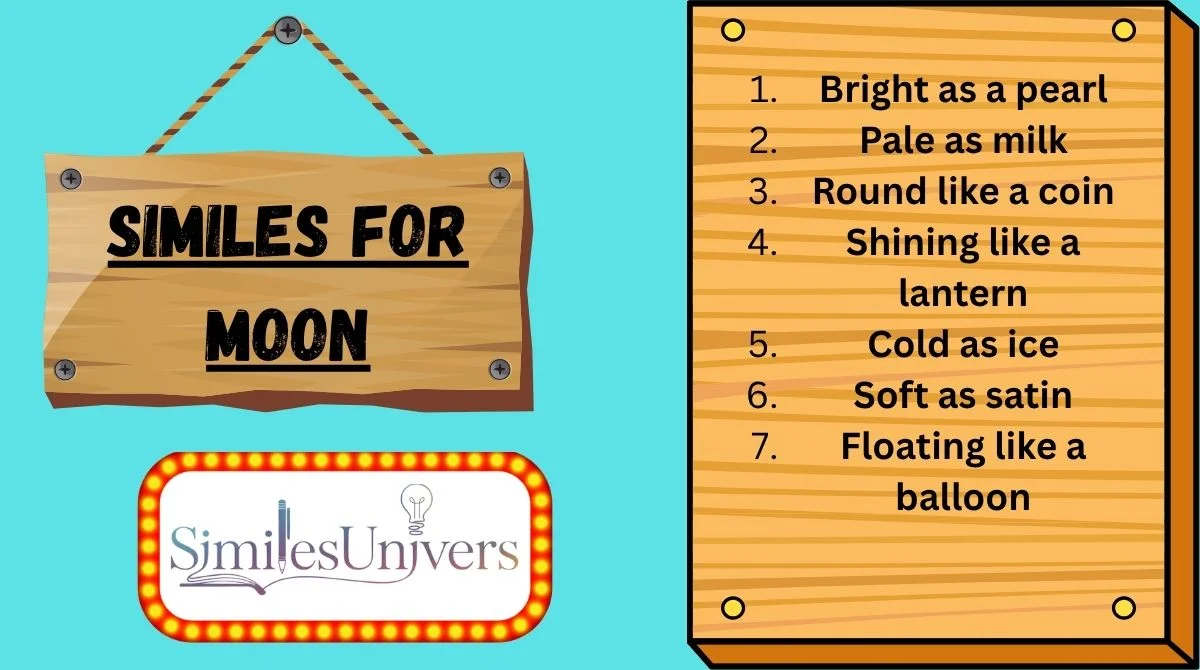
Quick List – Most Popular Similes for Moon
- Bright as a pearl
- Pale as milk
- Round like a coin
- Shining like a lantern
- Cold as ice
- Soft as satin
- Floating like a balloon
- Glowing like a candle
- Silent as a ghost
- High as a kite
Complete List of Similes for Moon (Grouped by Meaning)
Funny & Lighthearted
Like a Cheese Wheel
Meaning: Looks round and yellowish like cheese.
Explanation: This playful simile brings humor while describing the moon’s shape.
Examples:
- “The moon tonight looked like a cheese wheel ready for a mouse.”
- “I half expected a cartoon mouse to appear beneath a moon like a cheese wheel.”
Tone: Funny
Like a Nighttime Frisbee
Meaning: Appears flat and round, floating in the sky.
Explanation: Highlights the moon’s circular shape with whimsy.
Examples:
- “The moon spun slowly across the sky like a nighttime frisbee.”
- “It reminded me of tossing a frisbee in the dark, silent and smooth.”
Tone: Funny
Like a Giant Candy
Meaning: Round and tempting, almost edible.
Explanation: Creates a visual that is playful and sweet.
Examples:
- “The moon hung like a giant candy over the sleepy village.”
- “Children stared up, imagining the moon as a giant candy in the sky.”
Tone: Lighthearted
Emotional & Deep
Like a Beacon in Darkness
Meaning: Provides guidance or hope in a dark night.
Explanation: Emphasizes emotional comfort and reassurance.
Examples:
- “Her eyes met the moon, a beacon in darkness.”
- “The lone traveler looked to the moon, a beacon in the desert night.”
Tone: Serious
Like a Silver Tear
Meaning: Reflects sorrow or longing.
Explanation: Compares the moon’s shimmer to a tear, evoking melancholy.
Examples:
- “The moon hung above the lake like a silver tear.”
- “Memories of him floated as the silver tear of the moon.”
Tone: Poetic
Like a Guardian Watching Over
Meaning: Suggests protection and vigilance.
Explanation: The moon appears attentive, comforting in silence.
Examples:
- “The moon, like a guardian, watched over the sleeping town.”
- “Every night, she felt the moon’s presence, like a guardian watching over her.”
Tone: Serious
Dramatic & Intense
Like a Flaming Disc
Meaning: Looks fiery or extremely bright.
Explanation: Captures drama and intensity of the moon in vivid imagery.
Examples:
- “The moon rose like a flaming disc above the battlefield.”
- “Its light cut through the clouds like a flaming disc in the sky.”
Tone: Intense
Like a Spotlight in the Sky
Meaning: Illuminates everything beneath it.
Explanation: Gives a theatrical, dramatic effect.
Examples:
- “The moon shone like a spotlight in the forest clearing.”
- “Under the moon, every shadow seemed exaggerated, like a spotlight in the sky.”
Tone: Dramatic
Like a Pale Fireball
Meaning: Bright, energetic yet distant.
Explanation: Highlights power and intensity while maintaining mystery.
Examples:
- “The full moon glared like a pale fireball above the mountains.”
- “It surged through the night, like a pale fireball chasing the stars.”
Tone: Intense
Slow & Monotonous
Like a Lazy Balloon
Meaning: Moves slowly across the sky.
Explanation: Suggests a calm, unhurried motion.
Examples:
- “The moon drifted like a lazy balloon over the horizon.”
- “Time seemed slower as the moon floated, like a lazy balloon in the night.”
Tone: Casual
Like a Quiet Observer
Meaning: Still, calm, unchanging presence.
Explanation: Portrays monotony and quietness.
Examples:
- “The moon hung like a quiet observer, unmoved by the world below.”
- “It stayed in place, like a quiet observer, while the night passed.”
Tone: Serious
Creative & Unique
Like Frost on a Windowpane
Meaning: Cold, delicate, and fragile-looking.
Explanation: Compares moon’s light to frost catching glimmers of night.
Examples:
- “The moon spread across the sky like frost on a windowpane.”
- “Its glow felt sharp and delicate, like frost on a windowpane.”
Tone: Poetic
Like a Lantern in a Fog
Meaning: Slightly obscured, mystical.
Explanation: Captures mystery and soft illumination.
Examples:
- “The moon emerged like a lantern in a foggy harbor.”
- “Through the mist, it glowed like a lantern in a fog.”
Tone: Creative
Like a Floating Mirror
Meaning: Reflects light beautifully.
Explanation: Emphasizes its reflective, mesmerizing qualities.
Examples:
- “The moon appeared like a floating mirror, shimmering above the lake.”
- “It hung in the sky, like a floating mirror, reflecting the stars.”
Tone: Poetic
Poetic & Literary
Like a Silver Coin Tossed into the Sky
Meaning: Bright, small, and valuable-looking.
Explanation: Romanticizes the moon as precious and distant.
Examples:
- “The moon shone like a silver coin tossed into the sky.”
- “It lingered above, like a silver coin tossed by the hand of night.”
Tone: Poetic
Like a Pearl on Velvet
Meaning: Elegant, soft, and luminous.
Explanation: Evokes sophistication and beauty.
Examples:
- “The moon rested like a pearl on the velvet night.”
- “Its glow was soft, like a pearl on velvet.”
Tone: Poetic
Like a Whisper in the Dark
Meaning: Subtle, gentle, barely noticeable.
Explanation: Highlights quiet, mysterious presence.
Examples:
- “The moon appeared like a whisper in the dark sky.”
- “It moved silently, like a whisper in the dark.”
Tone: Poetic
Fresh and Unique Similes You Won’t Hear Every Day
- Like a teardrop of mercury – Reflects a liquid, shiny, and fragile beauty.
- Like a silver kite in a stormless sky – Suggests delicate motion in calm surroundings.
- Like an old coin in a forgotten drawer – Adds nostalgia and distance.
- Like the eyelid of night blinking – Personifies the moon with subtle motion.
- Like a frosted lantern on a winter night – Evokes chill, light, and clarity.
How to Use These Similes in Writing
- Essays: Add descriptive flair in narrative or reflective essays.
- Stories: Bring scenes to life; use moon similes for setting, mood, or emotion.
Example: “The moon, like a silver kite in a stormless sky, drifted above the quiet town, hinting at mysteries to come.”
How to Create Your Own Similes (Mini Writing Guide)
Step-by-step method:
- Observe the object (moon) and note its qualities (round, glowing, mysterious).
- Brainstorm related objects with similar qualities.
- Connect them using like or as.
- Test for readability and tone.
- Revise for originality.
5 Practical Tips:
- Avoid clichés.
- Match tone to context.
- Use sensory imagery.
- Keep it simple and clear.
- Experiment with humor or emotion.
3 Transformation Examples:
- “The moon glows brightly.” → “The moon glows like a lantern in a fog.”
- “The moon is cold.” → “The moon hangs like frost on a windowpane.”
- “The moon is round.” → “The moon floats like a giant candy in the night sky.”
Common Mistakes When Using Similes
- Overuse: Too many comparisons dilute impact.
- Clichés: Avoid phrases like “as bright as the sun” repeatedly.
- Tone mismatch: Funny similes in serious scenes feel off.
Practice Exercise
Fill-in-the-blank with a simile for the moon:
- The moon glowed _________.
- Its pale light was _________.
- The full moon hung _________ over the lake.
- The crescent moon looked _________.
- The night sky held the moon _________.
- The moon floated above _________.
- Its glow was like _________.
- The traveler watched the moon, _________.
- The moon’s reflection shimmered _________.
- The moon drifted _________.
- Its light was soft, like _________.
- The moon appeared in the sky, _________.
Answers:
- like a silver coin
- like milk spilled on black velvet
- like a lantern in fog
- like a tiny boat of light
- like a pearl on velvet
- like a lazy balloon
- a frosted lantern on a winter night
- like a quiet observer
- like mercury spilling over glass
- like a floating mirror
- a whisper in the dark
- like a teardrop of mercury
FAQs
What are some short similes for moon?
Short examples include: bright as pearl, pale as milk, round like a coin.
How do similes improve writing?
They create vivid imagery, evoke emotion, and make descriptions more memorable.
Can I use funny similes for serious writing?
Avoid it; tone mismatch can confuse the reader.
How do I make unique moon similes?
Observe the moon, brainstorm unusual comparisons, and connect using like or as.
Are moon similes only for poetry?
No, they work in stories, essays, captions, and descriptive writing.
How many similes should I use in one paragraph?
One or two is ideal; overuse can be distracting.
Final Thoughts
Moon similes are more than decorative phrases—they are tools to make writing glow.
With over 29 unique comparisons, including fresh, creative, and poetic options, you now have a treasure trove to inspire your essays, stories, or poems. Remember: the best similes spark imagery, evoke emotion, and fit the tone naturally.
Use them wisely, and let your writing shine as brightly as the moon itself.

Daniel Harper
I am simplifies complex literary concepts into clear, practical lessons for students and learners worldwide.
Through SimilesUnivers, he aims to make mastering similes engaging, structured, and academically enriching.