Nature has a magical way of speaking to our emotions. The wind whispers through trees, rivers glide over stones, and the sky stretches endlessly above us. But sometimes, describing that beauty with plain words just isn’t enough. That’s where similes come in.
Similes help writers paint vivid pictures by comparing one thing to another using words like “as” or “like.” With the right simile, a simple sentence can suddenly feel alive and colorful.
For example, saying “the lake was calm like a sleeping baby” instantly creates a peaceful image in the reader’s mind.
In this guide, you’ll discover 29+ powerful similes for nature that can make essays, poems, and stories more expressive and memorable. You’ll also learn how to create your own similes, avoid common mistakes, and practice using them in fun exercises.
Let’s explore the beauty of nature—one simile at a time.
Similes for Different Elements of Nature
Nature is filled with beautiful and powerful elements, from towering mountains and flowing rivers to colorful flowers, gentle rain, bright sunshine, and endless skies. The right simile can help describe each element in a more vivid and memorable way, making your writing feel richer, more expressive, and easier for readers to imagine.
What Is a Simile? (Quick Clear Definition)
A simile is a comparison between two different things using the words “like” or “as.”
It helps readers imagine something more clearly.
Example:
The moon shone like a silver coin in the night sky.
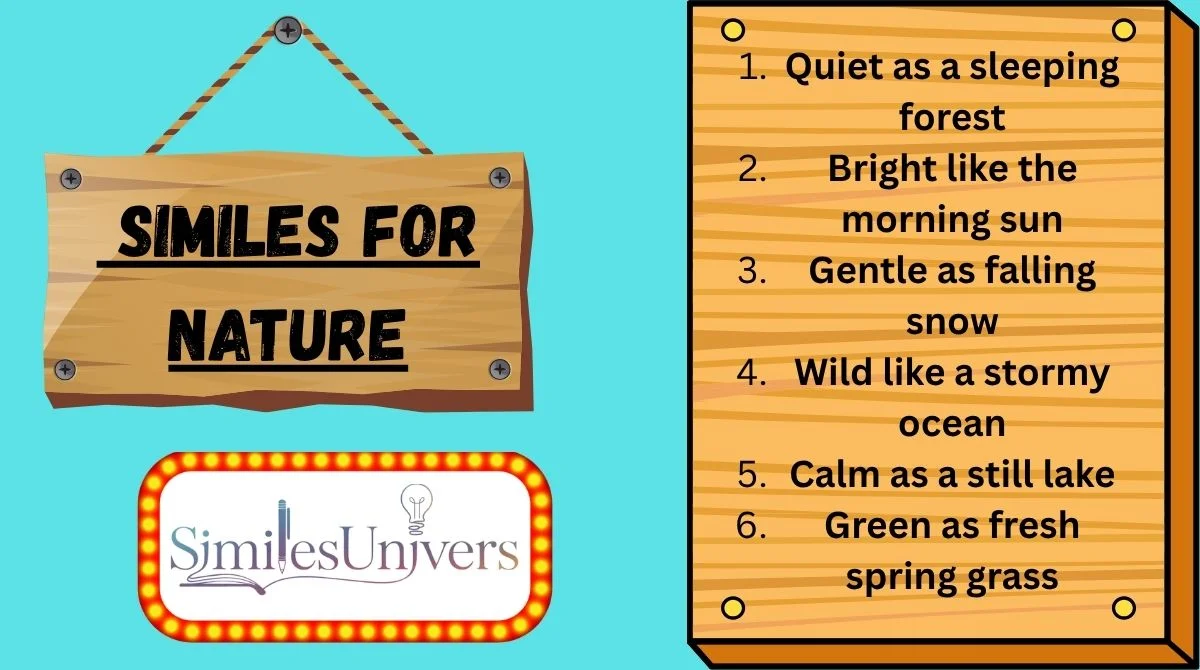
Quick List – Most Popular Similes for “Nature”
- Quiet as a sleeping forest
- Bright like the morning sun
- Gentle as falling snow
- Wild like a stormy ocean
- Calm as a still lake
- Green as fresh spring grass
- Soft like drifting clouds
- Free as a bird in the sky
- Loud like thunder in the mountains
- Wide as the open horizon
Complete List of Similes for “Nature” (Grouped by Meaning)
Funny & Lighthearted Nature Similes
As busy as bees in a flower field
Meaning: Very active and energetic.
Explanation: Bees constantly move between flowers, making this simile perfect for lively natural scenes.
Examples:
- The garden was as busy as bees in a flower field during spring.
- Butterflies fluttered around like bees in a flower field.
Tone: Casual / Playful
Like a squirrel chasing autumn leaves
Meaning: Moving quickly and playfully.
Explanation: Squirrels dart around trees and leaves, creating a funny and lively image.
Examples:
- The wind ran through the forest like a squirrel chasing autumn leaves.
- The puppy dashed across the yard like a squirrel after leaves.
Tone: Funny
As cheerful as birds at sunrise
Meaning: Full of happiness and energy.
Explanation: Birds singing in the morning symbolize joy and fresh beginnings.
Examples:
- The meadow felt as cheerful as birds at sunrise.
- Children laughed like birds greeting the morning sun.
Tone: Lighthearted
Like ducks splashing in a pond
Meaning: Playful and carefree.
Explanation: Ducks splashing around water create a fun and lively image.
Examples:
- The raindrops danced like ducks splashing in a pond.
- The kids ran through puddles like ducks in water.
Tone: Funny / Casual
As bright as a sunflower field
Meaning: Extremely cheerful or colorful.
Explanation: Sunflower fields are known for their bold yellow beauty.
Examples:
- The valley looked as bright as a sunflower field in summer.
- Her smile was like a sunflower field under the sun.
Tone: Happy
Emotional & Deep Nature Similes
As calm as a still lake at dawn
Meaning: Very peaceful and quiet.
Explanation: Early morning lakes often look smooth like glass.
Examples:
- The valley felt as calm as a still lake at dawn.
- His voice was like a quiet lake in the morning.
Tone: Peaceful
Like rain falling on thirsty soil
Meaning: Something deeply comforting or needed.
Explanation: Rain brings life to dry earth.
Examples:
- Her kind words felt like rain on thirsty soil.
- The cool breeze came like rain to dry land.
Tone: Emotional
As lonely as a single tree in a desert
Meaning: Very isolated.
Explanation: A lone tree in an empty landscape creates a strong emotional image.
Examples:
- The old house stood as lonely as a tree in the desert.
- He felt like a tree standing alone in endless sand.
Tone: Serious
Like waves whispering to the shore
Meaning: Gentle and soothing.
Explanation: Ocean waves softly touching the shore feel calm and emotional.
Examples:
- Her voice was like waves whispering to the shore.
- The breeze sounded like waves talking to sand.
Tone: Poetic
As quiet as snowfall at night
Meaning: Completely silent.
Explanation: Snow falling quietly creates a peaceful atmosphere.
Examples:
- The forest was as quiet as snowfall at night.
- The evening settled like snow over the hills.
Tone: Soft / Poetic
Dramatic & Intense Nature Similes
Like lightning splitting the sky
Meaning: Sudden and powerful.
Explanation: Lightning is bright and dramatic.
Examples:
- His anger flashed like lightning splitting the sky.
- The storm arrived like lightning tearing the clouds.
Tone: Dramatic
As fierce as a mountain storm
Meaning: Extremely powerful.
Explanation: Storms in mountains are intense and unpredictable.
Examples:
- The wind grew as fierce as a mountain storm.
- The waves crashed like a storm over cliffs.
Tone: Intense
Like thunder rolling through the valley
Meaning: Loud and overwhelming.
Explanation: Thunder echoes through valleys with deep sound.
Examples:
- The waterfall roared like thunder in a valley.
- The crowd cheered like thunder across hills.
Tone: Dramatic
As wild as the ocean in winter
Meaning: Untamed and chaotic.
Explanation: Winter oceans can be rough and powerful.
Examples:
- The storm grew as wild as the winter ocean.
- The wind screamed like waves crashing in winter.
Tone: Intense
Like a volcano ready to erupt
Meaning: Full of rising energy or tension.
Explanation: Volcanoes symbolize explosive power.
Examples:
- The sky darkened like a volcano about to erupt.
- His frustration built like molten lava.
Tone: Strong
Creative & Unique Nature Similes
Like moonlight spilled across water
Meaning: Soft and magical.
Explanation: Moonlight reflecting on water creates dreamy beauty.
Examples:
- The lake shimmered like moonlight spilled across water.
- Her dress flowed like silver light on a lake.
Tone: Poetic
As delicate as frost on a leaf
Meaning: Extremely fragile.
Explanation: Frost can melt quickly with sunlight.
Examples:
- The moment felt as delicate as frost on a leaf.
- The flower petals looked like frost in winter.
Tone: Gentle
Like a river carving through stone
Meaning: Persistent and powerful over time.
Explanation: Rivers slowly shape landscapes.
Examples:
- His determination worked like a river carving stone.
- Time moves like water shaping rock.
Tone: Thoughtful
As endless as the desert horizon
Meaning: Vast and limitless.
Explanation: Desert horizons seem to stretch forever.
Examples:
- The sky looked as endless as the desert horizon.
- Their dreams felt like an endless horizon.
Tone: Reflective
Like sunlight through morning mist
Meaning: Gentle and hopeful.
Explanation: Sunlight breaking through fog feels warm and hopeful.
Examples:
- Her laughter spread like sunlight through mist.
- The day began like golden light in fog.
Tone: Warm
Poetic & Literary Nature Similes
As silent as stars above mountains
Meaning: Extremely quiet.
Examples:
- The night was as silent as stars above mountains.
- The valley slept like stars watching quietly.
Tone: Poetic
Like petals drifting in the wind
Meaning: Graceful and soft.
Examples:
- The leaves fell like petals drifting in the wind.
- Snowflakes floated like flower petals.
Tone: Poetic
As golden as a wheat field at sunset
Meaning: Rich and warm in color.
Examples:
- The sky turned as golden as wheat at sunset.
- The hills glowed like fields in evening light.
Tone: Poetic
Like a waterfall of silver light
Meaning: Bright and flowing beautifully.
Examples:
- The stars looked like a waterfall of silver light.
- Moonlight poured like a shining waterfall.
Tone: Literary
As gentle as spring rain
Meaning: Soft and refreshing.
Examples:
- The breeze felt as gentle as spring rain.
- Her words fell like rain in April.
Tone: Soft
Fresh and Unique Similes You Won’t Hear Every Day
Here are five original similes designed to feel new and imaginative:
Like moss growing over old stones
Symbolizes quiet growth and patience.
As peaceful as fog hugging a valley
Creates a calm and dreamy image.
Like sunlight tiptoeing through pine trees
Suggests gentle, quiet movement of light.
As mysterious as a forest before dawn
Captures the unknown beauty of early morning.
Like rivers threading silver through mountains
Describes winding rivers shining under light.
These similes work especially well in creative writing, poetry, and storytelling.
How to Use These Similes in Writing
In Essays
Similes can make essays clearer and more vivid.
Example:
Instead of writing:
The forest was quiet.
Write:
The forest was as quiet as snowfall at night.
This helps readers imagine the scene.
In Stories
Similes add emotion and imagery to storytelling.
Example:
The wind rushed through the valley like a squirrel chasing autumn leaves.
This makes the scene feel alive and playful.
How to Create Your Own Similes (Mini Writing Guide)
Creating similes is simple if you follow these steps.
Step-by-Step Method
- Choose the thing you want to describe.
- Think about its main quality (soft, loud, bright).
- Find something in nature with the same quality.
- Connect them using “like” or “as.”
5 Practical Tips
- Use strong visual images.
- Avoid overused comparisons.
- Keep similes short and clear.
- Match the tone of your writing.
- Use nature for vivid imagery.
3 Transformation Examples
Plain sentence:
The river moved slowly.
Simile:
The river moved like a lazy snake through grass.
Plain sentence:
The sky was bright.
Simile:
The sky shone like polished glass in sunlight.
Plain sentence:
The wind was strong.
Simile:
The wind roared like a lion across the hills.
Common Mistakes When Using Similes
Overusing Similes
Too many similes can make writing feel heavy. Use them carefully.
Using Clichés
Common similes like “as busy as a bee” can feel boring if overused.
Try creative alternatives.
Tone Mismatch
A funny simile may not work in serious writing.
Example:
Avoid humorous similes in emotional scenes.
Similes for Beautiful Natural Places
Beautiful natural places can inspire wonder, peace, and emotion, whether you are describing a quiet forest, a breathtaking waterfall, a golden beach, a peaceful valley, or a colorful sunset. These similes compare natural scenery to familiar and imaginative images, helping you bring the beauty of landscapes to life in essays, poems, stories, and creative writing.
Practice Exercise
Fill in the blanks with a suitable simile.
- The lake was as calm as ______.
- The wind rushed through the trees like ______.
- The desert stretched as endless as ______.
- The snow fell like ______.
- The sky glowed as bright as ______.
- The forest was as quiet as ______.
- The waves crashed like ______.
- The sunset looked as golden as ______.
- The river moved like ______.
- The night sky sparkled like ______.
- The breeze felt as gentle as ______.
- The mountain stood as strong as ______.
Answers
- a still lake at dawn
- a squirrel chasing leaves
- the horizon
- petals drifting in wind
- the morning sun
- snowfall at night
- thunder in a valley
- a wheat field at sunset
- a snake through grass
- silver stars
- spring rain
- ancient stone
FAQs
What are similes for nature?
Similes for nature compare natural elements—like rivers, forests, or skies—to other things using “like” or “as.”
Example:
The lake was calm like glass.
Why are similes useful in writing?
Similes make descriptions more vivid and help readers imagine scenes clearly.
What is an easy simile for nature?
A simple example is:
The sky was as blue as the ocean.
Are similes common in poetry?
Yes. Poets often use similes to create vivid imagery and emotion.
How many similes should I use in a paragraph?
Usually one or two is enough. Too many can make writing feel crowded.
What is the difference between a simile and a metaphor?
A simile uses like or as.
A metaphor compares things directly.
Example:
Simile: The lake was like glass.
Metaphor: The lake was glass.
Final Thoughts
Nature offers endless inspiration for writers. With the right simile, a simple description can turn into a vivid scene that readers remember.
Whether you’re writing an essay, poem, or story, these 29+ similes for nature can help you describe the world more creatively and clearly.
The key is to choose comparisons that feel natural, visual, and meaningful. And once you practice creating your own similes, you’ll discover that nature itself is the best teacher for beautiful imagery.

Daniel Harper
I am simplifies complex literary concepts into clear, practical lessons for students and learners worldwide.
Through SimilesUnivers, he aims to make mastering similes engaging, structured, and academically enriching.