Sadness is a universal emotion, touching everyone at some point in life. Yet, capturing it in writing can be challenging. Similes, by comparing feelings to vivid imagery, bring emotions to life, making your readers feel what you feel.
From the subtle ache of loneliness to the raw intensity of heartbreak, using similes elevates your writing from plain description to immersive storytelling.
This guide dives deep into over 28 similes for sadness, from the classic to the imaginative, helping writers, poets, and storytellers convey melancholy with clarity and artistry.
By the end, you’ll have a toolkit of expressions that make sadness tangible, relatable, and unforgettable.
What Is a Simile?
A simile is a figure of speech that compares two different things using “like” or “as.” It creates vivid imagery in the reader’s mind. For example, “Her sadness was like a storm cloud hiding the sun.” Simple, yet powerful.
Quick List – Most Popular Similes for Sadness
- Sad as a rainy day
- Heavy like a wet blanket
- Cold as a winter morning
- Blue as midnight
- Hollow like an empty room
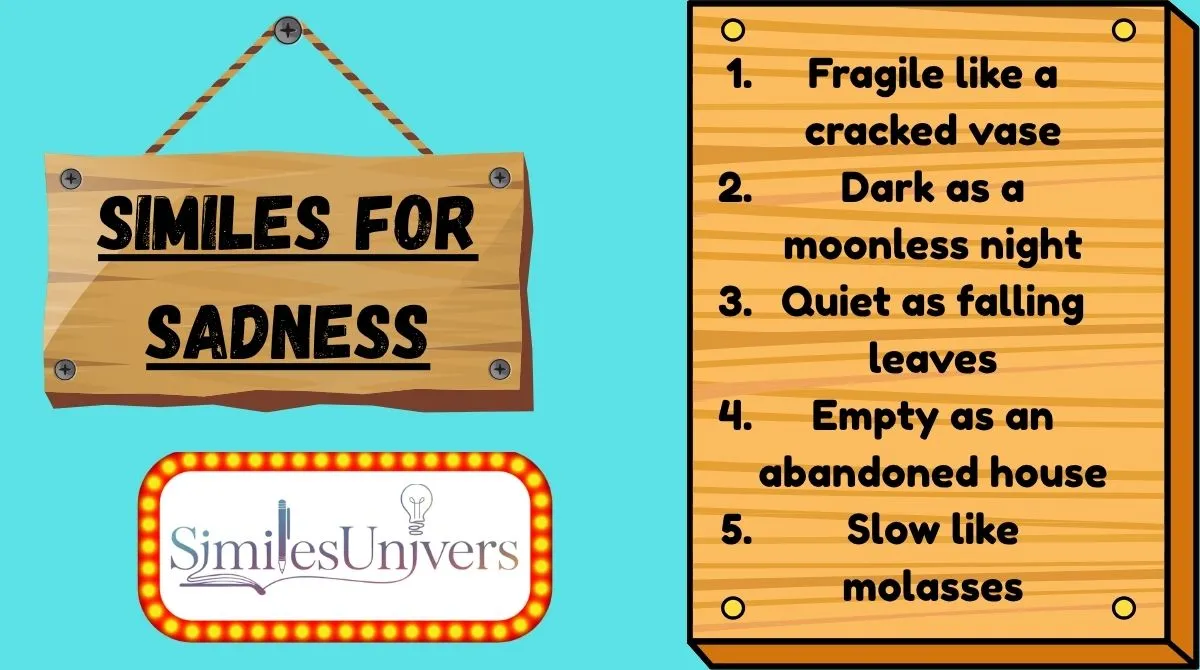
- Fragile like a cracked vase
- Dark as a moonless night
- Quiet as falling leaves
- Empty as an abandoned house
- Slow like molasses
Complete List of Similes for Sadness (Grouped by Meaning)
Funny & Lighthearted
Sad as a sock without a pair
- Meaning: Feeling incomplete or lonely
- Explanation: Imagines a sock left out of a pair, highlighting absurdity in sadness
- Examples:
- “After his cat ran away, he felt sad as a sock without a pair.”
- “Watching the final episode alone, she was sad as a sock without a pair.”
- Tone: Funny
Droopy like a wilted pancake
- Meaning: Feeling tired and sad at the same time
- Explanation: Compares emotional droop to a physically drooping pancake
- Examples:
- “After losing the match, he walked home droopy like a wilted pancake.”
- “Her mood sank droopy like a wilted pancake after the bad news.”
- Tone: Funny
Emotional & Deep
Heavy as a stone in the chest
- Meaning: Overwhelming emotional weight
- Explanation: Captures physical sensation of emotional burden
- Examples:
- “Grief made her heart heavy as a stone in the chest.”
- “His silence carried a heaviness as if a stone in the chest were pressing him down.”
- Tone: Serious
Tearful as a spring rain
- Meaning: Constant, gentle sadness
- Explanation: Continuous sadness compared to light rain
- Examples:
- “She wept tearful as a spring rain, quietly and without end.”
- “His apology left her tearful as a spring rain.”
- Tone: Poetic
Dramatic & Intense
Dark as a pit at midnight
- Meaning: Complete despair
- Explanation: Deep darkness represents hopelessness
- Examples:
- “His mind felt dark as a pit at midnight after the breakup.”
- “She wandered dark as a pit at midnight, lost in sorrow.”
- Tone: Serious
Shattered like a fallen mirror
- Meaning: Emotional fragmentation
- Explanation: Broken mirror symbolizes broken self or shattered emotions
- Examples:
- “When he lost his job, he felt shattered like a fallen mirror.”
- “The betrayal left her shattered like a fallen mirror.”
- Tone: Dramatic
Slow & Monotonous
Dragging like wet clay
- Meaning: Heavy, sluggish sadness
- Explanation: Comparing movement to sticky, slow clay emphasizes lethargy
- Examples:
- “His thoughts dragged like wet clay through the day.”
- “After the funeral, she walked home dragging like wet clay.”
- Tone: Serious
Fading like old ink
- Meaning: Gradual loss of joy
- Explanation: Sadness gradually replacing vibrancy
- Examples:
- “Her happiness faded like old ink on yellowed paper.”
- “Memories of laughter faded like old ink over time.”
- Tone: Poetic
Creative & Unique
Lonely as a crow in a snowstorm
- Meaning: Isolated and exposed
- Explanation: Combines visual and emotional imagery of solitude
- Examples:
- “He felt lonely as a crow in a snowstorm during the holiday season.”
- “After moving cities, she was lonely as a crow in a snowstorm.”
- Tone: Serious
Sinking like autumn leaves in a pond
- Meaning: Quiet, inevitable sadness
- Explanation: Leaves gradually sinking reflect gradual emotional decline
- Examples:
- “Her spirits sank like autumn leaves in a pond after the argument.”
- “Memories sank like autumn leaves in a pond as he reflected on the past.”
- Tone: Poetic
Poetic & Literary
As fragile as a candle in the wind
- Meaning: Vulnerable emotional state
- Explanation: Candle threatened by wind mirrors emotional fragility
- Examples:
- “Her hope felt as fragile as a candle in the wind.”
- “He whispered his secret, as fragile as a candle in the wind.”
- Tone: Poetic
Eyes like wilting lilies
- Meaning: Physical expression of sadness
- Explanation: Lily petals drooping symbolize drooping spirits
- Examples:
- “Her eyes looked like wilting lilies after hearing the news.”
- “He stared at the letter with eyes like wilting lilies.”
- Tone: Poetic
Fresh and Unique Similes You Won’t Hear Every Day
- Sad as a lantern without flame – Symbolizes lost light and guidance
- Like a ghost at a summer festival – Feeling out of place and invisible
- Murmuring like empty seashells – Quiet, hollow sadness
- Like spilled tea on a white carpet – Minor, lingering sadness
- Frozen like footprints in early frost – Stuck in grief, unable to move
How to Use These Similes in Writing
- Essays: Enhance emotional depth in reflections or personal narratives.
- Stories: Show rather than tell a character’s sadness, making scenes more vivid.
How to Create Your Own Similes
- Step 1: Identify the emotion
- Step 2: Find relatable sensory imagery
- Step 3: Use “like” or “as”
- Step 4: Keep it concise and vivid
- Step 5: Read aloud to ensure natural flow
- Tips: Avoid clichés, match tone, combine senses, exaggerate slightly, mix humor with depth
- Transformations:
- Sad → Sad as a wilting garden
- Lonely → Lonely as a lantern in a cave
- Hopeless → Hopeless like a kite without wind
Common Mistakes When Using Similes
- Overuse: Too many similes dilute impact
- Clichés: Avoid overused phrases like “sad as a rainy day” exclusively
- Tone mismatch: Funny similes in serious scenes confuse the reader
Practice Exercise
Fill in the blanks with appropriate similes for sadness:
- Her mood was __________ after the breakup.
- He felt __________ walking home alone.
- The empty room seemed __________.
- She stared at the letter __________.
- His heart sank __________.
- The news left him __________.
- Tears rolled down, __________.
- The abandoned playground looked __________.
- Her hopes crumbled __________.
- He wandered __________ through the city.
- The silence was __________.
- After the fight, she felt __________.
Answers (Examples):
- Heavy as a stone in the chest
- Lonely as a crow in a snowstorm
- Hollow like an empty room
- Eyes like wilting lilies
- Sinking like autumn leaves in a pond
- Dark as a pit at midnight
- Tearful as a spring rain
- Empty as an abandoned house
- Shattered like a fallen mirror
- Dragging like wet clay
- Quiet as falling leaves
- Sad as a sock without a pair
FAQs
What is the easiest way to create a simile for sadness?
Think of a visual, sound, or tactile comparison, then connect it with “like” or “as.”
Can similes be humorous when describing sadness?
Yes! Lighthearted similes can make emotional writing relatable without being heavy.
How many similes should I use in a paragraph?
1–2 similes per paragraph are sufficient for impact without overwhelming the reader.
Are similes better than metaphors for sadness?
Similes are more direct and easier for readers to grasp; metaphors are subtler.
Can I combine multiple senses in one simile?
Absolutely. Combining sight, sound, or touch creates vivid imagery.
How do I avoid clichés when writing similes?
Brainstorm fresh comparisons from personal experience or unexpected objects.
Final Thoughts
Similes are powerful tools to convey sadness vividly, adding depth and resonance to your writing. By mixing familiar expressions with fresh, imaginative comparisons, you can transform abstract emotions into tangible experiences.
Whether for poetry, essays, or stories, the 28+ similes shared here will help your readers truly feel the weight, nuance, and subtlety of sadness.
Don’t just tell your audience someone is sad—show it, with the perfect simile.

Daniel Harper
I am simplifies complex literary concepts into clear, practical lessons for students and learners worldwide.
Through SimilesUnivers, he aims to make mastering similes engaging, structured, and academically enriching.