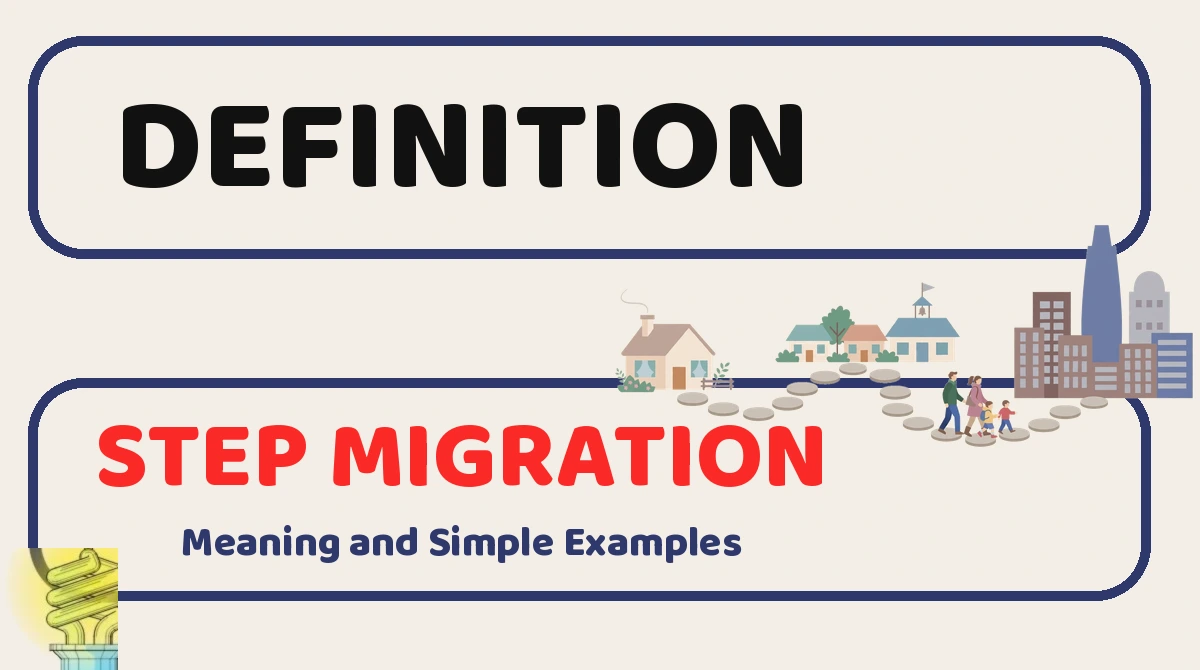
Many families do not move to a big city in one big jump at all. They move in small steps over time, and each step can feel safe and calm.
This kind of migration is called step migration, where people shift from place to place in clear stages, from a small village to a town, then to a larger town, and at last to a large city.
The step migration definition helps you name this path with ease. This guide explains the meaning in plain words, gives a clear worked example, and shows how it differs from other moves today.
What Is the Step Migration Definition?
The step migration definition is simple. Step migration is a move from place to place in stages over time. A person does not make one long move at once. The person makes short moves, one step at a time.
Most steps go up in size. A person starts in a small village. Then the person moves to a small town. Next comes a larger town. At last comes a big city.
Each step is a real move. The person lives, works, or learns in each place for a time. Then the person moves on.
So one short move does not tell the whole tale. All the steps linked in a row tell it.
How Step Migration Works Step by Step
Step migration works like stairs. You climb one step, rest, and then climb the next. You do not leap to the top in one go.
First, a person leaves a small place with few jobs. The next town is close and cheap to reach. The person finds work and learns new skills.
Next, the person saves cash and gains trust. A larger town then looks less hard to try. The person moves there for a better job or school.
At last, the city no longer feels strange or far. The person knows town life well. The last move feels like a small step, not a leap.
The steps below show the usual path:
- Step 1: Farm village with few jobs
- Step 2: Small town for school or work
- Step 3: Larger town for a better job
- Step 4: Large city for high pay or top school
Not all paths have four steps. Some have two. Some have five or more. The key point is the same. The move comes in stages, not at once.
A Clear Worked Example: Village to Town to City
A worked example makes the idea clear. Meet Rina, a young girl on a farm. Her tale is made up, but it shows a real path in life.
Rina grows up in a small farm village. It has a small school but no high school. At age 14, she moves to a small town near home. She lives with an aunt and goes to high school there.
Rina does well at school. At 18, she moves to a larger town. She trains as a nurse there. She works in a town clinic and earns her first pay.
At 23, Rina wants a big hospital job. She moves to a large city with a top hospital and high pay. City life does not scare her now. She knows town life and rents well.
Note what did not occur. Rina did not jump from the farm to the city at age 14. Each step gave her skills and cash for the next step. That is step migration in real life.
Why People Move in Steps: Main Reasons
People move in steps for clear reasons. A short move costs less and feels less hard than a long move. It is a safe way to test a new life.
Jobs pull people up each step. A town has more jobs than a village. A city has more jobs than a town. Each step opens new work.
School is a strong pull too. Small places may lack a high school or a trade school. Young people move step by step to learn more.
Cost shapes each step. A city flat costs a lot. A town room costs less. People earn and save at each step, so the next step fits their purse.
Family ties hold people close at first. A short move keeps kin near. A teen can still visit home on weekends.
Ravenstein’s Laws and Step Migration
The idea comes from Ernest Ravenstein. He was a geographer who wrote laws of migration in the 1880s. His work still guides study today.
Ravenstein said most moves are short. People tend to move a short way, not a long way. He also said long moves tend to go by steps. People move to a near town first, then on to a far city.
He saw a clear pattern in data. As people left small places, gaps formed. People from far places filled those gaps. So towns grew step by step.
He also said each main flow makes a small flow back. Some people return home. Step migration is not a one-way rule.
Key Features of Step Migration
Step migration has clear traits. If you know them, you can spot the pattern fast in a case study or a map.
First, the move takes place in stages. There are stops in the middle. The person lives in each stop for months or years.
Second, each step is often a short move. The next place is not far. This keeps risk low and cost low.
Third, places tend to grow in size and rank. Village, then town, then city. Geographers call this a move up the settlement hierarchy.
Fourth, the path takes time. It may span years. It is not a trip. It is a life path.
Fifth, each step builds skills and links. The person learns town ways and hears of jobs ahead.
Last, not all people reach the city. Some stop at a town and stay for life.
Step Migration vs. Direct, Chain, and Circular Migration
Four kinds of move can look alike at first. The table below keeps them apart in a clear way.
| Type of Move | How It Works | Main Trait |
|---|---|---|
| Step migration | Move in stages from small to large places | Many stops, each larger than the last |
| Direct migration | Move straight from home to the final place | One move, no stops in the middle |
| Chain migration | Kin or friends move first and help you follow | Help from people you know at the new place |
| Circular migration | Move to a place, then return home, then repeat | Moves go back and forth in a loop |
Direct migration is the main contrast. The person makes one long move at once. There are no stops to live and work in between.
Chain migration is about who helps you. One person moves, then sends news and help home. Kin follow the same path.
Circular migration is about return. A worker spends a season in a town, then goes home. The loop may repeat each year.
Advantages and Disadvantages of Step Migration
Step migration has strong points. It also has weak points. A fair view needs both sides.
The main plus is low risk. If a step fails, the loss is small. The person can go back home or try a new town.
It also spreads cost over time. The person does not need a large sum at once. Each job funds the next move.
It builds skills in stages. Town life teaches bus use and rent rules. City life then holds few shocks.
But the path is slow. It may take years to reach the best job or school. A direct move can be fast.
Each step can also bring loss. The person leaves friends at each stop.
And a plan in steps can stall. A town may have no job when you come. The path can stop at step one or two.
Step Migration in Human Geography and Exams
Geographers use the term a lot. It is a core term in human geography. It helps explain how towns and cities grow.
When a city grows, it does not draw all people straight from farms. It draws many from towns. Towns then draw people from villages.
The term shows up in school exams each year. Tasks often give a case and ask you to name the move. If the case shows stages over years, use this term.
To score well, learn this exam plan:
- State the step migration definition in one clear line.
- Name each step in the case, from small to large.
- Give one reason for each step, such as jobs or school.
- Link the case to Ravenstein and his law on step moves.
- Note one way the case does not fit, if the task asks.
Short, clear lines score best. Do not just retell the case. Use the key terms with care.
Examples of Step Migration in Sentences
Clear lines help you learn and use the term well. Read these examples and note the steps in each one.
- Her move from a farm village to a town, and then to the city, is a classic case of step migration.
- He did not move to the capital at once; his step migration took six years and two towns.
- The map shows step migration, with arrows from villages to towns and from towns to the port city.
- In the exam, she wrote that step migration means a move in stages up the settlement hierarchy.
- Their son used step migration: first a town for school, then a city for work.
- Old census data shows step migration, as each town lost youth to a larger town nearby.
Try to write your own line too. Name the start place, one middle stop, and the final city. Add one reason for the moves.
People Also Ask About Step Migration Definition
What is step migration in simple words?
In simple words, step migration is a move in stages over time. A person moves from a small place to a town, then to a larger town, and then to a city.
What is an example of step migration?
A clear example is a teen who leaves a farm village for a town high school, then moves to a larger town for training, and then to a city for a job.
Who gave the idea of step migration?
Ernest Ravenstein gave the idea in his laws of migration in the 1880s. He found that most moves are short and long moves tend to go step by step.
How is step migration different from direct migration?
Direct migration is one move straight to the final place, with no stops. Step migration has stops in the middle, where the person lives and works.
How is step migration different from chain migration?
Chain migration is about help from kin or friends who moved first. Step migration is about the path in stages. The two can overlap, but they name different things: help versus stages.
Why do people use step migration?
People use it as it costs less, feels safe, and builds skills step by step. Each step gives a job and cash for the next step.
Is step migration still common today?
Yes. Young people still move from villages to towns for school and work, and then on to cities. Cheap buses have changed the steps, but not the core pattern.
Conclusion
The step migration definition is now clear. Step migration is a move from place to place in stages over time, most often from a village to a town and then to a city.
Each step has a reason, such as a job, a school, cost, or kin nearby. Ravenstein saw this pattern long ago, and geographers still use it today.
Next time you read a case of moves over years, check for the steps. If you see stages from small to large, you have found step migration.

Daniel Harper
I am simplifies complex literary concepts into clear, practical lessons for students and learners worldwide.
Through SimilesUnivers, he aims to make mastering similes engaging, structured, and academically enriching.