Being smart isn’t just about knowing facts—it’s about thinking quickly, solving problems, and seeing connections that others miss.
Writers often struggle to describe intelligence in a way that feels vivid and relatable. That’s where similes come in. Similes make your writing sparkle, turning abstract traits like intelligence into images readers can see, feel, or even laugh at.
In this guide, you’ll discover over 27 similes for smart, ranging from classic comparisons to quirky, original ones you won’t find anywhere else.
Whether you’re writing a story, essay, or poem, these similes will help you paint characters and ideas with clarity, charm, and flair.
What Is a Simile?
A simile is a figure of speech that compares two things using words like “like” or “as.” It helps make descriptions vivid and relatable.
Example: She was as sharp as a tack.
Quick List – Most Popular Similes for Smart
- As sharp as a tack
- As bright as a new penny
- As clever as a fox
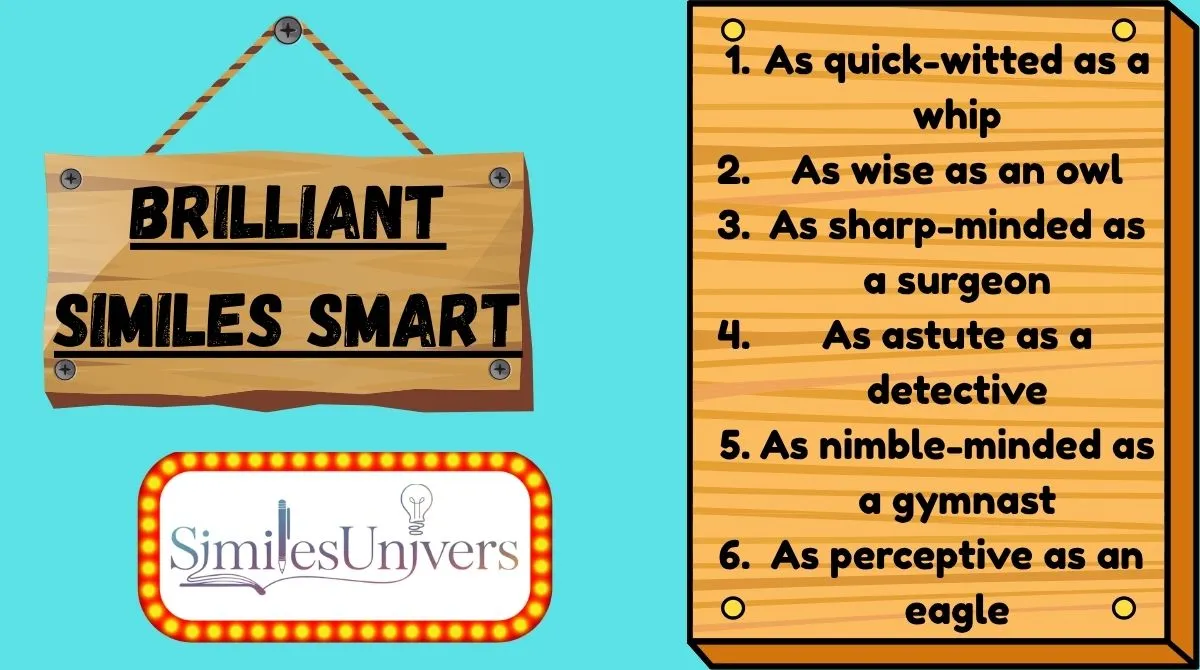
- As quick-witted as a whip
- As wise as an owl
- As sharp-minded as a surgeon
- As astute as a detective
- As nimble-minded as a gymnast
- As perceptive as an eagle
- As ingenious as Da Vinci
Complete List of Similes for Smart (Grouped by Meaning)
Funny & Lighthearted
As sharp as a cat’s claw
- Meaning: Quick-thinking and playful intelligence
- Explanation: Implies cleverness with a hint of mischief
- Examples:
- “He’s as sharp as a cat’s claw when it comes to spotting shortcuts.”
- “Her jokes were as sharp as a cat’s claw, leaving everyone laughing.”
- Tone: Funny
As bright as a lightbulb in a blackout
- Meaning: Instant clarity or a sudden smart idea
- Explanation: Highlights a sudden flash of brilliance
- Examples:
- “When she solved the puzzle, she was as bright as a lightbulb in a blackout.”
- “His invention was as bright as a lightbulb in a blackout—everyone noticed immediately.”
- Tone: Funny
As sly as a raccoon
- Meaning: Clever and cunning
- Explanation: Suggests intelligence mixed with trickiness
- Examples:
- “He managed the negotiation as sly as a raccoon.”
- “She snuck in the solution as sly as a raccoon.”
- Tone: Funny
Emotional & Deep
As wise as a river carving stone
- Meaning: Deep, patient intelligence
- Explanation: Suggests insight gained over time
- Examples:
- “He listened as wise as a river carving stone, never rushing judgment.”
- “Her advice flowed as wise as a river carving stone.”
- Tone: Poetic
As insightful as a lighthouse in fog
- Meaning: Clear understanding amidst confusion
- Explanation: Offers guidance or clarity in difficult situations
- Examples:
- “She navigated the crisis as insightful as a lighthouse in fog.”
- “His words were as insightful as a lighthouse in fog, guiding everyone.”
- Tone: Serious
Dramatic & Intense
As brilliant as lightning striking steel
- Meaning: Sudden, powerful intelligence
- Explanation: Implies a flash of mental power that leaves impact
- Examples:
- “His solution hit as brilliant as lightning striking steel.”
- “She realized the answer as brilliant as lightning striking steel.”
- Tone: Dramatic
As cunning as a serpent
- Meaning: Smart with an edge of danger or strategy
- Explanation: Highlights strategic or manipulative intelligence
- Examples:
- “The negotiator was as cunning as a serpent, outsmarting his opponents.”
- “She planned her moves as cunning as a serpent.”
- Tone: Dramatic
Slow & Monotonous
As deliberate as a chess grandmaster
- Meaning: Careful, strategic intelligence
- Explanation: Suggests intelligence that thinks before acting
- Examples:
- “He approached the project as deliberate as a chess grandmaster.”
- “Her reasoning was as deliberate as a chess grandmaster.”
- Tone: Serious
As methodical as a clock
- Meaning: Precise and systematic thinking
- Explanation: Suggests reliability and intelligence in process
- Examples:
- “Her research was as methodical as a clock.”
- “He organized the plan as methodical as a clock.”
- Tone: Serious
Creative & Unique
As inventive as a moonlight inventor
- Meaning: Original, unconventional intelligence
- Explanation: Imagery of creativity in unusual circumstances
- Examples:
- “She approached the design as inventive as a moonlight inventor.”
- “His idea was as inventive as a moonlight inventor, unexpected and brilliant.”
- Tone: Creative
As nimble as thought itself
- Meaning: Extremely quick mental agility
- Explanation: Suggests lightning-fast thinking
- Examples:
- “He answered questions as nimble as thought itself.”
- “Her mind moved as nimble as thought itself.”
- Tone: Creative
Poetic & Literary
As luminous as a star in a velvet sky
- Meaning: Bright intelligence
- Explanation: Suggests brilliance that shines naturally
- Examples:
- “Her mind was as luminous as a star in a velvet sky.”
- “He spoke with ideas as luminous as a star in a velvet sky.”
- Tone: Poetic
As deep as the ocean’s secrets
- Meaning: Vast and profound intelligence
- Explanation: Suggests wisdom with layers
- Examples:
- “She pondered as deep as the ocean’s secrets.”
- “His analysis was as deep as the ocean’s secrets.”
- Tone: Poetic
Fresh and Unique Similes You Won’t Hear Every Day
As clever as a shadow in moonlight – Intelligence that moves unseen, subtle
As sharp as frost on a windowpane – Cold, precise clarity
As bright as a spark in a cave – Small but powerful ideas
As calculating as an ant colony – Strategic, coordinated intelligence
As insightful as rain soaking roots – Quiet wisdom nourishing growth
How to Use These Similes in Writing
- Essays: Use similes to clarify abstract ideas, e.g., “His mind was as sharp as a tack, quickly analyzing the data.”
- Stories: Add character depth and personality, e.g., “She navigated the city as sly as a raccoon, finding every hidden shortcut.”
How to Create Your Own Similes
- Identify the trait you want to describe.
- Think of objects or creatures with similar qualities.
- Use “like” or “as” to connect them.
- Test the image for clarity and impact.
- Adjust for tone and audience.
5 Practical Tips:
- Avoid clichés
- Keep imagery clear
- Match tone with context
- Use sensory details
- Experiment with unusual comparisons
3 Transformation Examples:
- “He’s smart” → “He’s as sharp as a razor’s edge.”
- “She’s quick-witted” → “She’s as nimble as thought itself.”
- “They’re clever” → “They’re as inventive as a moonlight inventor.”
Common Mistakes When Using Similes
- Overuse: Too many similes can overwhelm readers
- Clichés: Avoid overused phrases like “as smart as Einstein”
- Tone mismatch: Ensure the simile fits the scene and mood
Practice Exercise
Fill in the blanks with appropriate similes for “smart”:
- He solved the puzzle _______.
- Her plan was _______ and unexpected.
- His analysis was _______ and profound.
- She answered questions _______.
- The negotiator was _______.
- His reasoning was _______.
- Her ideas shone _______.
- He approached strategy _______.
- Her insight flowed _______.
- The detective worked _______.
- His mind raced _______.
- She tackled problems _______.
Answers:
- as sharp as a tack
- as inventive as a moonlight inventor
- as deep as the ocean’s secrets
- as nimble as thought itself
- as cunning as a serpent
- as methodical as a clock
- as luminous as a star in a velvet sky
- as deliberate as a chess grandmaster
- as insightful as rain soaking roots
- as astute as a detective
- as quick-witted as a whip
- as bright as a spark in a cave
FAQs
What is a simile?
A simile is a comparison using “like” or “as” to make descriptions vivid.
Why use similes for smart?
They turn abstract intelligence into visual, emotional, or relatable imagery.
How many similes should I use in writing?
Use enough to enhance clarity but avoid overloading the text.
Can I make my own similes?
Yes! Compare the trait to something familiar or imaginative using “like” or “as.”
What’s the difference between a simile and a metaphor?
A simile uses “like” or “as,” while a metaphor directly states the comparison.
Are funny similes appropriate in essays?
Use them cautiously; they work best in creative or informal writing.
Final Thoughts
Similes are a powerful tool for bringing intelligence to life in writing. By mixing popular, classic, and fresh comparisons, you can make characters, ideas, and descriptions shine.
Experiment, stay original, and let your similes sparkle like the smart minds they describe.

Daniel Harper
I am simplifies complex literary concepts into clear, practical lessons for students and learners worldwide.
Through SimilesUnivers, he aims to make mastering similes engaging, structured, and academically enriching.