Fire has always fascinated humans—its warmth, its danger, and its mesmerizing glow. Using similes about fire can breathe life into your writing, helping readers see, feel, and almost touch the flames.
Similes make descriptions vivid, memorable, and emotional. They turn ordinary sentences into storytelling sparks that captivate attention.
In this guide, you’ll discover over 32 similes for fire—both classic and fresh—that you can use in essays, stories, poetry, and even casual writing.
From funny and lighthearted comparisons to dramatic and poetic expressions, this collection will give you the perfect phrases to ignite your imagination. By the end, you’ll have a toolbox of fire similes that elevate your writing effortlessly.
Similes for Fire and Strong Emotions
- Angry as a raging fire — Shows powerful anger that is difficult to control.
- Burning with jealousy like a wildfire — Describes jealousy that grows quickly and intensely.
- Love glowing like a warm flame — Suggests deep, gentle, and lasting affection.
- Passion burning like a furnace — Describes powerful desire or excitement.
- Rage spreading like wildfire — Shows anger quickly affecting everyone around.
- Hope glowing like a small candle — Represents hope that remains alive during difficult times.
- Grief smoldering like hidden embers — Describes sadness that remains beneath the surface.
- Excitement sparkling like flying sparks — Shows sudden and energetic happiness.
- Resentment burning like hot coals — Suggests anger that continues for a long time.
- Fear flickering like a nervous flame — Describes fear that rises and falls but never fully disappears.
What Is a Simile?
A simile is a figure of speech that compares two different things using “like” or “as” to create a vivid image. For example:
- “Her anger burned like fire.”
It’s a simple yet powerful way to help readers picture emotions, actions, or appearances in a relatable way.
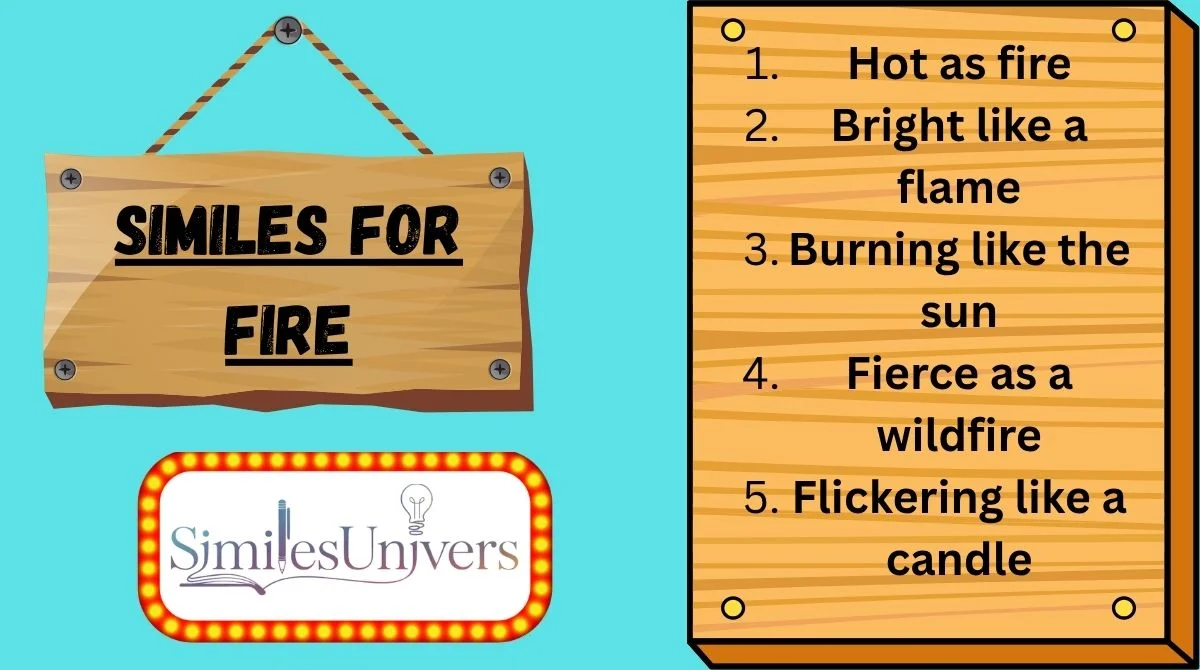
Quick List – Most Popular Similes for Fire
- Hot as fire
- Bright like a flame
- Burning like the sun
- Fierce as a wildfire
- Flickering like a candle
- Red as embers
- Sharp as a spark
- Smoldering like coal
- Wild as a blaze
- Warm like a hearth
Complete List of Similes for Fire (Grouped by Meaning)
Funny & Lighthearted
Hotter than a jalapeño in July
Meaning: Extremely hot
Explanation: This playful simile exaggerates heat, comparing it to spicy peppers in summer.
Examples:
- The soup was hotter than a jalapeño in July, and I had to blow on it for ten minutes.
- His temper was hotter than a jalapeño in July, but we still laughed at his antics.
Tone: Funny
Burning like a marshmallow at camp
Meaning: Slowly catching fire
Explanation: Evokes images of marshmallows roasting too long and turning black.
Examples:
- The paper in the fireplace burned like a marshmallow at camp.
- Her cheeks turned red, burning like a marshmallow at camp when she realized everyone was watching.
Tone: Casual
Flickering like a birthday candle
Meaning: Weak or intermittent flame
Explanation: Light-hearted image of a small, trembling flame.
Examples:
- The lamp flickered like a birthday candle in the breeze.
- His confidence flickered like a birthday candle under her teasing.
Tone: Funny
Emotional & Deep
Burning like the heart of passion
Meaning: Strong, emotional intensity
Explanation: Compares fire to deep emotional feelings.
Examples:
- Her love for him burned like the heart of passion.
- Anger surged through him, burning like the heart of passion.
Tone: Serious
Smoldering like hidden coal
Meaning: Quiet, simmering emotion
Explanation: Suggests emotions are present but not fully visible.
Examples:
- His resentment smoldered like hidden coal.
- Unspoken love smoldered like hidden coal beneath their friendship.
Tone: Poetic
Burning like memories in a fireplace
Meaning: Nostalgia or reflection
Explanation: Flames represent memories igniting in the mind.
Examples:
- Old photographs burned like memories in a fireplace.
- Her thoughts of home burned like memories in a fireplace.
Tone: Poetic
Dramatic & Intense
Fierce as a wildfire
Meaning: Out of control, dangerous
Explanation: Wildfires spread quickly and destructively, perfect for drama.
Examples:
- His rage was fierce as a wildfire.
- The battle erupted, fierce as a wildfire through the village.
Tone: Serious
Hotter than molten lava
Meaning: Extreme heat
Explanation: Lava is unbearably hot; the simile exaggerates intensity.
Examples:
- The debate was hotter than molten lava, and neither side yielded.
- Her anger felt hotter than molten lava.
Tone: Dramatic
Sparks flew like fireworks
Meaning: Sudden, explosive energy
Explanation: Evokes excitement or conflict in a dramatic scenario.
Examples:
- Their argument was intense; sparks flew like fireworks.
- In the room, ideas collided, and sparks flew like fireworks.
Tone: Dramatic
Slow & Monotonous
Flickering like a dying ember
Meaning: Weak, fading flame
Explanation: Shows gradual loss of energy or hope.
Examples:
- The candle flickered like a dying ember.
- His enthusiasm flickered like a dying ember after hearing the bad news.
Tone: Serious
Smoldering like wet coal
Meaning: Slow, persistent heat
Explanation: Heat exists but is suppressed.
Examples:
- Her anger smoldered like wet coal under control.
- The fire in the hearth smoldered like wet coal, barely warming the room.
Tone: Serious
Dim as a forgotten lantern
Meaning: Barely noticeable
Explanation: Suggests weakness or neglect, a slowly fading presence.
Examples:
- His hope was dim as a forgotten lantern.
- The lamp was dim as a forgotten lantern in the attic.
Tone: Poetic
Creative & Unique
Burning like starlight on sand
Meaning: Gentle but bright intensity
Explanation: A fresh visual of fire-like light glimmering delicately.
Examples:
- Her inspiration burned like starlight on sand.
- The campfire’s reflection on the beach burned like starlight on sand.
Tone: Poetic
Flames dancing like mischievous sprites
Meaning: Playful, lively fire
Explanation: Evokes whimsical, animated fire movement.
Examples:
- The fire in the hearth danced like mischievous sprites.
- His excitement made his eyes sparkle, flames dancing like mischievous sprites.
Tone: Creative
Burning like forgotten dreams
Meaning: Longing, melancholy
Explanation: Imagery of emotions that fade but leave a trace.
Examples:
- Memories of her youth burned like forgotten dreams.
- The old diary pages burned like forgotten dreams in her heart.
Tone: Poetic
Poetic & Literary
Bright like the first light of dawn
Meaning: Fresh, illuminating
Explanation: Evokes a soft, inspiring brightness akin to morning fire.
Examples:
- Her smile was bright like the first light of dawn.
- The sunrise painted the horizon bright like the first light of dawn.
Tone: Poetic
Hot as Hades’ forge
Meaning: Mythical extreme heat
Explanation: A literary, mythological comparison emphasizing fire’s power.
Examples:
- The debate grew hot as Hades’ forge.
- The dragon’s breath was hot as Hades’ forge.
Tone: Literary
Sparkling like phoenix feathers
Meaning: Magical, rebirth imagery
Explanation: Flames compared to the legendary bird’s fiery plumage.
Examples:
- Her courage sparkled like phoenix feathers.
- The fireworks ignited the night, sparkling like phoenix feathers.
Tone: Poetic
Fresh and Unique Similes You Won’t Hear Every Day
- Burning like a violin string under the sun – thin, tense, vibrant heat
- Flickering like whispers in a cathedral – subtle, sacred light
- Hotter than dragon scales in summer – mythical, fiery exaggeration
- Glowing like a storyteller’s eyes at midnight – warm, magical
- Flames twisting like silk ribbons in wind – delicate, elegant movement
These similes create striking imagery that draws readers into unique visual or emotional experiences.
How to Use These Similes in Writing
- Essays: Add emotional depth or vivid comparisons for persuasive writing.
- Stories: Enhance character actions, moods, and scenes with dynamic visual imagery.
Example: Instead of “He was angry,” say “His anger burned like molten lava, unstoppable and destructive.”
How to Create Your Own Similes (Mini Writing Guide)
Step-by-step method:
- Identify the feeling, object, or action.
- Find a vivid, relatable comparison.
- Use “like” or “as” for clarity.
- Keep the image simple but memorable.
- Test in a sentence for natural flow.
Practical tips:
- Observe nature for inspiration
- Combine senses (sight, touch, sound)
- Avoid clichés
- Use emotional resonance
- Be playful with exaggeration
Transformation examples:
- Boring: The fire was bright → Creative: The fire blazed like phoenix feathers
- Boring: He was angry → Creative: His temper burned like dragon scales in summer
- Boring: Candle flickered → Creative: The candle flickered like whispers in a cathedral
Common Mistakes When Using Similes
- Overuse: Too many similes can overwhelm the reader.
- Clichés: Phrases like “hot as fire” repeatedly become dull.
- Tone mismatch: Funny similes in serious moments may break immersion.
Similes for Fire, Heat, and Intense Situations
- Hot as a blazing furnace — Describes extremely high heat.
- Hotter than a summer fire — Emphasizes uncomfortable or intense heat.
- Burning like a desert at noon — Suggests harsh, relentless heat.
- Bright as a roaring flame — Describes something intensely bright.
- Fierce as a forest fire — Shows powerful and difficult-to-control intensity.
- Intense as molten metal — Describes extreme heat, pressure, or emotion.
- Scorching like a burning roof — Suggests dangerous and overwhelming heat.
- Blazing like a furnace door — Creates an image of powerful, concentrated heat.
- Explosive like a burst of flames — Describes a sudden and dramatic event.
- Relentless as a raging fire — Shows something that continues with great force.
- Sharp as a spark — Suggests something sudden, quick, or striking.
- Wild as dancing flames — Describes unpredictable movement or energy.
Practice Exercise
Fill in the blanks with the correct simile from the list:
- Her anger burned ________.
- The candle flickered ________.
- His excitement was ________.
- The sunlight was bright ________.
- The debate grew hot ________.
- Memories smoldered ________.
- Flames twisted ________.
- The soup was ________.
- Their argument was intense ________.
- His hope was dim ________.
- The fire danced ________.
- Inspiration burned ________.
Answers:
- like molten lava
- like a dying ember
- like sparks flying like fireworks
- like the first light of dawn
- hot as Hades’ forge
- like hidden coal
- like silk ribbons in wind
- hotter than a jalapeño in July
- fierce as a wildfire
- as a forgotten lantern
- like mischievous sprites
- like starlight on sand
FAQs
What is a simile?
A simile is a comparison using “like” or “as” to create vivid imagery.
Why use fire similes?
Fire similes create strong visual, emotional, or dramatic effects in writing.
How many similes should I use in a story?
Use them selectively; too many can overwhelm readers. 2–3 per paragraph is effective.
Can similes be humorous?
Absolutely! Funny similes make writing playful and relatable.
Are these similes suitable for poetry?
Yes, especially the poetic and unique categories—they enhance imagery and rhythm.
How to avoid clichés in similes?
Mix everyday objects with fresh perspectives and avoid overused phrases.
Final Thoughts
Similes for fire ignite imagination, emotion, and drama. From the playful flicker of birthday candles to the scorching intensity of molten lava, these 32+ similes provide writers with a versatile toolbox.
Using them thoughtfully can elevate essays, stories, and poems, making your writing unforgettable. Experiment with both classic and unique similes, and soon your descriptions will blaze in readers’ minds.
Daniel Harper
I am simplifies complex literary concepts into clear, practical lessons for students and learners worldwide.
Through SimilesUnivers, he aims to make mastering similes engaging, structured, and academically enriching.