Animals have a way of sparking imagination, bringing life and color to our words. A cleverly crafted simile can turn a simple sentence into a vivid scene, letting readers feel, see, or even hear your subject.
Imagine comparing a person’s sly grin to a fox or describing a loud laugh like a hyena—it instantly paints a picture.
In this guide, we’ve gathered over 35 creative, engaging, and sometimes unexpected similes for animals. Whether you’re a writer, student, or content creator, these comparisons will make your writing more lively and memorable.
By the end, you’ll have a treasure trove of animal-inspired similes to enrich stories, essays, or everyday descriptions.
What Is a Simile?
A simile is a figure of speech that compares two different things using “like” or “as.” It helps readers understand ideas through vivid imagery.
Example: “He was as busy as a bee.”
This instantly tells the reader someone is working hard, using the familiar behavior of bees as a visual clue.
Quick List – Most Popular Similes for Animals
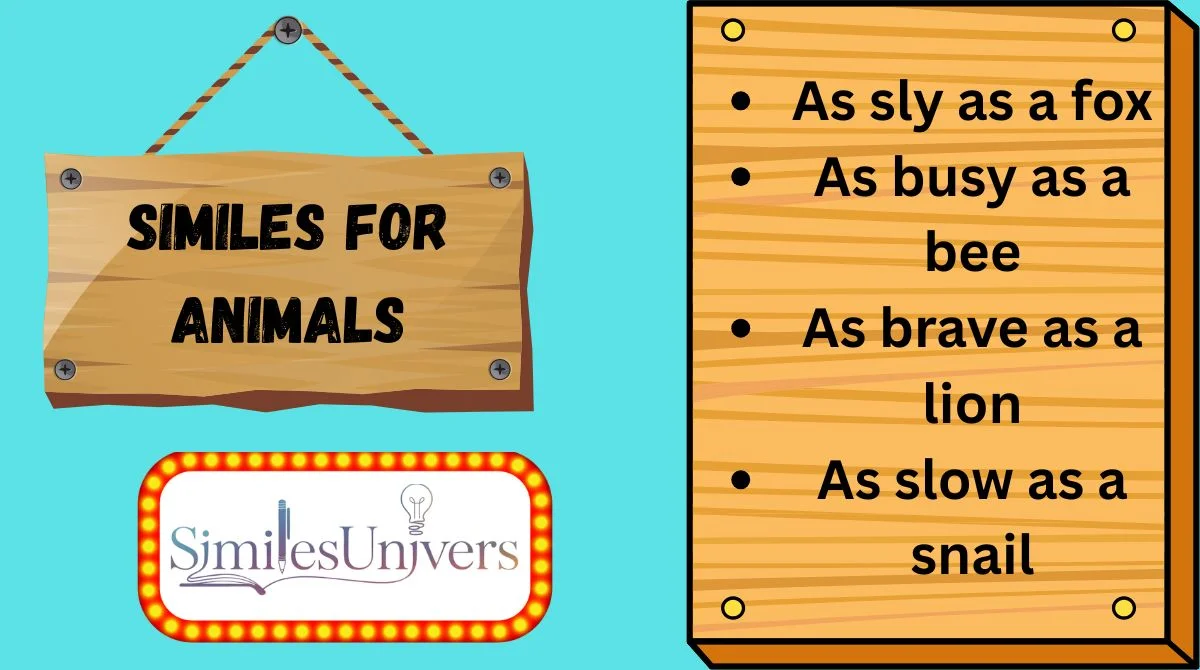
- As sly as a fox
- As busy as a bee
- As brave as a lion
- As slow as a snail
- As quiet as a mouse
- As stubborn as a mule
- As free as a bird
- As gentle as a lamb
- As proud as a peacock
- As playful as a kitten
Complete List of Similes for Animals
Funny & Lighthearted
As clumsy as a newborn giraffe
Meaning: Awkward in movement
Explanation: Like young giraffes learning to balance, this describes someone moving awkwardly.
Examples:
- “He tripped over his own shoes, as clumsy as a newborn giraffe.”
- “Trying to dance, she was as clumsy as a newborn giraffe.”
Tone: Funny
As chatty as a parrot
Meaning: Talks a lot
Explanation: Parrots mimic and repeat sounds; the simile highlights constant talking.
Examples:
- “During the meeting, she was as chatty as a parrot.”
- “My little brother is as chatty as a parrot when he’s excited.”
Tone: Funny
As lazy as a cat in the sun
Meaning: Extremely relaxed or unmotivated
Explanation: Cats basking in sun convey ultimate laziness.
Examples:
- “After lunch, he sprawled on the sofa, as lazy as a cat in the sun.”
- “The dog lay on the porch, as lazy as a cat in the sun.”
Tone: Casual
Emotional & Deep
As loyal as a golden retriever
Meaning: Unwaveringly faithful
Explanation: Golden retrievers are known for loyalty; perfect to describe steadfast friends.
Examples:
- “Through thick and thin, she was as loyal as a golden retriever.”
- “He kept his promise, as loyal as a golden retriever.”
Tone: Serious
As innocent as a newborn fawn
Meaning: Pure and naive
Explanation: Young deer symbolize vulnerability and innocence.
Examples:
- “Her eyes looked at the world, as innocent as a newborn fawn.”
- “He approached the puppy, as innocent as a newborn fawn.”
Tone: Poetic
As fierce as a tiger
Meaning: Extremely strong or aggressive
Explanation: Tigers are apex predators; used to convey intensity.
Examples:
- “She defended her brother, as fierce as a tiger.”
- “The boxer entered the ring, as fierce as a tiger.”
Tone: Serious
Dramatic & Intense
As hungry as a wolf
Meaning: Extremely hungry
Explanation: Wolves hunt with great hunger; useful in both literal and figurative senses.
Examples:
- “After the hike, he was as hungry as a wolf.”
- “She attacked the buffet, as hungry as a wolf.”
Tone: Dramatic
As silent as an owl
Meaning: Completely quiet and observant
Explanation: Owls hunt silently; great for stealthy or mysterious actions.
Examples:
- “He slipped into the room, as silent as an owl.”
- “She listened to their conversation, as silent as an owl.”
Tone: Serious
As wild as a stallion
Meaning: Untamed and free
Explanation: Stallions embody raw, untamed energy.
Examples:
- “The children ran around, as wild as a stallion.”
- “Her hair danced in the wind, as wild as a stallion.”
Tone: Dramatic
Slow & Monotonous
As slow as a tortoise
Meaning: Very slow
Explanation: Tortoises move slowly; perfect for pacing or sluggish actions.
Examples:
- “The traffic crawled, as slow as a tortoise.”
- “He trudged through homework, as slow as a tortoise.”
Tone: Casual
As steady as an elephant
Meaning: Slow but reliable
Explanation: Elephants are deliberate and stable; conveys patience.
Examples:
- “He approached the project, as steady as an elephant.”
- “The old bridge stood as steady as an elephant.”
Tone: Serious
As plodding as a camel
Meaning: Slow, tiring progress
Explanation: Camels travel long distances slowly; great for tedious tasks.
Examples:
- “The lecture dragged on, as plodding as a camel.”
- “She walked through the mud, as plodding as a camel.”
Tone: Casual
Creative & Unique
As sneaky as a raccoon at midnight
Meaning: Secretive and clever
Explanation: Raccoons are nocturnal scavengers, moving quietly to steal food.
Examples:
- “He took the cookies, as sneaky as a raccoon at midnight.”
- “She peeked into the room, as sneaky as a raccoon at midnight.”
Tone: Creative
As curious as a meerkat
Meaning: Extremely inquisitive
Explanation: Meerkats constantly scan their environment, symbolizing curiosity.
Examples:
- “The toddler explored, as curious as a meerkat.”
- “She watched the experiment, as curious as a meerkat.”
Tone: Creative
As jittery as a hummingbird
Meaning: Nervous and restless
Explanation: Hummingbirds hover quickly and unpredictably.
Examples:
- “He waited for his turn, as jittery as a hummingbird.”
- “The cat paced, as jittery as a hummingbird.”
Tone: Creative
Poetic & Literary
As graceful as a swan
Meaning: Smooth and elegant
Explanation: Swans glide on water effortlessly, symbolizing beauty.
Examples:
- “She danced across the stage, as graceful as a swan.”
- “His movements were as graceful as a swan.”
Tone: Poetic
As fleeting as a butterfly
Meaning: Short-lived or delicate
Explanation: Butterflies live briefly; used for ephemeral beauty or moments.
Examples:
- “Her smile was as fleeting as a butterfly.”
- “The memory was as fleeting as a butterfly.”
Tone: Poetic
As haunting as a raven
Meaning: Dark and memorable
Explanation: Ravens evoke mystery and foreboding.
Examples:
- “The poem’s ending was as haunting as a raven.”
- “His gaze was as haunting as a raven.”
Tone: Poetic
Fresh and Unique Similes You Won’t Hear Every Day
- As patient as a praying mantis – Waits calmly for the perfect moment.
- As nimble as a red panda on a tree – Light, playful movement in tricky spots.
- As relentless as a salmon swimming upstream – Persistent against all odds.
- As enigmatic as a chameleon in the rain – Constantly shifting, hard to read.
- As exuberant as a dolphin in waves – Joyful energy and playful motion.
Imagery Explanation: These similes use lesser-known animal behaviors to create vivid, original pictures that stick in readers’ minds.
How to Use These Similes in Writing
- Essays: Make arguments more relatable (“Her patience was as patient as a praying mantis”).
- Stories: Add imagery to characters, settings, or actions for depth and engagement.
How to Create Your Own Similes
- Step 1: Identify the trait or feeling you want to describe.
- Step 2: Think of an animal associated with that trait.
- Step 3: Use “like” or “as” to connect the animal to the subject.
- Step 4: Make sure it fits the tone of your text.
- Step 5: Revise for clarity and flow.
Practical Tips:
- Use unexpected animals for freshness.
- Keep it simple for readability.
- Match tone to context.
- Avoid clichés.
- Make it visual.
Transformation Examples:
- “She ran quickly” → “She ran as quick as a cheetah.”
- “He was very stubborn” → “He was as stubborn as a mule.”
- “The room was silent” → “The room was as silent as a sleeping fox.”
Common Mistakes When Using Similes
- Overuse: Too many similes can overwhelm the reader.
- Clichés: Avoid overused phrases like “as busy as a bee” unless intentionally playful.
- Tone mismatch: A humorous simile in a serious scene can confuse readers.
Practice Exercise
Fill in the blanks with an appropriate animal simile:
- She was _______ as a fox, sneaking past the guards.
- He moved _______ as a turtle through the mud.
- The baby slept _______ as a kitten.
- Her eyes sparkled _______ as a hawk spotting prey.
- He shouted _______ as a lion defending his cubs.
- The wind howled _______ as a wolf at night.
- He jumped _______ as a kangaroo.
- The dog wagged its tail _______ as a dolphin in the waves.
- She hid _______ as a chameleon on a branch.
- He studied _______ as an owl in the library.
- The crowd cheered _______ as monkeys in the jungle.
- She tiptoed _______ as a mouse in the kitchen.
Answers:
- as sly
- as slow
- as peaceful
- as sharp
- as fierce
- as lonely
- as high
- as playful
- as camouflaged
- as wise
- as excited
- as quiet
FAQs
What is the difference between a simile and a metaphor?
A simile uses “like” or “as” to compare, while a metaphor says something is something else.
Can similes make writing more engaging?
Yes! They create vivid imagery that helps readers visualize and connect emotionally.
How many similes should I use in a paragraph?
1–2 is usually enough; too many can distract.
Are animal similes better than object similes?
Animals evoke emotion and motion more naturally, making them often more memorable.
Can similes be funny?
Absolutely! Comparing humans to animals often creates humor.
How do I make unique similes?
Focus on less-known animal behaviors and connect them to the trait you want to describe.
Final Thoughts
Similes are powerful tools for writers, helping words leap off the page. Animal similes, in particular, give life, humor, and emotion to descriptions. With over 35 options here, plus fresh, original ones, you have everything you need to enrich essays, stories, or everyday writing. Experiment, be creative, and watch your writing come alive like never before.

Daniel Harper
I am simplifies complex literary concepts into clear, practical lessons for students and learners worldwide.
Through SimilesUnivers, he aims to make mastering similes engaging, structured, and academically enriching.