Writing can be magical, especially when words come alive like colorful sparks in a story.
One way to make your writing shine is by using similes—phrases that compare things using “like” or “as.” For children, similes make descriptions vivid, spark imagination, and help them connect with the world around them.
Whether you’re a teacher, parent, or young writer, this guide is your treasure chest of similes. From funny and silly comparisons to deep, emotional expressions, you’ll find over 34 ways to make your stories, essays, and poems sparkle.
By the end, you’ll not only have a ready list of similes but also know how to create your own, turning everyday words into magic.
What Is a Simile?
A simile is a figure of speech that compares two different things using the words “like” or “as.” It helps readers picture something clearly.
Example:
She was as quiet as a mouse.
This shows she was very quiet, using a mouse as the comparison.
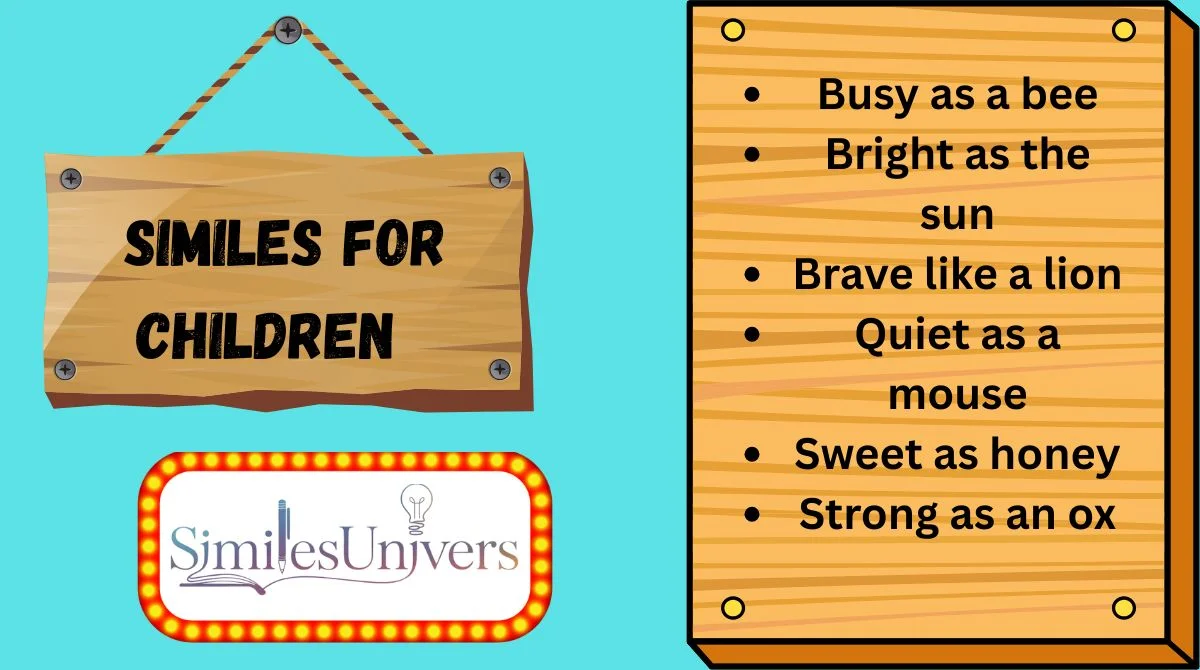
Quick List – Most Popular Similes for Children
- Busy as a bee
- Bright as the sun
- Brave like a lion
- Quiet as a mouse
- Sweet as honey
- Strong as an ox
- Light as a feather
- Happy as a clam
- Sleepy as a cat
- Sneaky as a fox
Complete List of Similes for Children (Grouped by Meaning)
Funny & Lighthearted
Crazy like a circus monkey
Meaning: Very silly or playful
Explanation: Compares someone acting wild to a monkey in a circus.
Examples:
- Tim was crazy like a circus monkey during the school play.
- She laughed crazy like a circus monkey at the joke.
Tone: Funny
Slow as a sleepy snail
Meaning: Moving very slowly
Explanation: Uses the image of a snail to show extreme slowness.
Examples:
- The turtle moved slow as a sleepy snail across the yard.
- Dad’s driving was slow as a sleepy snail in traffic.
Tone: Funny
Giggle like a bubbling brook
Meaning: Laughing softly and continuously
Explanation: Compares giggling to the gentle sound of flowing water.
Examples:
- The children giggled like a bubbling brook during storytime.
- She giggled like a bubbling brook at the funny drawing.
Tone: Funny
As silly as a puppy in socks
Meaning: Extremely playful and goofy
Explanation: Shows the amusing image of a puppy wearing socks.
Examples:
- He ran as silly as a puppy in socks across the room.
- Mom looked as silly as a puppy in socks when trying the hat.
Tone: Funny
Emotional & Deep
Brave like a lion
Meaning: Courageous and fearless
Explanation: Compares bravery to the strength of a lion.
Examples:
- She faced the new school day brave like a lion.
- He was brave like a lion when standing up to the bully.
Tone: Serious
Sad as a rainy day
Meaning: Feeling gloomy or down
Explanation: Compares sadness to the gray, wet feeling of rain.
Examples:
- His heart felt sad as a rainy day after the game.
- She was sad as a rainy day when her pet ran away.
Tone: Serious
Bright as the morning sun
Meaning: Full of hope and happiness
Explanation: Compares a joyful feeling to the brightness of the sunrise.
Examples:
- Her smile was bright as the morning sun.
- The classroom felt bright as the morning sun when the new students joined.
Tone: Poetic
Gentle as a butterfly
Meaning: Kind and delicate
Explanation: Uses the gentle movement of a butterfly to show softness or care.
Examples:
- She touched the kitten gentle as a butterfly.
- His words were gentle as a butterfly’s wings.
Tone: Poetic
Dramatic & Intense
Loud as a thunderstorm
Meaning: Extremely loud
Explanation: Compares a loud noise to booming thunder.
Examples:
- The applause was loud as a thunderstorm in the auditorium.
- His laugh was loud as a thunderstorm at recess.
Tone: Dramatic
Fast as a rocket
Meaning: Extremely fast
Explanation: Compares speed to the incredible pace of a rocket.
Examples:
- She ran fast as a rocket during the race.
- The car zoomed fast as a rocket down the hill.
Tone: Dramatic
Angry like a stormy sea
Meaning: Very angry or upset
Explanation: Compares human anger to the unpredictable waves of a storm.
Examples:
- He was angry like a stormy sea when his toy broke.
- Mom’s face looked angry like a stormy sea when she found the mess.
Tone: Dramatic
Slow & Monotonous
Tired as an old dog
Meaning: Extremely tired
Explanation: Compares fatigue to an elderly dog resting.
Examples:
- After soccer practice, he was tired as an old dog.
- She felt tired as an old dog after studying all day.
Tone: Casual
Quiet as a library
Meaning: Very silent
Explanation: Uses the image of a library to show stillness.
Examples:
- The room was quiet as a library while the baby slept.
- He tiptoed quiet as a library past the sleeping dog.
Tone: Casual
Slow as molasses
Meaning: Moving or happening very slowly
Explanation: Compares slowness to the thick syrup molasses.
Examples:
- The line moved slow as molasses at the amusement park.
- Her steps were slow as molasses because of the heavy backpack.
Tone: Casual
Creative & Unique
Eyes wide as a treasure chest
Meaning: Amazed or surprised
Explanation: Compares the eyes opening in wonder to a chest full of treasures.
Examples:
- His eyes were wide as a treasure chest when he saw the fireworks.
- She stared wide as a treasure chest at the magician’s trick.
Tone: Poetic
Hands soft as marshmallows
Meaning: Gentle and squishy
Explanation: Compares softness to the texture of marshmallows.
Examples:
- The kitten’s paws felt soft as marshmallows.
- Her hands were soft as marshmallows while kneading dough.
Tone: Funny
Heart light as a balloon
Meaning: Happy and carefree
Explanation: Compares a joyful feeling to a floating balloon.
Examples:
- He walked home with a heart light as a balloon.
- After the good news, she felt light as a balloon.
Tone: Poetic
Poetic & Literary
Silent as the falling snow
Meaning: Extremely quiet
Explanation: Compares stillness to the soft landing of snowflakes.
Examples:
- The forest was silent as the falling snow.
- She tiptoed silent as the falling snow in the dark hallway.
Tone: Poetic
Free as the morning breeze
Meaning: Feeling unbound and happy
Explanation: Compares freedom to the natural flow of the wind.
Examples:
- He felt free as the morning breeze on the first day of summer.
- She danced free as the morning breeze across the meadow.
Tone: Poetic
Bright as a shooting star
Meaning: Shining in a special way
Explanation: Uses the rare beauty of a shooting star to show brilliance.
Examples:
- Her ideas were bright as a shooting star in class.
- The dancer’s movements were bright as a shooting star.
Tone: Poetic
Fresh and Unique Similes You Won’t Hear Every Day
- Mischievous as a squirrel with a secret – Suggests playful trickiness.
Example: Tom was mischievous as a squirrel with a secret hiding the candy. - Curious as a cat in a room full of mirrors – Shows strong curiosity.
Example: Lily looked curious as a cat in a room full of mirrors at the science museum. - Excited as fireworks in a jar – Imagery of contained energy ready to burst.
Example: The kids were excited as fireworks in a jar before the birthday party. - Brave as a kitten learning to climb – Innocent yet courageous action.
Example: Max was brave as a kitten learning to climb the tall tree. - Happy as a balloon floating over a carnival – Pure joy and lightness.
Example: She felt happy as a balloon floating over a carnival on her first field trip.
How to Use These Similes in Writing
- Essays: Make descriptions more vivid and memorable.
Example: “The classroom was quiet as a library while the students focused on their tests.” - Stories: Bring characters and scenes to life with imagery.
Example: “He ran fast as a rocket to catch the runaway puppy.”
How to Create Your Own Similes (Mini Writing Guide)
Step-by-step method:
- Identify the quality you want to describe.
- Think of an object, animal, or phenomenon that shows that quality.
- Connect with “like” or “as.”
- Test if the comparison is clear and fun.
5 Practical Tips:
- Use familiar objects for children.
- Keep comparisons simple and clear.
- Avoid clichés.
- Match the tone to your story.
- Add sensory details.
3 Transformation Examples:
- Original: The boy was fast. → Simile: The boy ran fast as a rocket.
- Original: She was happy. → Simile: She was happy as a balloon floating over a carnival.
- Original: He was quiet. → Simile: He was quiet as a mouse hiding in the corner.
Common Mistakes When Using Similes
- Overuse: Too many similes can distract the reader.
- Clichés: Using “as busy as a bee” repeatedly may feel dull.
- Tone mismatch: A dramatic simile in a funny scene can feel odd.
Practice Exercise
Fill in the blanks with suitable similes:
- The puppy ran _____ across the yard.
- She was _____ when she heard the good news.
- The cat tiptoed _____ past the sleeping dog.
- He felt _____ after the long hike.
- The room was _____ during storytime.
- The baby giggled _____ at the funny face.
- She jumped _____ to catch the ball.
- He was _____ before his first piano recital.
- The snow fell _____ on the rooftops.
- The child held the kitten _____ in her hands.
- He was _____ when his toy broke.
- The classroom buzzed _____ before the bell rang.
Answers:
- Fast as a rocket
- Happy as a balloon floating over a carnival
- Quiet as a library
- Tired as an old dog
- Silent as the falling snow
- Giggle like a bubbling brook
- High as a kite
- Nervous as a cat in a room full of mirrors
- Silent as the falling snow
- Soft as marshmallows
- Angry like a stormy sea
- Busy as a bee
FAQs
What is the easiest way to teach similes to children?
Use fun comparisons with animals, food, or daily activities they know.
How many similes should I use in a story?
2–5 similes per paragraph are enough to create imagery without overwhelming the reader.
Are similes the same as metaphors?
No, similes use “like” or “as” while metaphors do not.
Can children create their own similes?
Yes! Encourage them to compare familiar things in creative ways.
Why are similes important in writing?
They make descriptions vivid, spark imagination, and make writing memorable.
What is a common mistake when using similes?
Overusing clichés or mismatching the tone with the story.
Final Thoughts
Similes are a playful and powerful tool for children’s writing. They can make stories fun, essays vivid, and poems memorable. With this guide, you now have over 34 similes, tips to create your own, and practice exercises to strengthen your skills. Dive in, experiment, and watch your words come alive like never before!
Daniel Harper
I am simplifies complex literary concepts into clear, practical lessons for students and learners worldwide.
Through SimilesUnivers, he aims to make mastering similes engaging, structured, and academically enriching.